```

Automotive Protection Services

APS Knowledge Base

The Complete Vehicle Protection Library

Comprehensive, practical guidance for understanding automotive protection technologies, comparing products intelligently, and making confident decisions about the long-term care of your car, truck, SUV, or commercial vehicle.

Protecting a vehicle should not require sorting through exaggerated claims, unexplained technical language, conflicting recommendations, or information written solely to promote one product.

The APS Knowledge Base is a growing collection of detailed educational guides created to explain how modern vehicle-protection products work, what their specifications actually mean, how competing technologies should be compared, and which questions deserve answers before you invest.

Whether you are researching automotive window film, ceramic coatings, paint protection film, rust prevention, professional detailing, spray-in bedliners, truck accessories, or complete vehicle-preservation strategies, our goal is the same:

Educate first. Recommend second.

01

Understand the Technology

Learn how automotive protection products work, what problems they are designed to solve, and how different technologies produce different results.

02

Compare Products Objectively

Understand performance measurements, warranties, materials, limitations, installation requirements, and long-term value without relying on one headline claim.

03

Make Confident Decisions

Choose the protection strategy that best fits your vehicle, driving habits, ownership plans, budget, and expectations.

Explore the APS Knowledge Base

Browse our comprehensive guides and educational resources by protection category, vehicle type, ownership goal, or technical subject.

Continuously Updated: APS guides are maintained as technologies, products, specifications, laws, and industry practices evolve.

```
```

Why We Built This

Better Information Creates Better Vehicle-Protection Decisions

The automotive protection industry is filled with impressive claims. Our goal is to provide the context customers need to understand what those claims actually mean.

Vehicle owners researching window film, ceramic coatings, paint protection film, rust prevention, detailing, bedliners, and other protection services are often presented with bold promises:

“Blocks nearly all heat.”

“Lifetime protection.”

“The most advanced ceramic technology.”

“The best product on the market.”

Some of these statements may be based on legitimate product strengths. The problem is that they are often presented without enough explanation for customers to compare them fairly.

A percentage may come from a narrow test. A warranty may contain important limitations. A product category may include materials with dramatically different performance. A premium brand may still depend on the skill of the person performing the installation.

Without context, even technically accurate information can create an incomplete or misleading impression.

APS Believes Education Should Come Before Recommendation

Before telling a customer which product or service to choose, we believe they deserve to understand how the technology works, what the measurements mean, where the limitations are, and which factors will affect the finished result.

We Want Customers to Understand the “Why”

The APS Knowledge Base is not intended to be a collection of promotional articles disguised as education.

Each guide is designed to answer deeper questions:

  • What problem is this product designed to solve?
  • How does the underlying technology work?
  • Which performance measurements are most useful?
  • Which claims require additional context?
  • How do competing technologies differ?
  • What role does installation quality play?
  • What are the product’s practical limitations?
  • Which questions should a customer ask before purchasing?
  • How does the service fit into a broader vehicle-protection strategy?

The goal is not simply to help someone buy a product. It is to help that person understand the decision well enough to choose confidently.

01

Explain the Science

We define the technologies, materials, measurements, and processes behind modern automotive protection products in language vehicle owners can understand.

02

Provide Context

We explain how performance figures are measured, what warranties actually cover, and why one headline number rarely tells the whole story.

03

Acknowledge Tradeoffs

Different products serve different owners. We discuss limitations, compromises, use cases, and the reasons an excellent solution for one vehicle may be wrong for another.

04

Separate Brand From Outcome

Brand reputation can matter, but the correct decision also depends on product specifications, installation quality, support, vehicle characteristics, and ownership goals.

05

Use Real Installation Experience

Our guides are informed by decades of automotive protection work, product evaluation, customer questions, installation challenges, warranty support, and long-term vehicle ownership.

06

Keep the Information Current

Products, specifications, technologies, laws, and industry practices change. APS guides are intended to be reviewed, expanded, and updated as the field evolves.

An Informed Customer Is Not a Difficult Customer

Informed customers ask better questions, understand the differences between options, form more realistic expectations, and are better equipped to recognize quality work.

They are also less likely to choose solely on price, brand recognition, a social-media claim, or one isolated performance figure.

APS does not view customer education as an obstacle to the sale. We view it as the foundation of a better relationship and a better long-term result.

The APS Standard

When a subject is simple, we explain it simply.

When a subject is complicated, we do not pretend otherwise.

Our responsibility is to provide enough information for the customer to understand the decision—not merely enough information to complete a transaction.

Our Purpose

The APS Knowledge Base exists to turn confusing product categories, technical specifications, warranty language, and marketing claims into useful decision-making information.

We explain first, compare honestly, recommend thoughtfully, and allow the customer to choose with confidence.

```
```html ```
```

The APS Philosophy

The APS Principles of Protection

Seven enduring principles that guide every recommendation we make, every service we perform, and every educational guide we publish.

Automotive protection products, technologies, and brand names will continue to change. The principles behind making a responsible protection decision should not.

The APS Principles of Protection provide a consistent framework for understanding how vehicles deteriorate, how protection technologies should be evaluated, and how individual services can support a broader ownership strategy.

These principles are not designed to persuade every customer to purchase every available service. They are intended to help vehicle owners understand where protection creates value, where individual products have limitations, and how informed decisions can improve the experience and economics of vehicle ownership.
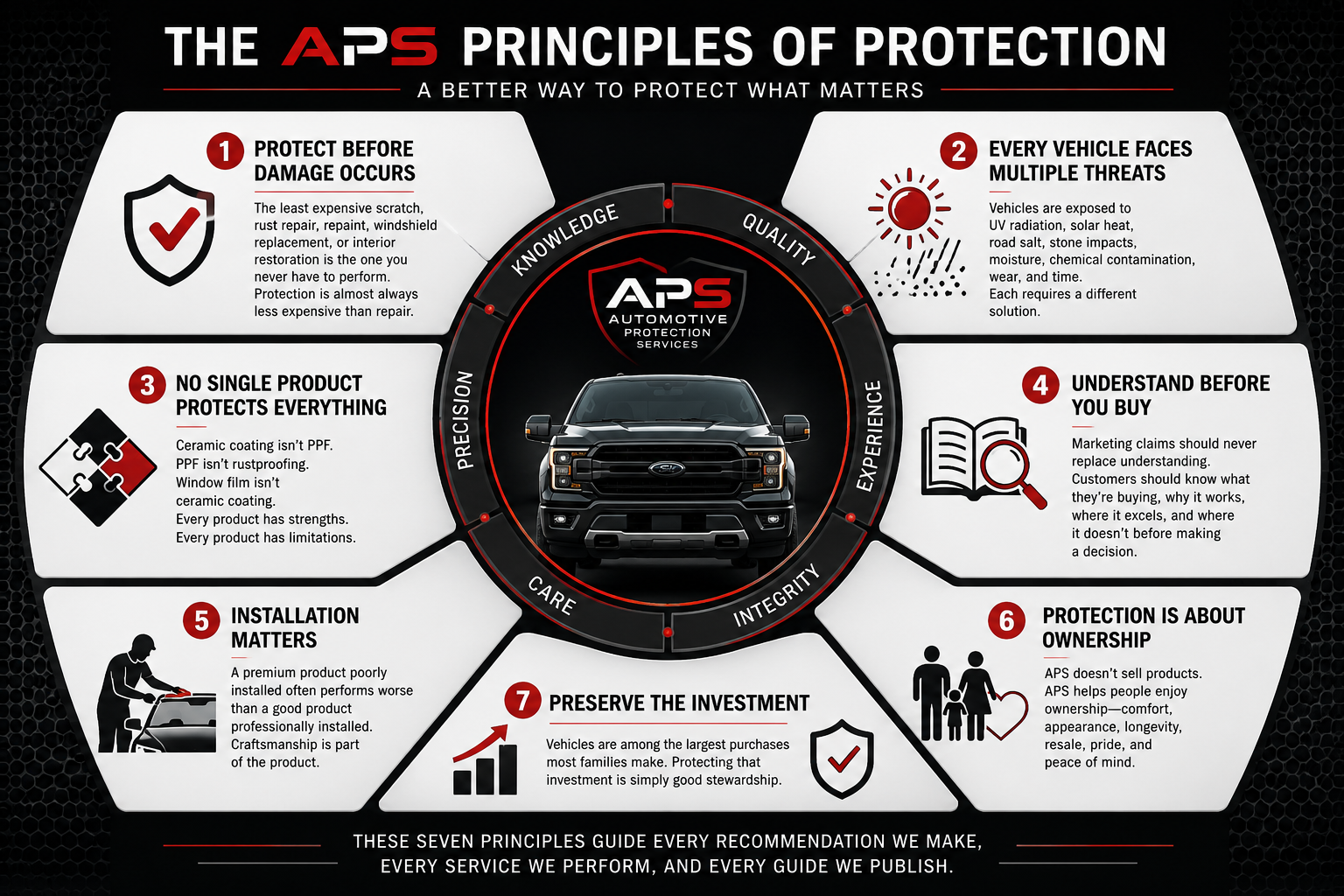
The seven APS Principles of Protection: protect before damage occurs, recognize multiple vehicle threats, understand that no single product protects everything, understand before buying, prioritize installation quality, focus on the ownership experience, and preserve the investment.
The APS Principles of Protection provide a practical framework for evaluating products, services, installation quality, ownership goals, and long-term vehicle preservation.

Protect Before Damage Occurs

The least expensive scratch repair, rust repair, repaint, windshield replacement, interior restoration, or component replacement is the one that never becomes necessary.

Protection cannot eliminate every possibility of damage, but it can reduce exposure, slow deterioration, and help prevent predictable problems before they become expensive repairs.

In many circumstances, thoughtful prevention is less disruptive and less expensive than correcting damage after it occurs.

Every Vehicle Faces Multiple Threats

Vehicles do not deteriorate in only one way.

They are continually exposed to:

  • Ultraviolet radiation.
  • Solar heat.
  • Road salt and deicing chemicals.
  • Moisture and humidity.
  • Stone impacts and road debris.
  • Bird droppings, tree sap, insects, and chemical contamination.
  • Interior wear and repeated daily use.
  • Cargo, tools, equipment, and loading damage.
  • Time, mileage, weather, and environmental exposure.

Each threat affects a different part of the vehicle and requires a different form of protection.

No Single Product Protects Everything

Ceramic coating is not paint protection film. Paint protection film is not rustproofing. Window film is not ceramic coating. A spray-in bedliner does not protect the undercarriage, and undercoating does not protect the passenger compartment from solar heat.

Every protection technology has specific strengths, practical limitations, and appropriate applications.

A responsible protection strategy does not expect one product to solve every problem. It combines the right technologies according to the vehicle, its use, the owner’s priorities, and the threats the vehicle is most likely to encounter.

Understand Before You Buy

Marketing claims should never replace understanding.

Before purchasing a protection product or service, customers deserve to understand:

  • What the product is designed to accomplish.
  • How the technology works.
  • Which specifications are most meaningful.
  • How those specifications were measured.
  • Where the product performs well.
  • Where its limitations begin.
  • What the warranty covers.
  • What maintenance will be required.
  • How installation quality affects the result.

The purpose of education is not to make a simple decision feel complicated. It is to make a complicated decision understandable.

Installation Matters

A premium product installed poorly can perform worse than a good product installed professionally.

Preparation, environment, equipment, technician experience, pattern accuracy, surface condition, curing procedures, quality control, and long-term support all influence the finished result.

Customers do not experience a product as a box, bottle, roll, coating, or specification sheet. They experience the completed installation.

Craftsmanship is therefore not separate from the product. It is part of the product.

Protection Is About Ownership

Automotive protection is not only about preventing physical damage.

It is also about improving the ownership experience through:

  • Greater comfort.
  • Improved appearance.
  • Reduced worry.
  • Easier maintenance.
  • Preserved utility.
  • Longer service life.
  • Greater pride of ownership.
  • More predictable long-term condition.
  • Peace of mind.

A protection service creates value when it helps the owner use, enjoy, maintain, and preserve the vehicle more successfully.

Preserve the Investment

Vehicles are among the largest purchases most individuals and families make.

They are also working assets that provide transportation, independence, safety, utility, convenience, and in many cases income.

Protecting that investment is not simply about preserving resale value. It is about maintaining the vehicle’s condition, extending its useful life, reducing avoidable repair costs, and receiving greater value from every year of ownership.

Thoughtful protection is an act of stewardship: caring for an important asset so it can continue serving its intended purpose.

Protection Should Be Proportional

The APS Principles of Protection do not suggest that every vehicle needs every available service.

A new truck expected to remain in service for fifteen years may justify a different strategy than a short-term leased sedan. A commercial fleet vehicle may have different priorities from a collector car. A daily commuter may value heat rejection and ease of maintenance more than maximum cosmetic perfection.

The correct protection plan is the one proportionate to the vehicle’s value, use, environment, ownership horizon, and the owner’s priorities.

How These Principles Shape APS Recommendations

When APS evaluates a vehicle or discusses a service with a customer, we consider more than whether a product can be installed.

We consider:

  • What problem the customer is trying to solve.
  • Which parts of the vehicle are exposed.
  • How the vehicle is used.
  • How long the owner expects to keep it.
  • Which protection already exists.
  • Which risks are most significant.
  • What the product can realistically accomplish.
  • Whether the value justifies the investment.
  • How the service fits into the broader ownership strategy.

This approach may lead to one service, several complementary services, a staged protection plan, or a recommendation that a particular product is unnecessary for the customer’s needs.

The APS Standard

Protection should be informed, proportional, professionally installed, and connected to a clear ownership goal.

We do not believe the strongest recommendation is always the largest package or the highest-priced product. The strongest recommendation is the one that honestly addresses the customer’s priorities and produces durable value.

Guided by Principles, Not Products

Products will evolve. Technologies will improve. Brand names and specifications will change.

The APS Principles of Protection provide a durable standard for evaluating those changes: prevent predictable damage, understand the threats, recognize product limitations, learn before purchasing, respect installation quality, improve the ownership experience, and preserve the investment.

These seven principles guide every recommendation we make, every service we perform, and every guide we publish.

```

The APS Library

Explore the APS Guides

Comprehensive reference guides covering the technologies, decisions, installation standards, maintenance requirements, and ownership strategies behind modern automotive protection.

Book cover for the published APS Guide to Automotive Window Film.

Published

The APS Guide to Automotive Window Film

A comprehensive reference covering window-film technology, solar-energy management, ceramic and dyed films, VLT, TSER, infrared rejection, product comparison, installation quality, Virginia tint laws, warranties, maintenance, and APS recommendations.

  • Window-film technologies explained
  • VLT, IRR, TSER, UVR, VLR, and SHGC
  • Premium-film comparison framework
  • Virginia window-tint regulations
  • Installer and warranty guidance
  • Frequently asked questions

Read the Complete Guide

Book cover for the published APS Guide to Automotive Ceramic Coatings.

Published

The APS Guide to Automotive Ceramic Coatings

A comprehensive reference covering ceramic-coating chemistry, paint correction, SiO₂ and graphene technology, hydrophobic performance, durability, maintenance, Paint Protection Film comparisons, warranties, ownership economics, and professional installation standards.

  • Ceramic coating science explained
  • SiO₂, graphene, and 9H hardness
  • Paint correction and preparation
  • Ceramic coating vs. wax and PPF
  • Maintenance and long-term care
  • Buying and installer guidance

Read the Complete Guide

APS Knowledge Base guide cover marked title in development and coming soon.

In Development

The APS Guide to Paint Protection Film

A complete guide to paint protection film, impact protection, self-healing technology, coverage packages, seams, edges, installation quality, warranties, maintenance, and long-term paint preservation.

APS Knowledge Base guide cover marked title in development and coming soon.

In Development

The APS Guide to Rust Protection and Undercoating

Understanding automotive corrosion, undercoating, rustproofing, cavity wax, road salt, moisture control, preparation, inspection, maintenance, and long-term vehicle preservation.

APS Knowledge Base guide cover marked title in development and coming soon.

In Development

The APS Guide to Professional Automotive Detailing

The differences between cleaning, decontamination, correction, restoration, and protection—and how professional detailing preserves vehicle appearance, condition, comfort, and value.

APS Knowledge Base guide cover marked title in development and coming soon.

In Development

The APS Guide to Spray-In Bedliners

How spray-in bedliners protect a truck bed, how materials and installation methods differ, how they compare with drop-in liners and mats, and what determines appearance, durability, repairability, and value.

APS Knowledge Base guide cover marked title in development and coming soon.

In Development

The APS Guide to Tonneau Covers

Comparing soft and hard covers, folding and rolling designs, security, water management, bed access, compatibility, installation, maintenance, and the right cover for different truck owners.

APS Knowledge Base guide cover marked title in development and coming soon.

In Development

The APS Guide to Stealth Hitch Systems

Understanding removable receiver systems, towing and accessory configurations, vehicle compatibility, electrical integration, installation requirements, appearance, and ownership considerations.

APS Knowledge Base guide cover marked title in development and coming soon.

In Development

The APS Guide to Vehicle Preservation

A complete ownership framework connecting window film, paint protection, coatings, rust prevention, detailing, bed protection, accessories, maintenance, and long-term asset preservation.

A Growing Reference Library

APS Guides are published as complete reference works rather than short promotional articles. As the APS Knowledge Base continues to grow, each completed guide is added to the library with its own dedicated cover, while future titles remain in development until they meet the same standard.

```html

Begin Your Journey

Knowledge Builds Better Decisions

Every guide in the APS Knowledge Base is written to help you better understand your vehicle, evaluate competing technologies, and make informed protection decisions with confidence.

Whether you are researching your first window tint installation, comparing ceramic coatings, exploring paint protection film, protecting a new truck, preserving a classic vehicle, or simply trying to understand which products genuinely provide long-term value, we hope these resources help you become a more informed vehicle owner.

Our library will continue to grow as new technologies emerge, products evolve, and customers ask new questions. Every guide is built upon the same philosophy that has shaped Automotive Protection Services for decades:

Educate first. Recommend second.

Help people understand the decision before asking them to make one.

When you're ready, explore one of our published APS Guides, continue learning through our educational articles, or visit Automotive Protection Services to discuss your vehicle with one of our specialists.

Protect your investment.
Preserve your vehicle.
Enjoy the journey.

```