The APS Guide to Automotive Ceramic Coatings
Everything you need to know about ceramic coatings—from the science behind modern paint protection to choosing the right coating, understanding maintenance, and protecting your vehicle for years to come.
Reading Time
Approximately 35–45 minutes
Difficulty
Beginner to advanced
Last Updated
July 2026
Ceramic coating has become one of the most talked-about products in the automotive world. Manufacturers promise extraordinary gloss, permanent protection, "10H hardness," graphene technology, self-cleaning surfaces, and years of durability. At the same time, social media, advertising, product packaging, and installer websites are filled with conflicting advice and exaggerated claims about what ceramic coatings actually do.
Some people believe ceramic coatings make paint scratch-proof. Others believe they eliminate the need to wash a vehicle. Some assume that every product marketed as "ceramic" provides the same level of protection.
None of these assumptions tells the full story.
The Purpose of This Guide
This guide is not designed to overwhelm you with technical language or persuade you that every vehicle needs the most expensive coating available. Its purpose is to help you understand how ceramic coatings work, what they realistically protect against, where their limitations begin, and how to evaluate the complete installation process.
The Big Picture
Ceramic coating is often marketed as protection against dramatic events, but its greatest value comes from preventing thousands of small ones. Every day your vehicle is exposed to ultraviolet light, road film, moisture, bird droppings, insects, mineral deposits, chemicals, and repeated washing. Individually these exposures may seem insignificant, but together they slowly diminish the condition of your paint.
The illustration above represents the central idea of this guide: ceramic coating is not intended to stop every impact. It is designed to slow the gradual environmental deterioration that occurs over years of ownership, making the finish easier to preserve, easier to maintain, and more enjoyable to own.
Whether you own a brand-new luxury vehicle, a daily commuter, a classic car, a pickup truck, or an electric vehicle, understanding ceramic coatings will help you make better decisions about protecting one of your largest investments.
Throughout this guide, we will explain the science behind modern ceramic coatings, how they interact with automotive clear coat, what separates professional systems from short-term consumer products, and why paint preparation is so important. We will also compare ceramic coatings with waxes, paint sealants, and Paint Protection Film, helping you understand where each form of protection fits within a complete vehicle-preservation strategy.
At Automotive Protection Services, we have spent years preparing, correcting, and protecting vehicles throughout Northern Virginia. That experience has taught us one principle that appears throughout this guide:
The quality of a ceramic coating is not determined solely by the product inside the bottle. It is determined by the condition of the paint, the preparation process, the skill of the installer, the curing environment, and the care the vehicle receives afterward.
A premium coating cannot compensate for contamination left beneath it. A long warranty cannot correct poor polishing. A hardness rating cannot prevent rock chips. And even the most advanced coating still requires appropriate washing and maintenance.
That is why this guide begins with education rather than product promotion. By the end, you should understand not only what ceramic coating is, but also how to compare products, installers, packages, durability claims, warranties, and ownership requirements with greater confidence.
What You Will Learn
- What ceramic coating is—and what it is not
- How modern automotive paint is constructed
- How ceramic coatings bond and cure
- Why decontamination, polishing, and paint correction matter
- What "9H" and "10H" hardness ratings actually mean
- What ceramic coating protects against
- What ceramic coating cannot prevent
- How ceramic compares with wax, paint sealants, and Paint Protection Film
- How to compare professional coating products and installers
- How durability claims and warranties should be interpreted
- How to wash and maintain a ceramic-coated vehicle
- How to determine whether ceramic coating makes economic sense for your vehicle
APS Knowledge Base Standard
Where manufacturers publish measurable specifications, this guide identifies them as manufacturer claims. Where coating performance depends on real-world variables, we explain those variables. Where the detailing industry relies heavily on marketing terminology, we separate the useful information from the sales language.
The objective is not to declare one product universally superior. It is to give vehicle owners the knowledge required to make a well-informed protection decision.
What Ceramic Coating Is—And What It Is Not
Ceramic coating is one of the most misunderstood products in the automotive industry. Before comparing brands, warranties, or performance claims, it's important to understand exactly what ceramic coating is—and just as importantly, what it isn't.
A ceramic coating is a liquid protective coating that chemically bonds to a vehicle's factory clear coat. Unlike waxes or traditional paint sealants, which primarily sit on top of the paint and gradually wash away, a professional ceramic coating forms a microscopic, durable layer that becomes part of the paint surface itself. Rather than creating a thick shell that changes the appearance of the vehicle, ceramic coatings create an ultra-thin, transparent barrier measured in microns. Although nearly invisible, this layer significantly changes the way the paint interacts with water, dirt, UV radiation, road salts, chemicals, and environmental contamination.
Modern professional coatings are primarily based on advanced silica (SiO₂) chemistry, often combined with proprietary polymers and other additives to improve durability, gloss, slickness, and chemical resistance. Some premium coatings—including APS's flagship coating system—also incorporate additional technologies such as graphene reinforcement to enhance specific performance characteristics.
Key Takeaway
Ceramic coating is not paint. It is not another layer of clear coat. It is not a plastic film. It is a chemically bonded protective layer that enhances the performance of your vehicle's factory finish.
What Ceramic Coating Does
- Creates a highly hydrophobic (water-repelling) surface.
- Helps protect paint from UV exposure and oxidation.
- Improves resistance to environmental contamination.
- Makes routine washing easier.
- Produces exceptional gloss and color depth.
- Reduces the tendency for dirt and grime to adhere to the paint.
- Provides long-term protection that can last for years when properly maintained.
What Ceramic Coating Does Not Do
- It does not make paint scratch-proof.
- It does not prevent rock chips.
- It does not eliminate swirl marks from improper washing.
- It does not replace Paint Protection Film (PPF).
- It does not eliminate the need to wash your vehicle.
- It does not permanently preserve neglected paint.
Perhaps the biggest misconception is that ceramic coating makes a vehicle "maintenance free." In reality, ceramic-coated vehicles still require regular washing and proper care. The difference is that contamination releases more easily, washing requires less effort, and the paint retains its appearance far longer than untreated surfaces.
Think of ceramic coating as making your vehicle easier to keep clean—not making it unnecessary to clean.
Throughout this guide, you'll see that the best ceramic coating isn't simply the product with the biggest marketing claims. It's the combination of proper surface preparation, professional installation, realistic expectations, and ongoing maintenance that determines long-term success.
Understanding Modern Automotive Paint
Before you can understand ceramic coating, you need to understand the surface it protects. Modern automotive paint is not a single layer of color—it is a sophisticated multi-layer system engineered to provide beauty, durability, corrosion resistance, and long-term protection. A ceramic coating interacts with only one of those layers: the clear coat.
As the illustration above shows, today's automotive finishes consist of multiple engineered layers working together. The steel or aluminum body provides structural strength, primer promotes adhesion and corrosion resistance, the base coat provides the vehicle's color, and the clear coat protects everything beneath it while creating the deep gloss we associate with a well-maintained finish.
A professionally installed ceramic coating does not replace any of these layers. Instead, it chemically bonds to the surface of the factory clear coat, creating an extremely thin transparent protective layer that improves water behavior, chemical resistance, UV protection, and long-term ease of maintenance.
Key Takeaway
When your vehicle is polished, compounded, corrected, or ceramic coated, the work is almost always being performed on the factory clear coat. The colored paint beneath it is left untouched unless the damage is severe enough to penetrate through the clear coat.
Why the Clear Coat Matters
Although the clear coat is typically only 40 to 60 microns thick—roughly half the thickness of a human hair—it performs an extraordinary amount of work. It protects the color coat from ultraviolet radiation, environmental contamination, oxidation, chemical exposure, and the countless small abrasions that occur during everyday driving and washing.
Because ceramic coatings bond directly to this layer, the condition of the clear coat determines the quality of the final result. A flawless clear coat produces exceptional gloss, while scratches, oxidation, water spot etching, and swirl marks remain visible beneath the coating if they are not corrected beforehand.
Understanding Paint Damage
Not all paint damage is created equal. The infographic illustrates four common types of defects, each affecting different layers of the paint system.
- Swirl marks typically affect only the upper portion of the clear coat and can often be removed through professional paint correction.
- Deeper scratches may penetrate much farther into the clear coat and sometimes reach the color layer.
- Base coat damage exposes or damages the vehicle's color and generally requires repainting.
- Rock chips frequently remove multiple layers at once, sometimes exposing the primer or even bare metal.
Understanding these differences explains why ceramic coating is not a repair product. It cannot fill deep scratches, replace missing paint, or restore damaged clear coat. Instead, it preserves the condition of the surface that already exists.
Think of ceramic coating like installing museum-quality glass over a valuable painting. If the artwork underneath is flawless, the result is spectacular. If the artwork already has scratches or fading, the glass protects those imperfections rather than making them disappear.
APS Insight
Many people assume the ceramic coating itself is responsible for the incredible finish they see after a professional installation. In reality, much of that beauty is created before the coating is ever opened. Inspection, decontamination, paint correction, and polishing restore the clear coat to its highest possible condition. The ceramic coating's job is to preserve that finish for years to come.
This understanding forms the foundation for the rest of this guide. Once you recognize that ceramic coating bonds only to the clear coat, it becomes much easier to understand what ceramic coatings can realistically protect against, what they cannot, and why professional surface preparation is one of the most important parts of the entire installation process.
How Ceramic Coatings Bond to Paint
A ceramic coating does more than rest on top of automotive paint. When applied to a properly prepared surface, its reactive ingredients cure and crosslink into a tightly bonded protective film. That bonding process is what separates a professional ceramic coating from a temporary wax or conventional paint sealant.
To understand how this works, it helps to think about the surface of automotive clear coat at a microscopic level. Although freshly polished paint may look perfectly smooth, it contains microscopic pores, valleys, irregularities, and chemically active sites. A liquid ceramic coating spreads across this surface and works into those minute imperfections. As the coating cures, its reactive components link together and anchor themselves to the clear coat, creating a continuous transparent film.
Key Takeaway
Ceramic coating performance depends on two related processes:
- Adhesion — the coating attaches to the prepared clear-coat surface.
- Crosslinking — the coating’s reactive ingredients connect with one another as the film cures and hardens.
If either process is compromised by contamination, poor preparation, incorrect application, or premature exposure to water and chemicals, the coating may not perform as intended.
The Bonding Process, Step by Step
The Paint Is Cleaned
Loose dirt, road film, waxes, oils, and other surface contamination must be removed. A coating cannot form a reliable bond if it is being applied over residue rather than directly to the clear coat.
Embedded Contamination Is Removed
Iron particles, industrial fallout, mineral deposits, tar, and other bonded contamination may remain after an ordinary wash. Chemical and mechanical decontamination help restore a clean, receptive surface.
The Clear Coat Is Polished
Polishing removes oxidation, old protection, embedded defects, and a controlled amount of damaged clear coat. It also improves clarity and creates a more uniform surface for the coating.
The Surface Is Degreased
Polishing oils and residues must be removed before application. A dedicated surface-preparation solution leaves the clear coat clean and chemically ready to receive the coating.
The Coating Is Applied
The liquid coating is spread evenly across small sections of paint. Proper coverage, overlap, temperature, working time, and product quantity all influence the consistency of the finished film.
The Coating Is Leveled
Excess product is carefully removed before it hardens. If the coating is not leveled correctly, darker patches, streaks, smears, or hardened high spots may remain visible in the finish.
The Coating Cures
The newly applied film continues to crosslink and develop its final characteristics over time. Initial curing may occur within hours, while full chemical cure can take several days.
Why Surface Preparation Matters So Much
Ceramic-coating manufacturers consistently emphasize that the surface must be thoroughly cleaned, polished when appropriate, and degreased before installation. This is not simply about making the vehicle look better before coating it. It is necessary for adhesion.
If wax, silicone, polishing oil, detergent residue, mineral deposits, or bonded contamination remain on the paint, the ceramic coating may attach to that material instead of bonding uniformly to the clear coat. As the contamination moves, degrades, or releases, coating performance can become inconsistent.
A coating can only bond as well as the surface beneath it has been prepared.
This is one reason two vehicles receiving the same product can produce very different long-term results. The coating chemistry may be identical, but the inspection, preparation, correction, application, curing environment, and aftercare may not be.
Bonding Is Not the Same as Adding Thickness
The phrase chemically bonded sometimes creates the impression that ceramic coating becomes a thick, permanent extension of the clear coat. That is not the case. A ceramic coating remains an extremely thin surface treatment. It can improve resistance to chemicals, oxidation, staining, contamination, and light wash-induced marring, but it does not add enough physical thickness to absorb meaningful impacts from stones, gravel, or road debris.
Ceramic Coating
Creates a thin, bonded surface film designed primarily to improve chemical resistance, water behavior, gloss retention, surface slickness, and ease of maintenance.
Paint Protection Film
Adds a substantially thicker urethane barrier designed to absorb physical impacts, abrasion, rock chips, and other mechanical damage.
This distinction is fundamental. Ceramic coating changes how the surface behaves. Paint Protection Film adds a sacrificial physical barrier. The two products can complement each other, but they perform different jobs.
What Happens During Curing?
A ceramic coating does not reach its final performance the moment it is wiped onto the paint. After application and leveling, the coating enters a curing period during which its internal structure continues to develop.
During this time:
- The coating continues to crosslink and harden.
- Hydrophobic behavior becomes more pronounced.
- Chemical resistance develops.
- The surface becomes less vulnerable to disturbance.
- Exposure to water, harsh detergents, or contamination may interfere with the developing film.
IGL specifies a full curing period of approximately three to five days for both Ecocoat Quartz and Ecocoat Kenzo. The vehicle should be kept dry during the initial period and should not be washed with harsh shampoos, all-purpose cleaners, or highly alkaline chemicals while the coating completes its cure.
APS Insight
Customers naturally focus on the brand and advertised lifespan of a ceramic coating. From an installer’s perspective, the invisible steps are often more important: decontamination, correction, degreasing, application timing, lighting, temperature control, leveling, and cure management.
A premium coating applied over a poorly prepared surface is not a premium installation.
Why Professional Application Produces More Consistent Results
Professional coatings often have narrower working windows and more demanding application procedures than consumer spray products. The installer must recognize when the coating has flashed, remove excess material without disturbing the developing film, identify high spots under controlled lighting, and manage the time between layers.
Some systems also use separate base and top coats. IGL Ecocoat Kenzo, for example, is installed as a two-part system. The base coat is applied and allowed to cure for a specified period before the top coat is installed. Each layer has its own application and leveling window.
These requirements do not make consumer products worthless. They explain why a professional ceramic-coating service should be evaluated as a complete process rather than priced as though the installer were simply applying liquid from a bottle.
The Bottom Line
Ceramic coating bonds best to paint that is clean, corrected, residue-free, and properly prepared. Once applied, the coating must be evenly leveled and allowed to cure under controlled conditions.
The strength of the finished system comes not only from its chemistry, but from the quality of every step performed before, during, and immediately after installation.
Ceramic Coating vs. Wax vs. Paint Sealant
Wax, paint sealant, and ceramic coating are often grouped together because all three can improve gloss and help protect automotive paint. But they differ significantly in chemistry, durability, maintenance, and the way they interact with the clear coat. Understanding those differences makes it easier to choose the right level of protection for your vehicle.
For decades, waxing was the traditional way to protect automotive paint. Synthetic paint sealants later offered longer durability and more consistent performance. Ceramic coatings represent the next stage in that progression, using reactive chemistry to form a more durable bond with the clear coat.
That does not mean wax and sealants are obsolete. Each product has a legitimate role. The right choice depends on how long you plan to keep the vehicle, how often you want to reapply protection, how the vehicle is stored, how much maintenance you are willing to perform, and what level of performance you expect.
Key Takeaway
Wax, sealant, and ceramic coating all protect paint, but they do not provide the same type or duration of protection.
- Wax offers short-term enhancement and traditional shine.
- Paint sealant provides longer-lasting synthetic protection.
- Ceramic coating forms a more durable, chemically bonded surface designed for multi-year performance.
Automotive Wax
Automotive wax is the oldest and most familiar form of paint protection. Traditional waxes are commonly based on natural carnauba wax, synthetic waxes, or blends of both. When applied, wax creates a thin sacrificial layer over the clear coat that improves gloss, adds warmth to the finish, and provides temporary resistance to water and contamination.
Wax is popular because it is relatively easy to apply, delivers an immediate visual improvement, and can be used by nearly any vehicle owner. It is particularly appealing to enthusiasts who enjoy regularly detailing their vehicles and do not mind reapplying protection several times a year.
Typical Strengths
- Rich, warm gloss
- Low initial cost
- Easy consumer application
- Useful for short-term protection
- Ideal for owners who enjoy frequent detailing
Typical Limitations
- Relatively short durability
- Vulnerable to heat and detergents
- Requires frequent reapplication
- Limited chemical resistance
- Performance can vary considerably between products
Depending on the product, climate, washing method, storage conditions, and mileage, wax protection may last anywhere from several weeks to a few months. Vehicles stored outdoors or washed frequently will usually lose wax protection more quickly.
Synthetic Paint Sealant
Paint sealants were developed to provide longer-lasting protection than traditional wax. Instead of relying primarily on natural waxes, sealants use synthetic polymers that spread across the paint and form a more durable protective film.
Sealants are generally more resistant to heat, detergents, ultraviolet exposure, and environmental contamination than conventional waxes. They often produce a sharper, more reflective appearance rather than the softer warmth associated with carnauba wax.
Typical Strengths
- Longer durability than traditional wax
- Consistent water repellency
- Good UV and environmental resistance
- Lower cost than professional ceramic coating
- Suitable for seasonal or annual protection plans
Typical Limitations
- Still requires periodic reapplication
- Less chemically resistant than professional coatings
- May gradually weaken with frequent washing
- Does not offer the same long-term surface behavior as a ceramic coating
- Often marketed using vague ceramic terminology
A quality paint sealant may provide several months of protection and, under favorable conditions, may last longer. It is a strong option for owners who want better durability than wax without committing to the cost and preparation involved in a professional coating installation.
Professional Ceramic Coating
A professional ceramic coating uses reactive ingredients that cure and crosslink into a durable film bonded to the clear coat. Unlike wax and most sealants, the coating is not designed simply to sit loosely on top of the paint and gradually wash away.
Once properly installed and cured, ceramic coating provides longer-lasting water repellency, chemical resistance, gloss retention, contamination resistance, and ease of cleaning. Depending on the product, installation quality, vehicle use, and maintenance, professional coatings may perform for several years.
Typical Strengths
- Multi-year durability
- Strong chemical resistance
- Excellent hydrophobic behavior
- Improved gloss and color depth
- Easier routine washing
- Reduced adhesion of dirt and environmental contamination
Typical Limitations
- Higher installation cost
- Requires thorough preparation
- May require professional paint correction
- Needs controlled application and curing
- Still requires proper washing and maintenance
- Does not prevent rock chips or deep scratches
Side-by-Side Comparison
| Category | Wax | Paint Sealant | Ceramic Coating |
|---|---|---|---|
| Primary Chemistry | Natural or synthetic waxes | Synthetic polymers | Reactive ceramic and polymer chemistry |
| How It Attaches | Rests on the surface | Forms a synthetic surface film | Bonds and crosslinks with the prepared clear coat |
| Typical Durability | Weeks to a few months | Several months | Multiple years, depending on the system |
| Water Behavior | Good when freshly applied | Generally strong and consistent | Strong, long-lasting hydrophobic performance |
| Chemical Resistance | Limited | Moderate | High relative to wax and sealant |
| Preparation Required | Basic cleaning | Thorough cleaning and decontamination recommended | Cleaning, decontamination, polishing, and degreasing |
| Application Difficulty | Low | Low to moderate | Moderate to high |
| Maintenance | Frequent reapplication | Periodic reapplication | Regular washing and occasional maintenance products |
| Best Suited For | Enthusiasts and short-term protection | Seasonal or annual protection | Long-term ownership and reduced maintenance effort |
Why “Ceramic” on the Label Can Be Confusing
The rapid popularity of ceramic coatings has led many manufacturers to add words such as ceramic, SiO₂, graphene, or nano to waxes, spray sealants, shampoos, and quick-detailing products.
Some of these products are genuinely useful. A ceramic spray sealant, for example, may offer better water behavior and durability than a conventional quick detailer. But the presence of ceramic ingredients does not automatically make a product equivalent to a professionally installed coating.
The word ceramic now describes a broad category that may include:
- Professional multi-year coatings
- Consumer-applied bottle coatings
- Spray-on ceramic sealants
- Ceramic-infused waxes
- Wash-and-wax shampoos containing SiO₂ additives
- Maintenance toppers designed for previously coated vehicles
APS Insight
The question is not simply, “Does this product contain ceramic ingredients?” The more useful question is, “What type of product is it, how does it attach to the paint, how long is it designed to last, and what preparation does it require?”
A spray product that takes ten minutes to apply may be excellent within its category. It should not, however, be compared directly with a professionally installed coating that requires decontamination, polishing, controlled application, leveling, and several days of curing.
Is Ceramic Coating Always the Best Choice?
Not necessarily.
A ceramic coating makes the most sense when the owner values long-term protection, improved ease of cleaning, strong water behavior, and reduced need for frequent reapplication. It is especially appropriate for newer vehicles, vehicles being corrected to a high standard, vehicles expected to remain in service for several years, and owners who want a more permanent protection strategy.
Wax or sealant may be the better choice when:
- The vehicle is being sold soon.
- The owner enjoys frequent detailing and reapplication.
- The paint is in poor condition and correction is not currently justified.
- The owner wants temporary seasonal protection.
- The budget does not support professional preparation and installation.
- The vehicle is rarely driven and stored in a controlled environment.
Choosing a less expensive protection product is not automatically a poor decision. Problems arise only when a short-term product is represented as though it provides the same performance as a true professional coating.
The best paint protection product is not always the one with the longest advertised lifespan. It is the one that matches the vehicle, the owner's expectations, the maintenance plan, and the intended length of ownership.
The Bottom Line
Wax provides traditional shine and short-term protection. Paint sealant offers a stronger synthetic barrier with longer durability. Ceramic coating requires more preparation and a larger initial investment, but delivers the greatest long-term resistance, water behavior, gloss retention, and ease of maintenance.
These products should not be judged solely by price. They should be compared by the length of protection, the preparation involved, the type of performance they provide, and how well each option fits the owner's long-term goals.
Ceramic Coating vs. Paint Protection Film
Ceramic coating and Paint Protection Film are often compared as though they are competing versions of the same product. They are not. Ceramic coating is designed primarily to improve surface behavior, chemical resistance, gloss, and ease of maintenance. Paint Protection Film is designed primarily to absorb physical damage from road debris, abrasion, and impact.
Both products protect automotive paint, but they protect it in fundamentally different ways.
A ceramic coating creates an extremely thin, chemically bonded layer over the clear coat. Paint Protection Film, commonly called PPF or clear bra, places a much thicker urethane membrane over the painted panel. The coating changes how the surface reacts to water, dirt, chemicals, and environmental contamination. The film creates a physical barrier between the paint and the outside world.
Key Takeaway
Ceramic coating protects primarily against chemical and environmental exposure. Paint Protection Film protects primarily against physical impact and abrasion.
One improves the performance of the surface. The other adds a sacrificial protective barrier.
What Ceramic Coating Is Designed to Do
Ceramic coating is best understood as a long-term surface treatment. Once installed and cured, it creates a slick, hydrophobic, chemically resistant layer that helps the vehicle remain cleaner and makes routine washing easier.
Ceramic Coating Helps Protect Against
- Ultraviolet exposure and oxidation
- Road salt and environmental contamination
- Bird droppings and insect residue
- Tree sap and industrial fallout
- Some chemical staining and etching
- Dirt adhesion and road film
- Premature fading and loss of gloss
Ceramic Coating Does Not Reliably Prevent
- Rock chips
- Gravel impacts
- Deep scratches
- Door-edge damage
- Parking-lot contact
- Scrapes and abrasions
- Damage from improper washing
Ceramic coating can provide some resistance to very light wash-induced marring because it creates a slicker surface and makes dirt easier to remove. That should not be confused with meaningful impact protection. The coating is far too thin to absorb the energy of a stone striking the front bumper at highway speed.
What Paint Protection Film Is Designed to Do
Paint Protection Film is a transparent, flexible urethane film installed directly over painted panels. Its thickness and elasticity allow it to absorb impacts, abrasion, and surface damage that would otherwise reach the clear coat.
Modern premium films may also include self-healing top coats. When exposed to heat from the sun, warm water, or another controlled heat source, light surface marks in the film can soften and become less visible.
Paint Protection Film Helps Protect Against
- Rock chips and road debris
- Sandblasting on lower body panels
- Light scratches and abrasions
- Bug impacts on leading edges
- Damage around door cups and door edges
- Minor contact with branches or brush
- Wear on high-contact painted surfaces
Paint Protection Film Does Not Eliminate
- The need for washing
- Water spotting
- Environmental contamination
- Surface staining if neglected
- Damage from severe impact
- The possibility of film wear or replacement
- Maintenance of unprotected panels
Thickness Changes the Type of Protection
The most important difference between ceramic coating and PPF is physical thickness.
Ceramic coating is measured in microns and creates an extremely thin surface layer. Paint Protection Film is many times thicker and is designed to flex, stretch, and absorb physical energy.
Ceramic coating behaves more like a durable protective finish. Paint Protection Film behaves more like a transparent sacrificial shield.
That difference explains why ceramic coating can resist chemicals and contamination yet still allow a stone to chip the paint. It also explains why PPF can stop many rock chips but may not provide the same slickness, water behavior, or ease of maintenance as a coated surface unless the film itself is coated.
Side-by-Side Comparison
| Category | Ceramic Coating | Paint Protection Film |
|---|---|---|
| Primary Purpose | Improve surface behavior and environmental resistance | Prevent physical paint damage |
| Material | Liquid coating that cures into a bonded film | Flexible thermoplastic urethane sheet |
| Physical Thickness | Extremely thin | Substantially thicker |
| Rock-Chip Protection | Minimal | Strong |
| Chemical Resistance | Strong | Varies by film and top-coat technology |
| Hydrophobic Performance | Typically excellent | Varies by film; may improve when coated |
| Gloss Enhancement | Strong enhancement of clarity and depth | Preserves gloss and may subtly enhance appearance |
| Scratch Resistance | Limited resistance to light marring | Protects against many light scratches and abrasions |
| Self-Healing | No meaningful physical self-healing | Available in many premium films |
| Common Coverage | Entire painted exterior | High-impact areas or entire vehicle |
| Maintenance Benefit | Makes the vehicle easier to wash and keep clean | Prevents physical damage but still requires regular care |
| Best Suited For | Long-term appearance, gloss, and ease of maintenance | Vehicles vulnerable to road-impact damage |
Why PPF Is Often Installed on Only Part of a Vehicle
Ceramic coating is commonly applied to the entire painted exterior because it is intended to provide consistent gloss, water behavior, and contamination resistance across the vehicle.
Paint Protection Film is often installed more strategically because physical impact is concentrated in predictable areas. Common coverage packages include:
- Partial front coverage: portions of the hood and front fenders, front bumper, and mirror caps
- Full front coverage: complete hood, complete front fenders, front bumper, mirror caps, and frequently headlights
- High-impact coverage: rocker panels, lower doors, rear wheel arches, luggage ledges, or other vulnerable areas
- Full-body coverage: film installed over nearly every painted exterior panel
The correct coverage depends on the vehicle, driving environment, body shape, mileage, and owner expectations. A highway-driven sports car may justify extensive front-end protection, while a lightly driven garage-kept vehicle may need only targeted coverage.
Can Ceramic Coating Be Installed Over PPF?
Yes. Ceramic coating and Paint Protection Film are frequently used together because their strengths are complementary.
In a combined system, the film is installed first over the areas requiring impact protection. Ceramic coating is then applied over the film and the remaining painted surfaces, provided the coating is compatible with the film manufacturer's recommendations.
Coating the film may provide:
- Improved water repellency
- Easier removal of insects and road film
- Reduced adhesion of environmental contamination
- More consistent surface behavior between filmed and unfilmed panels
- Additional protection for the film's top coat
The ceramic coating does not make the PPF physically stronger. Instead, it improves the way the film's exposed surface behaves and is maintained.
APS Insight
For many owners, the strongest protection strategy is not choosing between ceramic coating and PPF. It is using each product where it performs best.
Paint Protection Film can be installed on the front bumper, hood, fenders, mirrors, rocker panels, and other high-impact areas. Ceramic coating can then protect the film and the remaining exterior surfaces from contamination, oxidation, chemical exposure, and difficult maintenance.
Which One Should You Choose?
The answer depends on the type of damage you are most concerned about.
Choose Ceramic Coating When You Prioritize
- Gloss and color depth
- Hydrophobic performance
- Easier washing
- Environmental resistance
- Long-term surface protection
- Reduced need for waxing and sealing
Choose Paint Protection Film When You Prioritize
- Rock-chip prevention
- Protection from road debris
- Scratch and abrasion resistance
- Preservation of high-impact panels
- Protection for expensive or difficult-to-repair paint
- Maintaining factory paint condition
When Ceramic Coating Alone May Be Appropriate
Ceramic coating alone may be appropriate for a vehicle that is primarily driven locally, stored indoors, not frequently exposed to gravel roads or highway debris, and owned by someone whose main priorities are appearance and ease of maintenance.
It may also be appropriate when the vehicle already has minor paint defects that make the cost of extensive PPF difficult to justify, but the owner still wants to preserve the finish and reduce ongoing maintenance.
When PPF Should Be the Priority
PPF should usually be considered first when the owner is especially concerned about preserving original paint from physical damage.
Examples include:
- New luxury, exotic, or performance vehicles
- Vehicles with expensive multi-stage or specialty paint
- Cars driven frequently on highways
- Low-profile vehicles with vulnerable front ends
- Pickup trucks and SUVs driven on gravel or construction roads
- Vehicles expected to retain collector or resale value
- Owners who are highly sensitive to rock chips and visible paint damage
Why Ceramic Coating Cannot Replace PPF
Ceramic coating marketing sometimes creates the impression that increased hardness means meaningful protection from impacts. Claims such as “9H” or “10H” refer to standardized pencil-hardness testing, not resistance to highway-speed stones, shopping carts, door impacts, or deep scratches.
A coating may improve resistance to very light surface marring, but it does not possess the thickness or elasticity required to absorb substantial physical impact. That is the role of Paint Protection Film.
Why PPF Cannot Replace Ceramic Coating
PPF provides outstanding impact protection, but it does not automatically deliver every benefit associated with ceramic coating. Depending on the film, its exposed surface may still collect mineral deposits, road film, insect residue, and other contamination.
A vehicle with PPF still benefits from careful washing, decontamination, and surface protection. Applying an appropriate ceramic coating over the film can make that maintenance easier and create more consistent water behavior across the vehicle.
The Bottom Line
Ceramic coating and Paint Protection Film are not interchangeable. Ceramic coating improves gloss, chemical resistance, water behavior, and ease of maintenance. Paint Protection Film provides the physical thickness needed to defend against rock chips, scratches, abrasion, and road debris.
For maximum protection, PPF should be used on areas vulnerable to impact, while ceramic coating can be used across both the film and exposed paint to improve long-term appearance and maintenance.
The Automotive Paint Protection Pyramid
After comparing waxes, sealants, ceramic coatings, and Paint Protection Film individually, it helps to step back and view them as parts of a complete protection strategy. Rather than thinking of these products as competitors, think of them as different levels of investment designed to solve different problems.
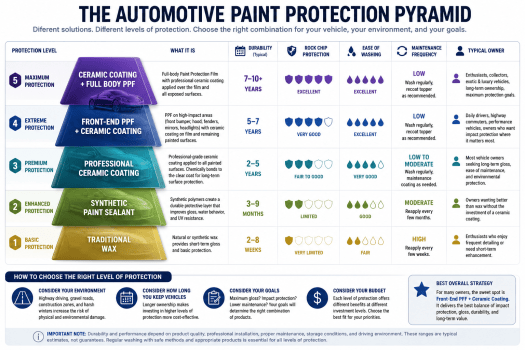
One of the biggest misconceptions in the automotive appearance industry is that every vehicle needs the most expensive protection package available. In reality, the best protection plan depends on how the vehicle is driven, where it is stored, how long it will be owned, and what type of damage the owner is trying to prevent.
Traditional wax remains an excellent choice for enthusiasts who enjoy frequent detailing. Paint sealants offer longer-lasting synthetic protection with relatively little maintenance. Professional ceramic coatings dramatically improve gloss, chemical resistance, and ease of washing for owners planning to keep their vehicles for years.
For drivers concerned about physical paint damage, Paint Protection Film moves protection into an entirely different category. Rather than improving the surface itself, PPF creates a sacrificial barrier capable of absorbing impacts that would permanently damage paint.
Key Takeaway
Each level of the pyramid builds upon the one below it. As protection increases, so do durability, long-term value, and resistance to environmental and physical damage. The goal is not to reach the top of the pyramid at any cost—it's to choose the level that best matches your vehicle, driving habits, budget, and ownership goals.
At Automotive Protection Services, we rarely recommend the exact same protection strategy for every customer. A daily commuter, a work truck, a family SUV, a luxury sedan, and a weekend sports car all face different risks. The best solution is the one that addresses those risks without paying for protection you don't actually need.
The right protection package isn't necessarily the most expensive one. It's the one that matches the way you use your vehicle.
The Science Behind Ceramic Coatings
Modern ceramic coatings are the result of decades of advances in materials science, surface chemistry, and nanotechnology. While marketing often focuses on buzzwords like 9H, graphene, or nano ceramic, understanding the underlying chemistry makes it much easier to evaluate those claims and choose the right protection for your vehicle.
Professional ceramic coatings are not simply "liquid glass" or hardened clear coat. They are carefully engineered chemical formulations that cure into an extremely thin, transparent protective film after being applied to properly prepared automotive paint.
Unlike traditional waxes or paint sealants, ceramic coatings rely on reactive chemistry. As the coating cures, its molecules crosslink into a tightly interconnected structure that bonds to the vehicle's factory clear coat. That network is responsible for many of the characteristics owners associate with ceramic coatings, including water repellency, chemical resistance, gloss retention, and long-term durability.
Key Takeaway
A ceramic coating is not defined by a single ingredient. It is a carefully balanced chemical system designed to cure into a durable protective surface. The performance of that system depends on both its formulation and the quality of its installation.
More Than One Ingredient
Many consumers assume ceramic coating consists of a single material—usually silicon dioxide (SiO₂). In reality, professional coatings are far more complex. Manufacturers combine multiple ingredients to achieve specific performance goals, balancing hardness, flexibility, gloss, chemical resistance, hydrophobic behavior, application characteristics, and long-term durability.
Although the exact formulations are proprietary, most professional coatings include combinations of reactive silicates, carrier solvents, catalysts, polymers, and performance additives. Premium products may also incorporate newer technologies such as graphene-enhanced chemistry or specialized top coats that improve slickness, water behavior, or environmental resistance.
Why Chemistry Matters
Every ceramic coating represents a series of engineering compromises. Increasing one characteristic often affects another.
Manufacturers Balance
- Hardness
- Flexibility
- Chemical resistance
- Hydrophobic performance
- Gloss and clarity
- Ease of application
- Curing time
- Long-term durability
Because Every Vehicle Needs
- A coating that bonds reliably
- Resistance to weather and UV exposure
- Protection from environmental contamination
- Ease of maintenance
- Consistent appearance
- Reasonable service life
- Predictable installation
- Stable long-term performance
This is one reason professional coatings differ so widely in price and performance. Two products may both advertise "9H hardness," yet perform very differently because their overall chemistry has been optimized for different priorities.
Not All Ceramic Coatings Are the Same
The term ceramic coating now describes an enormous range of products. Some are professional multi-layer systems requiring careful preparation and controlled curing. Others are consumer products designed for easy weekend application. Still others are spray sealants containing small amounts of ceramic additives.
The chemistry, concentration of active ingredients, curing process, and expected durability vary dramatically between these categories. A product described as "ceramic" is not necessarily comparable to another product carrying the same label.
The word ceramic tells you the general category of product—not its quality, durability, or real-world performance.
The Chapters Ahead
The remainder of this guide examines the major technologies that make up modern ceramic coatings. We'll begin with the ingredient most closely associated with ceramic protection—silicon dioxide (SiO₂)—before exploring graphene-enhanced coatings, hardness ratings, hydrophobic performance, curing, maintenance, and long-term durability.
APS Insight
When evaluating ceramic coatings, avoid focusing on a single specification. A balanced formulation installed correctly will almost always outperform a product chosen solely because it advertises the highest hardness rating, the newest buzzword, or the longest warranty.
The best coatings succeed because their chemistry, preparation, installation, and maintenance all work together as a complete system.
Silicon Dioxide (SiO₂): The Foundation of Modern Ceramic Coatings
If there is one ingredient most closely associated with modern ceramic coatings, it is silicon dioxide, commonly abbreviated as SiO₂. Nearly every professional ceramic coating relies on silica-based chemistry to create the durable, transparent protective layer that bonds to automotive clear coat. Understanding what SiO₂ is—and what it is not—is essential to understanding how ceramic coatings work.
Silicon dioxide is one of the most abundant compounds found on Earth. In nature it exists as quartz, sand, and many types of stone. While the silica used in professional ceramic coatings is not simply ground-up quartz, it is based on the same fundamental chemistry.
Through advanced chemical processing, manufacturers create reactive silica compounds that remain in liquid form during application. Once exposed to air and allowed to cure, these compounds crosslink into an extremely thin, durable network that bonds with the vehicle's factory clear coat.
Key Takeaway
Silicon dioxide is not applied to your vehicle as a layer of glass. It begins as a liquid chemical system that cures into a tightly bonded protective network only after professional application and proper curing.
Why SiO₂ Is Used
Engineers selected silica-based chemistry because it offers an excellent balance of properties required for automotive paint protection. Rather than excelling in only one area, SiO₂ performs well across many categories simultaneously.
SiO₂ Contributes
- Long-term chemical resistance
- Excellent UV stability
- Strong environmental durability
- High optical clarity
- Gloss retention
- Hydrophobic performance
- Resistance to oxidation
- Stable long-term bonding
Why That Matters
- Paint stays cleaner longer
- Color remains vibrant
- Contaminants release more easily
- Routine washing becomes easier
- Gloss lasts for years instead of weeks
- Environmental fallout is less likely to bond aggressively
- The coating withstands weather extremes
- Protection remains consistent over time
More SiO₂ Does Not Automatically Mean Better
One of the most common marketing claims is that a coating contains a very high percentage of SiO₂. While active silica content is certainly important, it does not tell the entire story.
A coating's performance depends on far more than one number. Manufacturers must balance silica concentration with solvents, catalysts, polymers, application characteristics, curing behavior, flexibility, and long-term durability. A coating with a slightly lower concentration of active silica may outperform another product if its overall formulation is better engineered.
The percentage of SiO₂ is one specification—not a complete measure of coating quality.
What SiO₂ Does Not Do
Silicon dioxide provides many of the properties that make ceramic coatings attractive, but it also has limitations.
It does not make paint immune to physical damage. It cannot prevent rock chips, eliminate deep scratches, or replace Paint Protection Film. Those types of damage involve forces far greater than an ultra-thin ceramic layer can absorb.
Common Misconception
Many advertisements imply that silica-based coatings create a glass-like shell around your vehicle. While cured coatings are sometimes described as "glass coatings," they do not create a thick, rigid shell. They remain an extremely thin protective surface measured in microns.
Their strength comes from chemistry—not thickness.
Why Nearly Every Professional Coating Uses SiO₂
Despite the emergence of newer marketing terms such as graphene, nearly every premium ceramic coating still relies on silica chemistry as its foundation. Graphene-enhanced coatings, titanium-infused coatings, and other specialty formulations all build upon the same basic silica-based technology rather than replacing it entirely.
For that reason, SiO₂ remains the cornerstone of the ceramic coating industry. It is the ingredient responsible for many of the characteristics owners immediately notice after installation, including increased gloss, impressive water behavior, chemical resistance, and long-term environmental protection.
The Bottom Line
Silicon dioxide forms the chemical backbone of modern ceramic coatings. It provides the stable foundation that allows coatings to bond to automotive paint while delivering long-lasting gloss, chemical resistance, UV protection, and hydrophobic performance.
But SiO₂ alone does not determine how well a coating performs. The overall formulation, professional installation, curing process, and ongoing maintenance remain just as important as the chemistry itself.
Graphene-Enhanced Ceramic Coatings: What Graphene Adds—and What It Does Not
Graphene has become one of the most prominent terms in ceramic-coating marketing. It is frequently associated with greater hardness, improved heat resistance, reduced water spotting, stronger chemical protection, and longer durability. Some of those claims may reflect legitimate formulation improvements—but graphene does not replace the silica chemistry at the foundation of a professional ceramic coating.
The infographic above illustrates an important principle: a professional ceramic coating is not one ingredient suspended inside a bottle. It is an engineered chemical system in which silica compounds, polymers, solvents, catalysts, and specialized additives must work together.
In a graphene-enhanced coating, graphene-based materials are incorporated as one part of that larger formulation. Their purpose is to modify or reinforce particular characteristics of the coating—not to replace the SiO₂-based network that creates the primary bonded protective layer.
Key Takeaway
Graphene is an enhancement technology, not an entirely separate category of paint protection. Most graphene ceramic coatings remain silica-based ceramic coatings with graphene-derived materials added to influence specific performance characteristics.
What Is Graphene?
Graphene is a carbon-based material associated with an extremely thin, tightly arranged structure of carbon atoms. In materials science, it is known for characteristics such as strength, thermal conductivity, electrical conductivity, and structural stability.
Those properties have made graphene an important area of research across electronics, energy storage, aerospace, construction, manufacturing, and protective materials. The automotive appearance industry has adopted graphene terminology to describe coatings that incorporate graphene-derived additives into a traditional ceramic-coating formula.
However, the graphene used in an automotive coating should not be imagined as a solid sheet wrapped around the vehicle. It is introduced into the liquid formulation in extremely small quantities and must remain evenly dispersed throughout the product.
A graphene coating is not a layer of pure graphene over the paint. It is a ceramic-coating formula enhanced with graphene-based material.
Why Add Graphene to a Ceramic Coating?
Manufacturers may use graphene-derived additives to influence the way a coating manages heat, chemicals, water, surface tension, flexibility, and long-term environmental exposure.
The exact benefit depends on the form of graphene material used, the concentration, the surrounding chemistry, and how successfully the manufacturer has integrated it into the complete formulation.
Potential Formulation Goals
- Improved thermal stability
- Greater chemical resistance
- Enhanced surface slickness
- Reduced surface energy
- Stronger hydrophobic behavior
- Improved resistance to environmental staining
- Greater flexibility within the cured coating
- More stable long-term performance
What Owners May Notice
- Strong water beading and sheeting
- Easier removal of road film
- A slicker-feeling surface
- Excellent gloss and clarity
- Reduced adhesion of contamination
- Improved ease of washing
- Long-lasting environmental protection
- Consistent performance through seasonal temperature changes
Graphene and Heat Management
One of the most frequently advertised benefits of graphene-enhanced coatings is improved heat dissipation. The reasoning is that graphene-related materials possess useful thermal characteristics and may help distribute heat more evenly through the coating system.
In real-world automotive use, however, a ceramic coating remains extremely thin. It should not be interpreted as a thermal shield that dramatically lowers body-panel temperatures or protects the vehicle from all heat-related effects.
The more reasonable interpretation is that graphene additives may help the coating remain stable as the vehicle repeatedly heats and cools. That may contribute to durability, chemical stability, and resistance to environmental stress over time.
Important Distinction
Improved thermal stability does not mean the vehicle remains cool to the touch. It means the coating may be better equipped to maintain its properties while exposed to changing temperatures, direct sunlight, hot body panels, and seasonal weather.
Does Graphene Prevent Water Spots?
Graphene coatings are sometimes promoted as water-spot resistant or even water-spot proof. That language requires careful interpretation.
Water spotting occurs when water evaporates and leaves minerals or other dissolved material behind. If those deposits remain on the surface—especially under heat or direct sunlight—they may bond to the coating or begin etching the surface beneath them.
A slick, chemically resistant coating may reduce the tendency for deposits to adhere aggressively and may make them easier to remove. Strong water sheeting can also reduce the amount of standing water left behind. But no ceramic coating can guarantee that mineral-rich water will evaporate without leaving residue.
A Graphene Coating May Help By
- Improving water sheeting
- Reducing contaminant adhesion
- Increasing surface slickness
- Improving chemical resistance
- Making fresh mineral deposits easier to remove
It Cannot Eliminate
- Hard-water minerals
- Sprinkler exposure
- Water drying in direct sunlight
- Neglected mineral deposits
- Improper washing or drying
- Etching caused by prolonged contamination
The most effective defense against water spots remains proper washing, prompt drying, appropriate maintenance products, and removing mineral deposits before they are allowed to harden or etch.
Does Graphene Make a Coating Harder?
Graphene may be incorporated into a formulation to improve structural stability or resistance to certain forms of surface wear. That does not mean a graphene-enhanced coating becomes immune to scratches or impact damage.
Terms such as 9H and 10H still require the same careful interpretation regardless of whether the coating contains graphene. They refer to a controlled hardness test—not resistance to rock chips, keys, shopping carts, door impacts, or deep scratches.
The distinction between hardness and toughness remains essential:
- Hardness describes resistance to scratching or indentation under defined conditions.
- Toughness describes the ability to absorb energy before breaking or failing.
- Impact resistance describes the ability to withstand physical force from an object striking the surface.
- Flexibility describes the ability to tolerate movement and expansion without cracking.
A successful automotive coating must balance these characteristics. A coating that is extremely hard but too brittle may not perform as well as a slightly more flexible formulation designed to tolerate the movement, vibration, expansion, and contraction experienced by an automotive body panel.
Graphene Does Not Replace Paint Protection Film
No matter how advanced the formulation may be, a graphene-enhanced ceramic coating remains a microscopic surface treatment. It does not have the physical thickness required to absorb meaningful impacts from stones, gravel, road debris, or parking-lot contact.
For owners concerned primarily with rock chips, scratches, and physical abrasion, Paint Protection Film remains the appropriate solution. Graphene ceramic coating can be installed over compatible film to improve gloss, water behavior, contamination resistance, and maintenance, but it does not perform the film's impact-protection function.
Not Every Graphene Coating Is Equal
As graphene terminology became popular, it began appearing across a wide range of products, including professional coatings, consumer bottle coatings, spray sealants, waxes, shampoos, and maintenance products.
The presence of the word graphene does not reveal:
- How much graphene-derived material is present
- What type of graphene material is being used
- How evenly it is dispersed
- Whether it meaningfully improves the formulation
- How much active coating material is present
- How the product cures
- How long it is designed to perform
- What preparation and maintenance it requires
Graphene can be a valuable part of a well-engineered coating. The word itself is not proof of superior performance.
How to Evaluate a Graphene Coating
Instead of asking only whether a coating contains graphene, evaluate the complete product and installation system.
| Question to Ask | Why It Matters |
|---|---|
| Is this a professional coating or a spray sealant? | The product category determines the expected bonding process, durability, and preparation requirements. |
| Is it a single-layer or multi-layer system? | Some coatings use separate base and top coats to deliver different performance characteristics. |
| What preparation is included? | Decontamination, paint correction, polishing, and degreasing directly affect the finished result. |
| How long does the coating require to cure? | Professional systems may need controlled conditions and several days to reach full performance. |
| What maintenance is required? | Even premium coatings require appropriate washing and periodic inspection. |
| What does the durability claim assume? | Storage, mileage, climate, washing, maintenance, and exposure all affect service life. |
| What does the warranty actually cover? | A warranty may require inspections, maintenance services, documentation, or specific care procedures. |
IGL Ecocoat Kenzo and Graphene Reinforcement
APS installs IGL Ecocoat Kenzo as its flagship professional ceramic-coating system. Kenzo is described by IGL as a graphene-reinforced, two-part coating consisting of a base coat and top coat.
The two-layer approach allows the system to divide responsibilities between separate formulations. The base layer establishes the primary bonded protection, while the top layer is designed to influence exposed-surface characteristics such as gloss, water behavior, slickness, and environmental resistance.
IGL publishes specifications that include a claimed 10H pencil-hardness rating, water contact angles greater than 120 degrees, 100% active material, and a full curing period of approximately three to five days. These specifications are manufacturer claims and should be interpreted alongside installation quality, vehicle use, environmental exposure, and maintenance.
APS Insight
Graphene matters most when it is part of a balanced, professionally engineered coating—not when it is used as a label on the front of the bottle.
The final result still depends on inspection, decontamination, paint correction, surface preparation, controlled application, proper leveling, adequate curing, and appropriate long-term care. A sophisticated formula cannot compensate for a poor installation process.
Graphene vs. Traditional SiO₂ Coatings
It would be misleading to suggest that every graphene-enhanced coating automatically outperforms every traditional SiO₂ coating. A mature, carefully engineered silica coating may outperform a poorly formulated graphene product.
The more useful comparison is between complete coating systems rather than individual ingredients.
| Characteristic | Traditional SiO₂ Coating | Graphene-Enhanced Coating |
|---|---|---|
| Primary Foundation | Silica-based ceramic chemistry | Silica-based chemistry enhanced with graphene-derived material |
| Potential Strengths | Gloss, hydrophobic behavior, chemical resistance, and established performance | May add thermal stability, slickness, chemical resistance, or other targeted characteristics |
| Rock-Chip Protection | Minimal | Minimal |
| Scratch-Proof | No | No |
| Water-Spot Proof | No | No |
| Quality Determined By | Complete formulation, preparation, installation, curing, and maintenance | Complete formulation, preparation, installation, curing, and maintenance |
The Bottom Line
Graphene can be a meaningful enhancement to a professional ceramic coating. It may help manufacturers improve thermal stability, chemical resistance, surface slickness, water behavior, and long-term durability.
But graphene does not make a coating scratch-proof, impact-proof, water-spot proof, or maintenance-free. It does not replace silica chemistry, professional preparation, or Paint Protection Film.
The best graphene coating is not necessarily the product with the largest graphene claim. It is the coating whose complete formulation, installation process, and maintenance requirements best match the vehicle and the owner's protection goals.
Understanding 9H and 10H Hardness Claims
Few ceramic-coating claims are repeated more often—or misunderstood more frequently—than “9H hardness” and “10H hardness.” These numbers can sound like proof that a coating creates an nearly indestructible shell over automotive paint. In reality, they describe performance in a specific laboratory-style scratch test. They do not mean the vehicle is scratch-proof, chip-proof, impact-proof, or immune to careless washing.
The infographic above captures the essential distinction: hardness ratings can provide useful information when comparing similar coating products, but they are frequently presented without enough context.
A coating may legitimately earn a high pencil-hardness rating while remaining far too thin to stop a rock chip, key scratch, shopping-cart impact, or deep abrasion. Those forms of damage involve different forces and require different kinds of protection.
Key Takeaway
A 9H or 10H rating describes resistance to scratching from a standardized pencil under controlled conditions. It does not mean that the coating—or the paint beneath it—has become physically indestructible.
What the “H” Means
The “H” in 9H refers to the hardness scale used for pencils. Artist and technical pencils are manufactured in a range of grades, from softer graphite pencils to harder grades that contain more clay and less graphite.
On the commonly used scale, softer pencils are identified with “B” grades, while harder pencils are identified with “H” grades. As the number preceding the H increases, the pencil becomes harder.
A pencil-hardness test evaluates the hardest pencil grade that can be moved across a coated test surface without producing a defined scratch or failure under the test procedure.
Examples of Pencil Grades
- 6B–2B: Very soft graphite grades
- B and HB: Common writing and drawing grades
- H–4H: Progressively harder pencils
- 5H–9H: Very hard pencil grades used in coating tests
The Rating Indicates
- Surface resistance under a defined procedure
- Performance against a controlled scratching instrument
- A useful comparison point between similar materials
- One characteristic of the cured coating
How the Pencil-Hardness Test Works
Pencil-hardness testing is commonly associated with standards such as ASTM D3363, although manufacturers may use different methods, substrates, curing conditions, film thicknesses, or reporting practices.
During the test, pencils of increasing hardness are prepared and moved across the coated surface at a controlled angle and force. The tester observes whether the pencil cuts, scratches, gouges, or otherwise damages the film.
The reported result is based on the hardest pencil grade the coating can resist according to the specific test criteria being used.
Why Test Conditions Matter
A hardness rating is meaningful only when the complete test conditions are understood. The substrate, coating thickness, cure time, temperature, pencil preparation, applied pressure, and failure definition can all influence the result.
That is why a number printed on a package should not automatically be treated as a direct, independent comparison with every other coating on the market.
What 9H Actually Tells You
A legitimate 9H result suggests that the cured coating surface demonstrated strong resistance to a hard pencil under the conditions of the test. That can indicate that the coating has developed a hard, stable surface and may offer useful resistance to certain forms of light abrasion and surface marring.
It may also help manufacturers evaluate consistency between batches or compare variations within their own product line.
However, the test does not simulate most of the damage a vehicle encounters in daily life.
What 9H Does Not Tell You
It Does Not Measure
- Rock-chip resistance
- Impact absorption
- Resistance to deep scratches
- Protection from metal keys or sharp objects
- Door-ding resistance
- Protection from shopping carts
- Film thickness
- Long-term weathering by itself
It Does Not Guarantee
- Scratch-proof paint
- Improper-wash immunity
- Permanent hydrophobic performance
- Protection from all chemicals
- Resistance to neglect
- Multi-year durability
- A high-quality installation
- Better performance than every lower-rated coating
Hardness Is Not the Same as Toughness
One of the most important principles in materials science is that hardness and toughness are not the same property.
- Hardness describes resistance to scratching, cutting, or indentation.
- Toughness describes the ability to absorb energy before cracking or failing.
- Flexibility describes the ability to bend, expand, or contract without breaking.
- Impact resistance describes the ability to survive a sudden physical force.
A material can be very hard yet relatively brittle. Glass is a familiar example: it resists many light scratches, but a concentrated impact can still chip, crack, or shatter it.
Automotive coatings must perform on panels that vibrate, flex slightly, heat in direct sunlight, cool overnight, and experience seasonal expansion and contraction. A successful coating therefore needs a balanced formulation rather than maximum hardness at the expense of every other property.
The best coating is not necessarily the hardest coating. It is the coating that balances hardness, flexibility, adhesion, chemical resistance, clarity, and long-term durability.
Why 10H Claims Require Additional Context
The traditional graphite pencil scale commonly used in coating discussions is usually described as extending to 9H. Some coating manufacturers nevertheless advertise 10H ratings.
A 10H claim may refer to a manufacturer-specific test, a different test medium, an extended scale, a proprietary procedure, or another interpretation of surface hardness. It should not automatically be treated as impossible—but it should be accompanied by a clear explanation of the test method.
Questions to Ask About a 10H Claim
- What test standard was used?
- What material or pencil produced the rating?
- What substrate was coated?
- How thick was the test film?
- How long was it cured?
- Was the test performed by the manufacturer or an independent laboratory?
- Is the rating directly comparable with conventional 9H pencil-hardness claims?
Without those details, 10H is best interpreted as a manufacturer specification rather than definitive proof that the product provides greater real-world protection than every 9H coating.
Can Ceramic Coating Reduce Swirl Marks?
Ceramic coating can help reduce the conditions that cause wash-induced swirl marks, but it cannot eliminate them.
A coated surface is generally slicker and releases dirt more easily. That means less scrubbing may be required during routine washing, reducing friction between contamination, wash media, and paint. The coating also acts as a sacrificial surface above the clear coat, so some extremely light marring may affect the coating before reaching the paint beneath it.
But improper washing can still create damage. Automatic brush washes, dirty wash mitts, aggressive drying towels, dry wiping, and rubbing dirt across the surface can produce visible defects on a coated vehicle.
A Coating Can Help By
- Reducing dirt adhesion
- Increasing surface slickness
- Making contamination easier to release
- Reducing the amount of scrubbing required
- Providing a sacrificial microscopic surface
Safe Washing Still Requires
- Proper pre-rinsing
- Clean wash media
- Appropriate automotive shampoo
- Minimal pressure
- Safe drying techniques
- Avoidance of brush-style automatic washes
Why Paint Protection Film Is Different
Paint Protection Film is designed to provide the kind of physical protection that a ceramic coating cannot. Its urethane construction is substantially thicker and more flexible, allowing it to absorb many stone impacts, abrasions, and light scratches before they reach the paint.
A ceramic coating may improve the exposed surface of PPF by adding hydrophobic behavior, chemical resistance, slickness, and easier maintenance. It does not replace the film's physical thickness or impact-absorbing ability.
Owners primarily concerned about rock chips should evaluate Paint Protection Film, either alone or as part of a combined PPF and ceramic-coating strategy.
How Hardness Should Be Used When Comparing Coatings
Hardness can be one useful specification, but it should be evaluated alongside the entire coating system.
| Specification | What It Helps Explain | What It Cannot Establish Alone |
|---|---|---|
| Pencil Hardness | Resistance to a controlled surface-scratch test | Impact protection, durability, or installation quality |
| Active Material Content | How much of the formula remains as active coating material | Overall formulation quality or real-world longevity |
| Contact Angle | How water beads on a fresh surface | Chemical resistance, sheeting behavior, or long-term durability |
| Advertised Lifespan | The manufacturer's intended service period under stated conditions | Actual life without considering use, climate, washing, and maintenance |
| Layer Count | Whether the system uses one or multiple installed products | Whether those layers are properly prepared, applied, and cured |
| Warranty Length | The duration of the manufacturer's or installer's written program | Automatic proof of coating quality or complete coverage of every failure |
Interpreting IGL's 9H and 10H Specifications
IGL publishes a claimed 9H pencil-hardness rating for Ecocoat Quartz and a claimed 10H rating for the graphene-reinforced Ecocoat Kenzo system.
These figures should be treated as manufacturer specifications describing one aspect of the cured coating surface. They do not imply that either product makes the vehicle scratch-proof or resistant to meaningful physical impact.
The more useful comparison considers the complete systems:
- Ecocoat Quartz is positioned as a professional silica-based coating with a published 9H rating, approximately 80% active material, a contact angle greater than 110 degrees, and a claimed two-year service life.
- Ecocoat Kenzo is positioned as a graphene-reinforced base-and-top-coat system with a published 10H rating, 100% active material, a contact angle greater than 120 degrees, and a three-to-five-day full curing period.
Those specifications help describe the products, but the condition of the paint, correction performed, installer technique, cure environment, vehicle storage, mileage, washing practices, and maintenance schedule will all influence the real-world result.
APS Insight
Hardness is valuable when it is kept in proportion. It can help describe how a cured coating behaves under one controlled form of testing, but it should never become the entire reason a coating is selected.
At APS, the priority is the complete protection system: paint condition, preparation, correction, product compatibility, controlled application, cure management, and realistic maintenance expectations.
The Bottom Line
A 9H or 10H hardness rating does not mean ceramic coating makes automotive paint scratch-proof. It refers to resistance within a defined surface-hardness test, usually involving pencils and controlled laboratory-style conditions.
Hardness is only one piece of coating performance. Adhesion, flexibility, chemical resistance, hydrophobic behavior, optical clarity, installation quality, curing, and maintenance are equally important—and often more important in real-world ownership.
Do not choose a ceramic coating because of the largest number on the bottle. Choose a complete protection system whose chemistry, preparation, installation, and maintenance requirements match your vehicle and your goals.
Hydrophobic Performance: Why Water Behaves Differently on Ceramic-Coated Paint
One of the most visible characteristics of a ceramic coating is the way water behaves on the surface. Instead of spreading into a flat, irregular film, water often gathers into tight beads or rapidly sheets away from the paint. This hydrophobic behavior is visually impressive, but its real value is not simply the appearance of water droplets. It changes how dirt, moisture, and contamination interact with the vehicle during everyday use and maintenance.
The word hydrophobic means “water fearing,” but ceramic coatings do not literally repel water with force. Instead, they create a low-energy surface across which water has difficulty spreading.
On untreated or contaminated paint, water may flatten, cling to the surface, and remain behind in irregular patches. On a properly coated vehicle, water is more likely to contract into rounded droplets or move away from the panel in larger sheets.
Key Takeaway
Hydrophobic performance describes how water interacts with the coated surface. It can make the vehicle easier to rinse, wash, and dry, but it does not make the paint immune to mineral deposits, water spots, or environmental contamination.
Surface Energy and Water Behavior
Every surface has a level of surface energy that influences how liquids spread across it. High-energy surfaces encourage water to spread outward. Low-energy surfaces encourage water to pull together into more compact droplets.
Ceramic coatings alter the exposed surface chemistry of the clear coat, reducing the tendency of water to spread and increasing the tendency for it to bead or sheet away.
Higher Surface Energy
- Water spreads across the panel
- Droplets appear flatter
- Moisture may remain in irregular patches
- Dirt and minerals can settle over a wider area
- Drying may require more towel contact
Lower Surface Energy
- Water gathers into rounded droplets
- Droplets move more easily
- Large amounts of water may sheet away
- Less moisture may remain after rinsing
- Drying can require less physical contact
What Is a Contact Angle?
Water behavior is often described using a measurement called the contact angle. This is the angle formed where the outer edge of a water droplet meets the surface beneath it.
A flatter droplet produces a lower contact angle. A taller, more rounded droplet produces a higher contact angle.
- Lower contact angle: Water spreads more broadly across the surface.
- Higher contact angle: Water forms tighter, more rounded beads.
Manufacturers frequently publish contact-angle figures to describe a coating’s fresh hydrophobic performance. A coating advertised with a contact angle above 110° or 120° is intended to produce pronounced water beading under the manufacturer’s test conditions.
The infographic above illustrates why the angle matters. As the contact angle increases, the droplet becomes taller and more compact because less of the water is spreading across and wetting the surface.
At a contact angle below approximately 60°, water spreads broadly and clings to the panel. Between approximately 60° and 90°, visible beading begins, but the droplet still has substantial contact with the surface. At 110°, the droplet becomes considerably more rounded. At 120° and above, the bead is tighter and has a smaller contact area relative to its volume.
That reduced contact can help droplets move more freely, carry loose contamination with them, and leave less water behind during rinsing and drying.
Important Context
A contact-angle number is a useful specification, but it represents one controlled measurement. It does not independently establish durability, chemical resistance, water-spot resistance, installation quality, or long-term coating performance.
The angle shows how a droplet sits on the surface. It does not necessarily show how easily that droplet begins moving or how the coating will perform after years of environmental exposure.
Contact Angle vs. Sliding Angle
Contact angle and water mobility are related, but they are not identical.
The contact angle describes the shape of a stationary droplet. The sliding angle, sometimes called the roll-off angle, describes how far a surface must be tilted before the droplet begins to move.
Contact Angle
- Measures the shape of the droplet
- Indicates how much water spreads
- Helps describe surface hydrophobicity
- Is commonly used in coating marketing
Sliding Angle
- Measures how easily the droplet moves
- Reflects adhesion between water and the surface
- Helps explain real-world water evacuation
- May matter more during rinsing and drying
A coating may create a very tall bead but still hold the droplet relatively firmly in place. Another coating may produce a slightly lower contact angle while allowing water to roll away more easily.
A beautiful water bead demonstrates hydrophobicity. A bead that leaves the surface easily demonstrates useful water mobility.
Beading vs. Sheeting
Water beading receives most of the attention because it is easy to photograph and visually dramatic. However, beading and sheeting are different behaviors, and both can be useful.
| Water Behavior | What It Looks Like | Potential Benefit | Potential Limitation |
|---|---|---|---|
| Beading | Water forms tight, rounded droplets | Demonstrates low surface energy and allows droplets to move easily | Stationary droplets may leave mineral deposits if allowed to dry |
| Sheeting | Water pulls together and moves off the panel in larger sections | May leave less standing water behind after rinsing | Can appear less visually dramatic than tight beading |
A well-performing coating may demonstrate both behaviors. Small amounts of water may form pronounced beads, while a steady stream from a hose may cause water to collect and rapidly sheet from the panel.
The most visually dramatic water behavior is not always the most useful water behavior. Efficient removal of water from the surface is often more important than producing perfect beads for a photograph.
Why Hydrophobic Paint Is Easier to Wash
A ceramic coating does not prevent dirt from reaching the vehicle, but it can reduce how aggressively that dirt attaches to the surface.
Road film, dust, pollen, insect residue, and environmental contamination may still collect on the paint. Because the coated surface is smoother and lower in surface energy, much of that material can be removed with less friction and less repeated scrubbing.
During Washing
- Loose dirt rinses away more easily
- Contamination may require less agitation
- Wash media moves with less drag
- Rinsing removes shampoo more efficiently
- Less repeated contact may be required
During Drying
- Less water may remain on the vehicle
- Large sections can sheet dry
- Drying towels may require fewer passes
- Compressed air or blow-drying becomes more effective
- Reduced towel contact can lower marring risk
This reduction in necessary contact is one of the most practical benefits of ceramic coating. Every time a towel, mitt, brush, or drying aid touches the paint, there is some possibility of abrasion. Making the vehicle easier to clean can reduce—but not eliminate—that risk.
Does Hydrophobic Mean Self-Cleaning?
Ceramic coatings are often described as self-cleaning. That phrase should be understood as a relative benefit rather than a literal promise.
Rain and moving water may carry away some loose dust and light contamination. Dirt may also adhere less aggressively than it would to untreated paint. But a ceramic-coated vehicle still accumulates road film, brake dust, pollen, salt, oils, insect residue, and other contaminants that require proper washing.
Common Misconception
A ceramic coating does not continuously clean the vehicle by itself. It creates a surface that is easier to clean and less likely to hold contamination as tightly.
Think of it as reduced maintenance effort, not the elimination of maintenance.
Why Water Beading Can Still Create Water Spots
The same rounded droplets that make a coated vehicle look impressive can create a problem if they remain on the surface and evaporate.
Most water contains dissolved minerals. When the water evaporates, those minerals remain behind. Under heat and direct sunlight, deposits may harden, bond to the coating, or begin etching the surface.
This is especially common with:
- Sprinkler water
- Hard municipal water
- Well water
- Water allowed to dry in direct sunlight
- Rain mixed with environmental contamination
- Repeated washing without proper drying
A chemically resistant ceramic coating may make fresh mineral deposits easier to remove and may delay the onset of etching. It cannot prevent minerals from existing in the water or guarantee that neglected deposits will cause no damage.
How to Reduce Water Spotting
During Washing
- Wash out of direct sunlight
- Work on cool body panels
- Do not allow shampoo to dry
- Rinse thoroughly
- Dry the vehicle promptly
- Use filtered or deionized water when available
During Ownership
- Avoid regular sprinkler exposure
- Remove fresh mineral deposits promptly
- Use coating-safe water-spot removers when appropriate
- Maintain strong water behavior through proper washing
- Have persistent deposits professionally evaluated
- Do not aggressively scrub hardened spots
Why Hydrophobic Performance Changes Over Time
A coating may appear less hydrophobic even when much of the protective layer remains present. This often happens because contamination accumulates on top of the coating and changes the exposed surface behavior.
Common causes include:
- Road film
- Mineral deposits
- Iron contamination
- Soap residue
- Wax or silicone buildup
- Automatic car-wash chemicals
- Improper maintenance products
- Environmental fallout
When contamination covers the coating, water is interacting with the contamination rather than directly with the ceramic surface. A thorough decontamination wash may restore much of the original beading and sheeting behavior.
Loss of Beading Does Not Always Mean Coating Failure
Reduced hydrophobic performance may indicate that the coating is contaminated rather than completely gone. Proper cleaning, chemical decontamination, or an approved maintenance treatment may restore the surface.
The coating should be evaluated before assuming that it has failed or requires complete replacement.
Maintenance Toppers and Hydrophobic Boosters
Many coating systems include maintenance sprays or top-up products designed to reinforce slickness and water behavior. These products are sometimes called ceramic boosters, toppers, maintenance sealants, or sacrificial layers.
They can be useful for preserving the exposed surface and refreshing hydrophobic performance between professional maintenance services. However, they should not be confused with the underlying professional coating.
| Product | Primary Role | Typical Service Life |
|---|---|---|
| Professional Ceramic Coating | Creates the primary bonded protective layer | Potentially multiple years, depending on the system and care |
| Maintenance Topper | Refreshes slickness, water behavior, and sacrificial surface protection | Usually weeks to several months |
| Ceramic Shampoo | Cleans while depositing a small amount of temporary hydrophobic material | Typically short-term and wash-dependent |
A topper can improve the way the vehicle behaves during washing, but it may temporarily mask the condition of the coating beneath it. For that reason, professional inspections should evaluate the surface after appropriate cleaning rather than relying only on dramatic water beading.
Contact Angle Is Not the Whole Story
Two coatings can produce similar water beads while differing greatly in chemical resistance, durability, slickness, ease of maintenance, and contamination resistance.
A high contact angle does not automatically tell you:
- How quickly water rolls from the panel
- How strongly contaminants adhere
- How resistant the coating is to chemicals
- How long the water behavior will last
- How easily mineral deposits can be removed
- How well the coating was installed
- Whether the coating remains bonded after years of exposure
The contact angle should therefore be evaluated as one useful measurement within a much larger performance system.
Water behavior should be judged by how the surface performs during real washing and drying—not only by how a single droplet looks in a photograph.
Interpreting Manufacturer Contact-Angle Claims
IGL publishes contact-angle specifications greater than 110° for Ecocoat Quartz and greater than 120° for Ecocoat Kenzo. These figures describe strong hydrophobic performance under the manufacturer’s stated testing conditions.
The difference between 110° and 120° may appear small when expressed numerically, but visually it represents a noticeably tighter and more elevated bead with less contact against the surface.
These measurements should still be understood as manufacturer specifications rather than guarantees that every installed vehicle will produce identical droplets throughout the coating’s entire service life.
Real-world water behavior depends on:
- Surface preparation
- Application consistency
- Curing conditions
- Environmental contamination
- Maintenance products
- Water chemistry
- Washing frequency
- Vehicle storage
- Age of the coating
APS Insight
Customers often judge a coating by how tightly water beads on the hood. From an installer’s perspective, the more important questions are whether the surface releases contamination easily, whether water evacuates efficiently, whether the vehicle can be washed with less friction, and whether the coating remains chemically stable over time.
Beautiful water beads are a visible benefit. Easier, safer maintenance is the practical benefit.
The Bottom Line
Ceramic coatings create a low-energy surface that changes how water spreads, beads, and moves across automotive paint. Contact angles above 110° and 120° indicate increasingly rounded droplets and strong hydrophobic behavior under controlled conditions.
This behavior can make rinsing, washing, and drying easier while reducing the amount of physical contact required to maintain the vehicle.
But hydrophobic does not mean self-cleaning, maintenance-free, or water-spot proof. Water chemistry, environmental exposure, drying practices, contamination, and ongoing maintenance all influence how the surface performs.
The best measure of hydrophobic performance is not simply how dramatic the beads look. It is how effectively the coating helps the vehicle remain cleaner, release contamination, and tolerate safe routine maintenance over time.
What Ceramic Coating Actually Protects Against
Ceramic coating is most effective against the slow, cumulative forms of damage that gradually diminish automotive paint. It does not create a thick impact barrier, but it can significantly improve resistance to ultraviolet exposure, oxidation, chemicals, road salt, organic contamination, and the environmental fallout vehicles encounter every day.
Many paint-protection discussions focus on dramatic events such as rock chips and deep scratches. Those risks are real, but most vehicles lose their appearance more gradually.
Sunlight slowly oxidizes the finish. Road film accumulates. Bird droppings and insect residue introduce acids. Salt and industrial contamination settle onto the surface. Repeated washing creates friction. Minerals dry onto the paint. Over time, these small exposures can leave the clear coat dull, stained, etched, oxidized, and increasingly difficult to maintain.
Ceramic coating is designed to reduce the effect of those repeated environmental exposures by creating a durable, chemically resistant surface over the factory clear coat.
The infographic above illustrates the central idea behind ceramic coating: it is not a shield against every form of vehicle damage. It is a preservation layer designed primarily to resist the environmental and chemical exposures that slowly degrade automotive paint.
Its value is cumulative. Rather than stopping one dramatic event, ceramic coating helps reduce the effects of thousands of smaller exposures that occur during normal driving, parking, washing, and seasonal weather.
Key Takeaway
Ceramic coating is strongest against environmental and chemical deterioration—not major physical impact.
Its primary value is preserving gloss, reducing contamination adhesion, slowing oxidation, and making the vehicle easier and safer to maintain over time.
Ultraviolet Exposure and Oxidation
Automotive paint is exposed to ultraviolet radiation every time the vehicle sits outside. The clear coat contains UV-resistant chemistry, but prolonged exposure can gradually weaken the finish.
Oxidation occurs when oxygen, sunlight, heat, and environmental exposure begin altering the paint surface. As oxidation progresses, the finish may lose depth, clarity, reflectivity, and color intensity.
A ceramic coating adds another UV-stable and oxidation-resistant layer above the clear coat. It does not make the paint permanently immune to sunlight, but it helps reduce direct environmental exposure and supports longer-lasting gloss retention.
Without Additional Protection
- Clear coat receives direct environmental exposure
- Gloss may diminish over time
- Dark colors may show fading more visibly
- Oxidized paint becomes increasingly difficult to restore
- Outdoor storage accelerates deterioration
With Ceramic Coating
- The coating becomes the exposed surface
- UV and oxidation resistance are improved
- Gloss and clarity are easier to preserve
- Contamination is less likely to bond directly to the clear coat
- Routine maintenance becomes more manageable
The benefit is especially relevant for vehicles parked outdoors, exposed to intense summer sunlight, driven year-round, or expected to remain in service for many years.
Road Salt and Winter Contamination
Road salt is highly effective at lowering the freezing point of water, but it is aggressive toward vehicle surfaces. During winter driving, salt spray can cover lower doors, rocker panels, bumpers, wheels, trim, and rear body panels.
On the painted exterior, ceramic coating creates a more chemically resistant and easier-to-clean surface. Salt and brine can still reach the vehicle, but they are less likely to adhere as stubbornly and can often be removed with less repeated scrubbing.
Important Distinction
Ceramic coating protects painted exterior surfaces from salt exposure. It does not protect the hidden seams, cavities, frame components, suspension parts, and underside of the vehicle.
Long-term corrosion prevention beneath the vehicle requires a dedicated undercoating and rustproofing system.
For year-round vehicles in Northern Virginia, ceramic coating and undercoating protect different parts of the same asset. Ceramic coating helps preserve the visible finish, while undercoating addresses the corrosion-prone structures beneath it.
Bird Droppings
Bird droppings contain acids, salts, pigments, and biological material. Their exact chemistry varies depending on the bird's diet, but they can be highly damaging when left on automotive paint.
Heat from sunlight can accelerate the problem by drying the material onto the surface. As the paint warms and cools, the clear coat may expand and contract around the deposit, contributing to staining or etching.
Ceramic coating improves resistance by placing a chemically durable sacrificial layer between the contamination and the clear coat. It may also make fresh droppings easier to soften and remove.
However, protection does not mean bird droppings can be ignored indefinitely. Prompt removal remains the safest approach.
Ceramic Coating Can Help
- Reduce direct exposure of the clear coat
- Improve chemical resistance
- Make fresh contamination easier to remove
- Reduce the amount of scrubbing required
- Provide a sacrificial surface above the paint
Owners Should Still
- Remove droppings promptly
- Soften dried material before wiping
- Avoid aggressive rubbing
- Use coating-safe cleaning products
- Inspect for etching after removal
Insect Residue
Insects contain proteins, acids, pigments, and organic material that can dry onto leading surfaces such as the front bumper, hood, mirror caps, windshield surround, and grille area.
Once baked onto hot paint, insect residue can become difficult to remove and may stain or etch the surface. Ceramic coating reduces the tendency for that material to attach aggressively and usually allows it to be released with less mechanical effort.
That does not mean insects simply disappear during rainfall. Regular washing and prompt removal remain necessary, particularly during warm-weather highway driving.
Tree Sap and Organic Contamination
Tree sap, pollen, seeds, berries, leaves, and other organic contamination can settle onto parked vehicles. Some materials are sticky, acidic, resinous, or highly pigmented.
Ceramic coating improves the vehicle's ability to resist staining and makes many fresh contaminants easier to remove. It can also reduce the likelihood that sticky material bonds directly to the clear coat.
Tree sap still requires attention. Once cured or hardened, it may need specialized removal products and careful technique. Aggressive scraping can damage both the coating and the paint beneath it.
Industrial Fallout and Airborne Contamination
Vehicles are constantly exposed to airborne material, even when they do not appear visibly dirty.
Common environmental contaminants include:
- Industrial fallout
- Rail dust
- Brake dust
- Metallic particles
- Construction dust
- Airborne oils
- Soot and exhaust residue
- Pollen and agricultural material
Some particles can embed themselves into the exposed surface and begin oxidizing. Others combine with moisture to create stubborn deposits or stains.
Ceramic coating creates a more resistant exposed layer and may make bonded contamination easier to remove during chemical or mechanical decontamination. It does not prevent all particles from landing on or embedding in the surface.
Protection Does Not Mean Contamination-Free
A coated vehicle can still become contaminated. The advantage is that the contamination is interacting primarily with the coating rather than directly with the factory clear coat.
Periodic decontamination may still be necessary, particularly for vehicles driven in dense traffic, industrial areas, construction zones, or near rail lines.
Chemical Exposure
Automotive paint may encounter a wide range of chemicals during ordinary use. These include road brine, fuel residue, detergents, degreasers, acidic contamination, alkaline cleaners, and accidental spills.
Ceramic coatings are valued partly for their chemical resistance. A properly cured professional coating can tolerate a broader range of exposure than wax or many conventional sealants.
Chemical resistance, however, is not absolute. Strength, concentration, temperature, dwell time, and frequency of exposure all matter.
| Exposure | How Ceramic Coating Helps | Owner Responsibility |
|---|---|---|
| Road Salt and Brine | Reduces direct exposure and improves cleanability | Wash the vehicle regularly during winter |
| Bird Droppings | Adds chemical resistance and a sacrificial surface | Remove promptly and carefully |
| Insect Residue | Reduces adhesion and required scrubbing | Do not allow residue to bake onto the paint |
| Fuel or Chemical Spills | Provides temporary resistance to staining and attack | Rinse and clean the area as soon as possible |
| Harsh Cleaning Products | May tolerate stronger chemistry than wax or sealant | Use coating-safe products whenever possible |
Acid Rain and Atmospheric Deposits
Rainwater is not always chemically neutral. As rain moves through the atmosphere, it can collect pollutants, dust, soot, pollen, and other airborne material.
When contaminated water dries on the vehicle, it can leave deposits behind. Repeated exposure may contribute to staining, mineral buildup, and etching.
Ceramic coating improves resistance to this exposure and makes many deposits easier to remove. Strong hydrophobic behavior may also reduce the amount of water that remains after rinsing or rainfall.
But rainwater can still leave contamination behind, particularly when droplets dry on hot horizontal panels.
Water Spots and Mineral Deposits
Water spots form when water evaporates and leaves dissolved minerals behind. These deposits can range from light surface residue to hardened mineral buildup and etched marks.
Ceramic coating can improve resistance by making the surface more hydrophobic and chemically durable. Fresh deposits may be easier to remove before they harden.
However, ceramic coating does not make a vehicle water-spot proof. Mineral-rich water allowed to dry repeatedly—especially under heat or direct sunlight—can still leave deposits and potentially etch the coating.
Best Practice
Prompt drying remains one of the most important maintenance habits for a ceramic-coated vehicle. The coating makes water easier to remove, but the minerals inside the water do not disappear.
Light Wash-Induced Marring
Ceramic coating can provide limited protection against extremely light surface marring, but this benefit must be described carefully.
The coating creates a sacrificial microscopic layer above the clear coat and produces a slicker surface that releases dirt more easily. Because less friction and scrubbing may be required, the risk of wash-induced damage can be reduced.
The coating itself may also receive some very light marring before the damage reaches the clear coat beneath it.
However, ceramic coating cannot overcome poor washing technique. Abrasive brushes, dirty towels, dry wiping, excessive pressure, and automatic brush washes can still scratch a coated vehicle.
Coating Reduces Risk By
- Increasing surface slickness
- Reducing dirt adhesion
- Lowering the effort required to wash
- Reducing repeated towel contact
- Providing a sacrificial exposed layer
Coating Cannot Overcome
- Dirty wash mitts
- Brush-style automatic washes
- Dry wiping dusty paint
- Contaminated drying towels
- Excessive pressure
- Abrasive household cleaners
Gloss Loss and Surface Deterioration
A vehicle's finish does not usually lose its gloss in a single event. Gloss diminishes as the clear coat accumulates oxidation, contamination, mineral deposits, fine scratches, chemical staining, and repeated wash damage.
Ceramic coating helps preserve gloss by addressing several of those causes simultaneously. It improves chemical resistance, lowers contamination adhesion, supports safer washing, and places a sacrificial layer over the polished clear coat.
This is why much of the visual value of ceramic coating is measured over time. The initial gloss may be dramatic, but the more meaningful benefit is how well the vehicle retains that appearance years later.
Ceramic coating does not create beautiful paint from nothing. It helps preserve the best condition the paint has already achieved.
What Ceramic Coating Does Not Protect Against
The infographic also highlights several forms of damage ceramic coating is not designed to prevent.
Physical Damage It Cannot Stop
- Rock chips and highway debris
- Deep scratches
- Key scratches and sharp-object damage
- Shopping-cart impacts
- Door dings
- Hail damage
- Severe abrasion
Protection Required Instead
- Paint Protection Film for rock chips and abrasion
- Careful washing for swirl-mark prevention
- Indoor or covered storage when available
- Prompt repair of chips and damaged paint
- Realistic expectations about physical impact
Ceramic coating protects through chemistry. Paint Protection Film protects through physical thickness. Understanding that distinction prevents one of the most common sources of disappointment in the ceramic-coating industry.
Painted, Plastic, Glass, and Metal Surfaces
Ceramic coatings are often discussed only in relation to painted body panels, but specialized coating products may also be used on other exterior surfaces.
Depending on the coating system, compatible products may be available for:
- Painted body panels
- Paint Protection Film
- Exterior plastic trim
- Wheels and brake calipers
- Automotive glass
- Metal and polished surfaces
- Headlights and taillights
Not every coating should be used on every material. Surface chemistry, heat exposure, flexibility, texture, and optical requirements vary considerably.
A professional installer should match the coating to the specific surface rather than applying one product indiscriminately across the entire vehicle.
What Determines the Amount of Protection?
Ceramic coating performance varies because the real-world result depends on far more than the product name.
| Variable | Why It Matters |
|---|---|
| Condition of the Paint | The coating preserves the surface condition that exists when it is installed. |
| Surface Preparation | Contamination, oil, or residue can interfere with adhesion and consistency. |
| Product Formulation | Different coatings balance chemical resistance, flexibility, slickness, and durability differently. |
| Application Quality | Coverage, leveling, layer timing, temperature, and humidity affect the finished film. |
| Curing Conditions | Premature exposure to water or chemicals can interfere with early coating development. |
| Driving Environment | Outdoor storage, highway mileage, winter use, and industrial exposure increase demand on the coating. |
| Maintenance | Safe washing and timely decontamination preserve surface performance. |
APS Insight
The most valuable protection provided by ceramic coating is often invisible. It is the contamination that releases before becoming permanent, the oxidation that develops more slowly, the clear coat that requires less aggressive cleaning, and the gloss that remains years later.
Ceramic coating should be viewed as a preservation system—not simply a way to create water beads or temporary shine.
The Bottom Line
Ceramic coating protects automotive paint most effectively against ultraviolet exposure, oxidation, road salt, chemical contamination, organic residue, industrial fallout, mineral deposits, and the gradual loss of gloss associated with everyday environmental exposure.
It also makes routine maintenance easier by reducing contamination adhesion and the amount of physical contact required during washing and drying.
Its greatest strength is not stopping a single dramatic impact. It is slowing the thousands of small exposures that gradually diminish a vehicle's appearance and condition.
What Ceramic Coating Cannot Prevent
Ceramic coating creates a durable chemical barrier against environmental contamination, ultraviolet exposure, oxidation, moisture, and many of the substances that gradually diminish automotive paint. It does not, however, create a thick physical shield capable of absorbing substantial force, friction, or impact.
Understanding this distinction is essential because many of the most common ceramic-coating misconceptions begin with unrealistic expectations. Ceramic coating can make paint more resistant to environmental damage and easier to maintain, but it cannot change the laws of physics.
A professionally installed coating is extremely thin. Depending on the product and application system, the cured layer is generally measured in microns. That is enough material to change the chemical and surface properties of the paint, but not enough to absorb the energy produced by stones, doors, shopping carts, hail, keys, abrasive brushes, or other hard objects.
Chemical Protection Is Not Impact Protection
Ceramic coating protects primarily through chemistry. It creates a slick, hydrophobic, chemically resistant surface that helps reduce contamination adhesion and environmental deterioration.
Paint Protection Film protects primarily through thickness. Its flexible urethane construction is designed to absorb impacts, resist abrasion, and protect vulnerable painted surfaces from physical damage.
The illustration above shows the types of damage that fall outside the realistic protective abilities of ceramic coating. These threats involve enough force, pressure, or abrasion to penetrate the coating layer and damage the clear coat, color coat, primer, or underlying body panel.
Rock Chips and Highway Debris
Ceramic coating cannot prevent rock chips. A stone traveling at highway speed carries far more energy than a microscopic coating layer can absorb. When that stone strikes the hood, bumper, fender, mirror cap, or lower rocker panel, it may fracture or remove paint regardless of whether the vehicle has been ceramic coated.
A coating may make the surrounding surface easier to clean and may help reduce the adhesion of road film, insects, and grime, but it should never be marketed as a substitute for Paint Protection Film when impact protection is the primary objective.
Deep Scratches and Deliberate Damage
Ceramic coating is not scratch-proof. It may provide limited resistance against extremely light wash marring or minor contact, particularly when paired with safe washing practices, but it cannot stop a key, zipper, metal tool, tree branch, or other sharp object from cutting through the coating and into the paint.
The same principle applies to vandalism. A person intentionally dragging a key or sharp object across a panel can easily generate enough pressure to penetrate the coating and damage the clear coat or color layer beneath it.
Resistance Does Not Mean Immunity
A coating may increase surface hardness and reduce the likelihood of very light marring, but that does not make the vehicle immune to scratches. The amount of damage depends on the hardness of the contacting object, the pressure applied, the angle of contact, the cleanliness of the surface, and the duration of the abrasion.
Door Dings and Shopping Cart Impacts
Ceramic coating cannot prevent dents. When another vehicle door, shopping cart, bicycle handlebar, or similar object strikes a body panel, the damage is caused by physical deformation of the metal or composite panel.
Because ceramic coating has almost no meaningful thickness compared with the force of an impact, it cannot cushion the panel or prevent the metal from bending. At most, it may reduce surface contamination or paint transfer in some minor contact situations, but it should not be expected to prevent a dent or crease.
Hail Damage
Hail damage is another form of physical impact. Depending on the size, density, and velocity of the hailstones, the force can dent metal panels, crack trim, break glass, and damage painted surfaces.
Ceramic coating may help the paint resist water, environmental contamination, and staining after a storm, but it cannot absorb the impact energy of hail. Covered parking, garage storage, or a suitable hail-protection system offers more meaningful protection against this type of threat.
Heavy Abrasion and Automatic Car-Wash Brushes
A ceramic coating can reduce friction and make dirt easier to release, but repeated contact with abrasive brushes, dirty towels, stiff bristles, rough surfaces, or contaminated wash equipment can still create scratches and swirl marks.
This is particularly important with automatic car washes that use rotating brushes or fabric strips. Those materials may carry dirt from previous vehicles and repeatedly drag contamination across the paint. Ceramic coating may reduce some of the resulting friction, but it cannot eliminate the risk of abrasion.
For that reason, ceramic-coated vehicles should still be washed using appropriate methods, clean wash media, quality drying towels, and pH-appropriate products.
Paint Defects That Already Exist
Ceramic coating does not remove swirl marks, scratches, oxidation, water-spot etching, sanding marks, or other defects already present in the paint.
Because most coatings enhance gloss, depth, and reflectivity, they may actually make existing defects easier to see. Once cured, the coating preserves the condition beneath it—good or bad. That is why decontamination, polishing, and paint correction are such important parts of a professional installation.
Ceramic coating preserves the finish that exists when the coating is applied. It does not automatically improve the finish beneath it.
Water Spots Under Every Condition
Ceramic coating can reduce the adhesion of mineral contamination and make many water spots easier to remove, but it cannot guarantee that water spots will never form.
When hard water is allowed to evaporate on a hot surface, minerals remain behind. If those deposits are exposed to heat or remain on the surface for an extended period, they may stain the coating or chemically etch the surface.
Hydrophobic behavior can sometimes increase the number of small water beads left on a panel. Those beads may concentrate minerals as they evaporate. Prompt drying and appropriate maintenance therefore remain important even on a highly hydrophobic coating.
Permanent Protection Without Maintenance
No ceramic coating should be interpreted as permanent, maintenance-free protection. Coatings gradually lose performance through washing, abrasion, chemical exposure, ultraviolet exposure, contamination buildup, and environmental conditions.
Even a coating marketed with a long durability claim requires appropriate washing and periodic inspection. Contamination can accumulate on top of the coating and temporarily reduce slickness, gloss, and water behavior. In many cases, professional decontamination or a compatible maintenance product can restore performance, but neglect will shorten the useful life of the system.
What to Use for Physical Protection
When physical impact is the main concern, Paint Protection Film is generally the more appropriate solution. PPF is substantially thicker than ceramic coating and is engineered to absorb stone impacts, resist abrasion, and protect high-risk painted surfaces.
The front bumper, hood, front fenders, mirror caps, rocker panels, door edges, and rear loading areas are common locations where PPF may provide meaningful protection.
Ceramic Coating and PPF Are Complementary
Ceramic coating and Paint Protection Film are sometimes presented as competing products, but they solve different problems.
| Feature | Ceramic Coating | Paint Protection Film |
|---|---|---|
| Primary protection type | Chemical and environmental barrier | Physical impact and abrasion barrier |
| Typical thickness | Measured in microns | Typically measured in mils |
| Best protection against | UV exposure, oxidation, chemicals, contamination, road film, and staining | Rock chips, road debris, scratches, abrasion, and minor impacts |
| Appearance benefit | Enhances gloss, depth, clarity, and slickness | Preserves the underlying finish with a nearly invisible film |
| Maintenance benefit | Makes washing easier and reduces contamination adhesion | Protects high-risk surfaces from physical damage |
| Primary limitation | Cannot absorb meaningful physical impact | Higher investment and more complex installation |
Many well-protected vehicles use both systems. Paint Protection Film is installed on the areas most vulnerable to impact, while ceramic coating is applied over the remaining painted surfaces and, when compatible, over the film itself. This creates a broader protection strategy that addresses both physical and environmental threats.
The Practical Standard
Choose ceramic coating when your priorities include gloss retention, chemical resistance, easier washing, reduced contamination adhesion, and long-term environmental protection.
Choose Paint Protection Film when your priorities include rock-chip resistance, abrasion protection, and preserving high-impact areas.
Choose both when you want the most complete combination of physical and chemical paint protection.
Ceramic coating remains an extremely valuable form of automotive protection when it is evaluated honestly. Its strength is not that it makes paint invincible. Its strength is that it helps preserve the finish through thousands of ordinary exposures that would otherwise accelerate contamination, oxidation, staining, and loss of gloss.
Understanding what ceramic coating cannot prevent allows vehicle owners to choose the right product, combine protection systems intelligently, and avoid disappointment caused by unrealistic marketing claims.
Why Paint Correction Matters Before Ceramic Coating
One of the biggest misconceptions about ceramic coating is that it creates a flawless finish. In reality, ceramic coating does not repair paint—it preserves the condition of the paint beneath it. That is why professional surface preparation and paint correction are among the most important steps in the entire installation process. :contentReference[oaicite:0]{index=0}
Every vehicle tells a story through its paint. Daily washing, automatic car washes, dealership preparation, environmental contamination, road debris, improper drying techniques, and years of normal use all leave small imperfections behind. Many of these defects are nearly invisible until they are illuminated under proper inspection lighting.
Applying a ceramic coating over those defects does not make them disappear. In many cases, the additional gloss and clarity produced by the coating actually make swirl marks, scratches, and haze easier to see. The coating permanently locks in whatever condition exists at the moment it is applied. :contentReference[oaicite:1]{index=1}
The Most Important Principle of Professional Ceramic Coating
Ceramic coating preserves beautiful paint.
It does not create beautiful paint.
The illustration above demonstrates the complete process. Professional ceramic coating is not simply the application of a protective product. It is the final step in a carefully controlled process that begins with inspection, continues through decontamination and paint correction, and concludes by sealing the best possible finish beneath a durable ceramic coating.
What Is Paint Correction?
Paint correction is the process of refining the vehicle's clear coat through machine polishing to reduce or eliminate imperfections such as swirl marks, light scratches, oxidation, haze, water-spot etching, dealership wash marring, and other defects that diminish gloss and clarity. The objective is not to remove unnecessary amounts of clear coat—it is to safely improve the appearance of the finish while preserving as much healthy paint as possible. :contentReference[oaicite:2]{index=2}
Preparation Always Comes Before Protection
Before any polishing begins, the paint must first be thoroughly cleaned and decontaminated. Professional preparation often includes a foam pre-wash, careful hand washing, iron-removal treatment, clay-bar or synthetic clay decontamination, and a detailed inspection under specialized lighting. Only after these contaminants have been removed can the true condition of the paint be evaluated. :contentReference[oaicite:3]{index=3}
Skipping these preparation steps can interfere with the coating's ability to bond correctly. Contaminants, polishing oils, or residue left on the surface may reduce durability, create uneven performance, or shorten the useful life of the coating. Professional installers therefore spend significantly more time preparing paint than applying ceramic coating itself. :contentReference[oaicite:4]{index=4}
Correction Does Not Always Mean Heavy Polishing
Every vehicle requires a different level of correction. A brand-new vehicle may need only a light polishing to remove dealership wash marring, while an older daily driver may benefit from a more comprehensive correction. The appropriate approach depends on the condition of the paint, available clear coat, ownership goals, and the customer's expectations—not on a one-size-fits-all package.
Even New Vehicles Often Need Correction
Many owners assume a brand-new vehicle has perfect paint. In reality, vehicles commonly arrive with minor wash marring, transportation marks, dealership preparation defects, or environmental contamination accumulated during shipping and storage. A professional inspection frequently reveals imperfections that become much more noticeable after ceramic coating increases gloss and reflectivity. :contentReference[oaicite:5]{index=5}
Why Professional Preparation Produces Better Results
A ceramic coating performs best when it bonds directly to clean, properly prepared clear coat. That bond produces better durability, more consistent hydrophobic behavior, greater gloss, and easier long-term maintenance. Conversely, coating over contamination, polishing residue, or visible defects simply preserves those imperfections beneath the coating. :contentReference[oaicite:6]{index=6}
Inspection. Preparation. Correction. Protection. Each step builds upon the one before it, and no ceramic coating can outperform the quality of the surface beneath it.
The APS Philosophy
At Automotive Protection Services, ceramic coating is never viewed as a standalone product. It is the final stage of a complete paint-preservation process. Every vehicle is individually inspected, the paint is evaluated under proper lighting, the appropriate level of correction is recommended, and only then is the coating applied. That process helps ensure the coating preserves the highest-quality finish the paint can safely achieve, rather than simply sealing in existing defects. :contentReference[oaicite:7]{index=7}
Professional vs. Consumer Ceramic Coatings
Professional and consumer ceramic coatings are designed around the same general objective: creating a protective, hydrophobic layer over automotive paint. The important differences are not found in the word ceramic alone. They are found in the formulation, preparation requirements, application difficulty, curing process, expected durability, installer skill, and complete system surrounding the product.
The ceramic-coating market includes everything from easy-to-use spray products to concentrated professional coatings intended for installation in controlled environments. All may use ceramic-related chemistry, but that does not mean they provide identical bonding, resistance, thickness, durability, or long-term performance.
Consumer products are generally designed to be forgiving. They often prioritize simple application, longer working times, easier removal, and reduced risk of visible installation errors. Professional coatings may be less forgiving because they are formulated around trained application, careful surface preparation, controlled curing, and longer-term performance.
The Difference Is More Than the Bottle
A professional ceramic-coating installation is not simply a consumer product applied by someone who works in a detailing shop. It is a complete process that includes paint inspection, decontamination, correction when appropriate, surface preparation, controlled application, curing, quality inspection, and long-term maintenance guidance.
The illustration above summarizes the broad differences between professional and consumer ceramic-coating systems. These categories are not absolute, and product quality varies significantly within both groups. Some consumer coatings are genuinely capable products, while some services marketed as professional may involve little more than a short-term spray sealant.
The useful question is therefore not simply whether a product is labeled professional or consumer. The better question is:
What preparation, chemistry, application process, curing procedure, support, and realistic service life are included with the coating?
Product Formulation and Concentration
Professional coatings are often formulated with a higher concentration of active coating ingredients and stronger cross-linking behavior than products designed primarily for easy consumer application. This can allow them to form a more chemically resistant and durable layer when they are installed correctly.
Consumer coatings are often formulated to reduce application risk. A more forgiving product may remain workable longer, wipe away more easily, and be less likely to leave high spots, streaks, or dark patches. Those characteristics make the product more accessible, but they may also limit how aggressively it bonds or how long it performs under difficult conditions.
Concentration Alone Does Not Determine Quality
A higher percentage of silicon dioxide or another advertised ingredient does not automatically make one coating superior. Performance also depends on the complete formulation, carrier solvents, resin structure, curing behavior, application thickness, compatibility with the paint, and the quality of the installation.
Ingredient percentages should therefore be treated as one specification—not as a complete measure of coating quality.
Preparation Requirements
Consumer ceramic products are frequently marketed around convenience. Some can be applied after a normal wash, while others require chemical decontamination, clay treatment, polishing, and a final surface-preparation wipe.
Professional installations generally involve a much more deliberate preparation process. The vehicle may be washed, chemically decontaminated, mechanically decontaminated, inspected under specialized lighting, measured where appropriate, polished, and wiped with a coating-preparation solution before application begins.
This difference matters because ceramic coating bonds to the condition that exists beneath it. Even an excellent professional product will underperform if it is applied over oils, residue, oxidation, embedded contamination, or unstable paint.
Application Difficulty and Working Time
Consumer coatings are commonly designed with longer or more forgiving working times. This gives the user more opportunity to spread the product evenly and remove excess material before it cures.
Professional coatings may begin flashing or reacting more quickly. The installer must recognize the correct removal window based on temperature, humidity, panel temperature, lighting, product behavior, and the size of the working area.
Removing the product too early may reduce coverage. Removing it too late may leave high spots, streaking, uneven texture, or dark patches that require polishing to correct.
What Is a Ceramic-Coating High Spot?
A high spot is an area where excess coating remains on the surface and begins curing unevenly. It may appear as a darker patch, rainbow effect, smear, or distorted reflection.
High spots are not usually coating failures. They are installation defects caused by uneven application or incomplete removal during the working window.
Application Environment
Professional ceramic coatings are normally installed indoors where lighting, temperature, moisture, airborne contamination, and vehicle access can be better controlled. The paint should remain dry and protected while the coating begins curing.
Outdoor or driveway application introduces additional variables. Wind may carry dust or pollen onto the surface. Direct sunlight can heat panels unevenly and accelerate flashing. Dew, rain, humidity, or rapidly changing temperatures may interfere with application or early curing.
Some consumer products are intentionally designed to tolerate a wider range of conditions, but every coating still has environmental limits that should be followed.
Curing and Cross-Linking
Ceramic coating does not reach full performance the moment it is wiped from the paint. The coating must cure as its ingredients react, stabilize, and form a bonded protective layer.
Professional systems may include an initial indoor curing period, restrictions on water exposure, limitations on washing, and specific instructions for the first several days after installation. Some systems may also use infrared curing equipment where recommended by the coating manufacturer.
Consumer coatings may have simpler curing requirements, but they still require time before they reach their intended resistance. Exposing a newly coated vehicle to rain, detergents, bird droppings, or harsh chemicals too soon may interfere with the curing process.
Bonding and Coating Thickness
A professional coating may create a more durable bonded layer than a short-term consumer product, but ceramic coatings remain extremely thin. Even multiple coating layers are microscopic compared with Paint Protection Film.
The purpose of the coating is not to create a thick impact barrier. Its purpose is to change the behavior of the surface by improving chemical resistance, water behavior, slickness, gloss, contamination release, and ease of maintenance.
Additional layers may improve coverage or provide specific performance benefits when the system is designed for layering. However, more layers do not always produce proportionally greater thickness or durability. Each product must be used according to its intended installation system.
Durability and Real-World Service Life
Professional ceramic coatings are commonly designed to provide multiyear performance when properly installed and maintained. Consumer products may range from several months to multiple years depending on the specific formulation, preparation, application, vehicle use, and maintenance.
It would be inaccurate to assume that every consumer coating lasts only a few weeks or that every professional coating automatically lasts for years. There are excellent and poor-performing products in both categories.
Real-world durability depends on more than the label. Important variables include:
- Whether the vehicle is garaged or stored outside
- Annual mileage and driving environment
- Exposure to road salt, industrial fallout, insects, and hard water
- Washing frequency and washing technique
- Use of automatic car washes or abrasive chemicals
- Quality of surface preparation
- Number and compatibility of coating layers
- Climate, heat, humidity, and ultraviolet exposure
- Maintenance inspections and decontamination
Chemical and Environmental Resistance
Professional coatings may offer stronger resistance to ultraviolet exposure, oxidation, road film, bird droppings, insect residue, detergents, and environmental contamination. This does not mean they are immune to those substances.
Bird droppings, mineral deposits, tree sap, chemicals, and insect residue should still be removed promptly. A coating can increase the time available to respond and make contamination easier to remove, but prolonged exposure can still stain or etch the coating.
Consumer products may provide useful hydrophobic behavior and contamination resistance, but those characteristics can diminish more quickly under frequent washing, outdoor storage, or harsh chemical exposure.
Gloss and Appearance
Both professional and consumer ceramic coatings can improve gloss, depth, reflectivity, and slickness. However, the greatest improvement often comes from the preparation performed before the coating is installed.
A carefully corrected vehicle protected with a modest coating may look better than an uncorrected vehicle covered with a more expensive product. The coating can enhance the condition of the surface, but it cannot replace proper paint refinement.
The coating contributes to the finish. The preparation creates the foundation for that finish.
Hydrophobic Performance
Many consumer products produce dramatic water beading immediately after application. That visible behavior can create the impression that the product performs exactly like a professional coating.
Initial water behavior, however, is only one measure of performance. A complete evaluation also considers how long the hydrophobic behavior lasts, how the product resists chemicals and contamination, whether the surface remains easy to clean, and how consistently the coating performs after months or years of exposure.
Strong initial beading does not necessarily prove long-term durability.
Support, Warranty, and Accountability
Consumer products are generally supported through written instructions, product documentation, customer-service channels, and limited manufacturer guarantees. The owner is responsible for preparation, application, inspection, correction of installation errors, and ongoing maintenance.
Professional coating systems may include installer training, manufacturer support, documented maintenance requirements, product registration, inspections, and warranty coverage. The value of these benefits depends on the actual warranty terms and the accountability of the installer.
A long warranty should never be evaluated by duration alone. Vehicle owners should understand:
- What specific coating failures are covered
- What maintenance is required
- Whether annual inspections are mandatory
- What conditions void coverage
- Whether gloss loss, water behavior, staining, or oxidation are included
- Who performs warranty repairs
- Whether the warranty is manufacturer-backed or installer-backed
Cost and Long-Term Value
Consumer ceramic coatings have a lower initial product cost because the owner supplies the labor, equipment, preparation, application, and risk. For an experienced enthusiast with the proper environment and realistic expectations, this can provide meaningful value.
A professional installation costs more because the customer is purchasing more than the coating product. The service may include inspection, decontamination, machine polishing, paint correction, controlled application, curing time, quality control, warranty registration, maintenance guidance, and accountability if a problem occurs.
The value comparison should therefore consider the entire installation rather than comparing the price of a consumer bottle with the price of a professional package.
| Factor | Professional Ceramic Coating | Consumer or DIY Ceramic Coating |
|---|---|---|
| Primary design goal | Long-term performance through trained installation and controlled preparation | Accessible application and reduced installation difficulty |
| Surface preparation | Usually includes professional decontamination, inspection, and polishing as required | Depends entirely on the user, product instructions, and available equipment |
| Working time | May be shorter and less forgiving | Often designed to be longer and more forgiving |
| Application environment | Typically installed indoors under controlled lighting and conditions | May be installed in a home garage or outdoor environment |
| Installation risk | Managed by trained installers familiar with flashing, leveling, and high-spot removal | User assumes responsibility for streaking, missed areas, residue, and high spots |
| Durability | Often designed for multiyear performance with proper maintenance | Ranges from short-term protection to multiyear performance depending on the product |
| Warranty and support | May include manufacturer support, registration, inspections, and installer accountability | Generally limited to product support and written instructions |
| Initial cost | Higher because preparation, correction, labor, curing, and support are included | Lower product cost, with labor and risk supplied by the owner |
| Best suited for | Owners seeking professional preparation, long-term performance, and accountability | Experienced enthusiasts who enjoy the process and accept the installation responsibility |
When a Consumer Coating May Make Sense
A consumer coating may be appropriate for an owner who enjoys detailing, has access to a clean and sheltered workspace, understands decontamination and polishing, and is comfortable assuming responsibility for the final result.
It may also be suitable for a vehicle that does not justify a full professional correction and coating package, or for an owner who wants improved gloss and easier maintenance without expecting the longest possible service life.
When Professional Installation May Make Sense
Professional installation may be the better choice when the vehicle has visible paint defects, the owner expects long-term performance, the coating requires specialized application, or the customer wants warranty support and professional accountability.
It may also make sense for new, luxury, collector, enthusiast, or high-value vehicles where installation errors, inadequate preparation, or unnecessary polishing could be costly to correct.
Warning: “Professional” Is Not a Performance Standard
The fact that a coating is sold or installed by a business does not automatically make it a true professional system. Some services use products with limited durability, minimal preparation, and exaggerated marketing claims.
Customers should evaluate the installer’s preparation process, correction standards, application environment, coating documentation, maintenance requirements, and realistic explanation of limitations—not simply the use of the word professional.
The Practical Conclusion
Consumer ceramic coatings are not inherently ineffective, and professional coatings are not automatically superior under every condition. A carefully applied consumer coating can outperform a poorly installed professional product.
The professional advantage comes from combining appropriate chemistry with proper inspection, preparation, correction, application, curing, and long-term support. When those elements are present, the customer is purchasing a complete preservation system rather than simply a bottle of coating.
The APS Standard
At Automotive Protection Services, the coating product is only one component of the installation. The condition of the paint, the level of preparation, the correction strategy, the application environment, the curing process, and the customer’s maintenance expectations are evaluated together.
That complete process is what determines whether a ceramic coating delivers meaningful long-term value.
How Long Ceramic Coating Really Lasts
Ceramic coatings are commonly marketed with durability claims ranging from several months to ten years or more. Those numbers can be useful, but they should not be interpreted as unconditional expiration dates or guarantees of identical performance on every vehicle. Real-world service life depends on the product, preparation, installation, vehicle use, storage, climate, washing habits, and maintenance performed afterward.
One of the most difficult questions in the ceramic-coating industry is also one of the most common:
How long will this coating actually last on my vehicle?
The honest answer is that ceramic coating does not have one universal lifespan. Two vehicles coated with the same product on the same day can age very differently. A low-mileage vehicle stored indoors and washed carefully may retain strong performance for years, while a daily-driven vehicle parked outside, exposed to road salt, hard water, automatic car washes, and frequent contamination may experience a much faster decline.
That does not make manufacturer durability claims meaningless. It means those claims must be understood within the conditions under which the coating is expected to operate.
Advertised Durability Is a Performance Expectation, Not a Countdown Clock
A coating described as a five-year product does not necessarily perform perfectly for exactly five years and then fail overnight. Coating performance usually declines gradually. Water behavior, slickness, contamination resistance, gloss, and ease of cleaning may change at different rates.
The more useful question is not simply whether the coating is still physically present. It is whether the coating continues to deliver the level of protection and maintenance benefit the owner expects.
What Does “Lasting” Actually Mean?
The word lasting can refer to several different things. Manufacturers, installers, and vehicle owners may use the same word while describing different performance characteristics.
A coating may still be chemically bonded to the paint even after its dramatic water beading has weakened. It may continue providing some chemical resistance while feeling less slick. It may still protect the finish even though contamination has accumulated on top of it and temporarily changed its surface behavior.
When evaluating coating life, it is helpful to separate the following characteristics:
- Bonding: Whether the coating remains attached to the prepared clear coat
- Hydrophobic behavior: How strongly water beads, sheets, and releases from the surface
- Slickness: How smooth or low-friction the surface feels
- Chemical resistance: How well the surface resists detergents, road film, bird droppings, insects, minerals, and environmental fallout
- Gloss retention: How well the protected surface maintains clarity, depth, and reflectivity
- Ease of maintenance: How easily contamination releases during washing
- Visible uniformity: Whether the coating performs consistently across the vehicle
These qualities do not always diminish at the same time. A coating can lose some visible beading while continuing to provide meaningful protection beneath the contamination sitting on top of it.
Advertised Lifespan vs. Real-World Service Life
An advertised lifespan is generally based on the product being installed correctly, allowed to cure properly, and maintained according to the manufacturer’s requirements. It may also assume conditions that differ from the way a particular vehicle is actually used.
Real-world service life reflects everything that happens after the vehicle leaves the installer:
- How many miles the vehicle travels
- Whether it is stored indoors or outdoors
- How frequently it is washed
- Whether it uses touchless or brush-style automatic car washes
- Exposure to road salt, industrial fallout, pollen, insects, and tree sap
- Exposure to hard water and mineral deposits
- Quality of wash mitts, towels, chemicals, and drying methods
- Frequency of professional inspections and decontamination
- Whether compatible maintenance products are used
- Whether damage or contamination is addressed promptly
A Five-Year Coating Does Not Create Five Identical Years
The first year of a coating’s life may not look or behave exactly like the fifth. Surface slickness and water behavior can change gradually, especially on high-exposure panels such as the hood, roof, trunk lid, rocker panels, lower doors, and rear bumper.
Long-term durability should therefore be viewed as a performance curve rather than an on-or-off condition.
The Factors That Most Influence Coating Longevity
1. Surface Preparation
Ceramic coating can only bond effectively to a properly prepared surface. Paint that still contains polishing oils, bonded contamination, wax, sealant residue, oxidation, or unstable material may prevent the coating from forming a strong and uniform bond.
Poor preparation can create a coating that looks impressive initially but loses performance prematurely. The quality of the preparation process is often more important to longevity than the durability number printed on the product packaging.
2. Paint Condition
Healthy, stable clear coat provides a better foundation than heavily oxidized, failing, repainted, or compromised paint. Ceramic coating cannot repair clear-coat failure or restore structural integrity to damaged paint.
A coating installed over unstable paint may remain bonded to material that is itself deteriorating. In that situation, the limitation is not necessarily the coating—it is the condition of the surface beneath it.
3. Application Quality
Coverage, leveling, working time, panel temperature, humidity, coating thickness, and curing conditions all affect performance. Missed areas, uneven application, incomplete removal, contamination during installation, or exposure to water too soon can reduce uniformity and durability.
Professional application does not guarantee success by itself, but a controlled installation process reduces many of the variables that lead to premature failure.
4. Curing Conditions
Ceramic coatings require time to cure and develop their intended chemical resistance. The initial curing period may involve restrictions on water exposure, washing, detergents, and environmental contamination.
Rain, dew, bird droppings, or harsh chemicals during the early curing period can interfere with the surface before it has fully stabilized. Following the installer’s aftercare instructions is especially important during the first several days.
5. Vehicle Storage
A vehicle kept in a garage generally experiences less ultraviolet exposure, moisture, pollen, bird activity, tree sap, industrial fallout, and temperature cycling than one stored outdoors.
Outdoor storage does not make ceramic coating ineffective. In many cases, it makes protection more valuable. It does, however, increase the workload placed on the coating and may shorten the period during which peak performance is maintained.
6. Annual Mileage and Driving Conditions
A vehicle driven 5,000 miles per year in mild conditions experiences a very different environment from one driven 25,000 miles through highway construction, winter salt, rain, insects, and heavy traffic.
Mileage is not the only variable, but it is a useful indicator of cumulative exposure. More miles generally mean more road film, abrasion, chemicals, washing, and environmental contact.
7. Washing Technique
Improper washing is one of the fastest ways to reduce coating performance. Dirty brushes, harsh chemicals, heavily alkaline cleaners, abrasive towels, and repeated contact washing can gradually abrade or chemically stress the surface.
A ceramic coating may make washing easier, but it does not make washing technique irrelevant. Safe maintenance remains essential throughout the life of the coating.
8. Environmental Exposure
Road salt, acidic contamination, bird droppings, insects, tree sap, industrial fallout, mineral deposits, heat, humidity, and ultraviolet radiation all affect coating performance.
Vehicles in Northern Virginia may experience hot summers, freezing winters, road-treatment chemicals, pollen, rain, hard-water spotting, and wide temperature changes. These conditions create a more demanding environment than a climate-controlled laboratory or low-use collector-car setting.
9. Maintenance and Decontamination
Over time, contamination can accumulate on top of the coating. Iron particles, road film, minerals, oils, detergents, and organic material may reduce water behavior and slickness even when the coating beneath them remains functional.
Periodic chemical decontamination and professional inspection can often restore much of the original performance by removing the material masking the coating.
Weak Water Beading Does Not Automatically Mean the Coating Is Gone
Reduced beading may indicate contamination, mineral buildup, detergent residue, environmental film, or wear on the uppermost surface. Before concluding that a coating has failed, the vehicle should be properly washed, decontaminated, and evaluated.
A contaminated coating and a failed coating are not the same condition.
Why Different Panels Age at Different Rates
Ceramic coating rarely wears evenly across the entire vehicle. Horizontal and high-exposure panels usually experience more environmental stress than protected vertical surfaces.
The hood, roof, and trunk lid receive direct sunlight, standing water, mineral deposits, bird droppings, and airborne contamination. Lower doors, rocker panels, rear bumpers, and tailgates experience road film, salt, tire spray, exhaust residue, and abrasion.
A coating may therefore remain strong on one panel while showing reduced performance on another. This is one reason why a professional inspection should evaluate the vehicle panel by panel rather than making a judgment based on one small area.
Does More Coating Mean Longer Life?
Not necessarily. Some ceramic-coating systems are specifically designed for multiple layers, while others reach their intended performance with one properly installed layer.
Additional layers may improve coverage, create a more uniform surface, or add specific performance characteristics when the manufacturer’s system supports layering. However, applying more product does not always produce a proportional increase in thickness or service life.
Improperly layered coatings may trap residue, interfere with bonding, or create uneven curing. The correct number of layers is determined by the product system—not by the assumption that more is always better.
Can a Maintenance Topper Extend Coating Life?
Compatible maintenance products can improve slickness, water behavior, gloss, and contamination resistance. They may help preserve the coating’s upper surface and reduce the amount of environmental stress placed directly on the base coating.
However, a topper should not be confused with the original ceramic coating. A freshly applied maintenance product can temporarily create strong water beading even if the underlying coating has weakened.
That is why coating condition should not be judged solely by the appearance of water immediately after a maintenance treatment.
What Causes Premature Coating Failure?
A coating may fail earlier than expected because of one major problem or a combination of smaller ones.
- Insufficient surface decontamination
- Polishing oils or residue left before application
- Application over wax, sealant, or unstable paint
- Incorrect flash time or removal technique
- Exposure to water before the initial cure
- Repeated use of aggressive chemicals
- Brush-style automatic car washes
- Heavy mineral deposits left untreated
- Severe environmental contamination
- Lack of maintenance or inspection
- Unrealistic durability claims attached to a short-term product
How Can You Tell When a Coating Is Near the End of Its Useful Life?
No single visual test provides a complete answer. The coating should be evaluated after the vehicle has been thoroughly washed and, when appropriate, chemically decontaminated.
Possible signs of significant wear include:
- Water behavior remains weak after proper cleaning and decontamination
- Contamination adheres much more strongly than it did previously
- The surface no longer cleans or dries easily
- Loss of slickness is widespread rather than isolated
- Chemical staining becomes increasingly difficult to remove
- Performance varies dramatically across large areas
- The installer confirms that the coating has reached the end of its service life
Even then, the coating may not require complete removal in every case. Some systems can be professionally cleaned, refreshed, or supplemented with a compatible maintenance layer. Others may require polishing and reapplication.
Warranty Length and Coating Lifespan Are Not the Same Thing
A coating warranty may describe the period during which certain specified failures are eligible for coverage. It does not necessarily guarantee that every performance characteristic will remain unchanged for the entire warranty term.
Warranties may require documented maintenance, approved washing methods, annual inspections, prompt removal of contamination, or reapplication of maintenance products. They may exclude scratches, water spots, accident damage, neglect, automatic car washes, paint failure, or environmental events.
Before choosing a coating based on warranty length, customers should understand:
- What the warranty specifically covers
- Which performance characteristics are guaranteed
- What maintenance is required
- Whether inspections involve additional cost
- What conditions may void the warranty
- Who is responsible for evaluating a claim
- Whether the warranty covers product, labor, or both
A Longer Warranty Does Not Automatically Mean a Better Coating
Warranty duration is partly a product decision and partly a marketing decision. The quality of the chemistry, preparation, installer, maintenance program, and claim process matters more than the number of years printed on a brochure.
Typical Durability Categories
Ceramic products are commonly grouped into broad durability categories. These descriptions should be treated as general expectations rather than guaranteed outcomes.
| Product Category | Commonly Advertised Range | Typical Use | Important Considerations |
|---|---|---|---|
| Ceramic spray or maintenance product | Weeks to several months | Gloss enhancement, water behavior, maintenance support | Easy to apply but generally requires frequent reapplication |
| Entry-level consumer coating | Several months to approximately one year | DIY protection and easier maintenance | Durability depends heavily on preparation and application |
| Advanced consumer coating | Approximately one to several years | Experienced enthusiasts seeking longer-term protection | May require polishing, controlled application, and careful curing |
| Professional ceramic coating | Several years | Long-term paint preservation with professional preparation and support | Real-world life depends on installation, use, storage, and maintenance |
| Multilayer or premium professional system | Often marketed for extended multiyear performance | Owners seeking maximum gloss, resistance, durability, and support | Package value depends on preparation, compatible layers, warranty terms, and maintenance |
How to Maximize Ceramic-Coating Life
The most effective way to extend coating performance is not to search for one miracle maintenance product. It is to follow a consistent ownership process.
- Allow the coating to complete its initial curing period
- Wash the vehicle regularly before contamination becomes severe
- Use clean, soft wash media and drying towels
- Avoid brush-style automatic car washes
- Use chemicals appropriate for coated surfaces
- Remove bird droppings, insects, tree sap, and mineral deposits promptly
- Avoid allowing hard water to dry repeatedly on the paint
- Perform periodic chemical decontamination when needed
- Use compatible maintenance products rather than random waxes or sealants
- Schedule professional inspections according to the coating system
- Address reduced performance before contamination becomes deeply established
Ceramic-coating longevity is created twice: first during installation, and then through the way the vehicle is maintained.
The Practical Meaning of a Durability Claim
A durability claim should help customers compare the intended service category of different coatings. It should not be used as the only basis for choosing a product or package.
A well-installed three-year coating on properly corrected paint may provide more value than a poorly prepared coating marketed for seven or ten years. Likewise, a shorter-duration system that matches the owner’s budget, storage conditions, and ownership plans may make more economic sense than the longest available warranty.
The best coating is not always the one with the largest number attached to it. It is the system whose preparation, performance, maintenance requirements, and realistic service life match the way the vehicle will actually be owned.
The APS Standard
At Automotive Protection Services, coating durability is evaluated as part of a complete protection system. Product specifications matter, but so do paint condition, surface preparation, correction, vehicle storage, annual mileage, environmental exposure, washing habits, and maintenance expectations.
The objective is not to promise that every vehicle will experience identical results. It is to recommend a coating system whose expected real-world performance aligns with the owner’s vehicle, use, goals, and ownership horizon.
The Bottom Line
Ceramic coating can provide years of meaningful paint protection, gloss retention, chemical resistance, and easier maintenance when it is properly selected, installed, cured, and maintained.
Its lifespan is not controlled by one number on a product label. It is the result of the entire relationship between the coating, the paint, the installer, the environment, and the owner.
Understanding that distinction makes durability claims easier to compare and helps vehicle owners choose protection based on realistic expectations rather than marketing alone.
How to Compare Ceramic-Coating Packages
Ceramic-coating packages are difficult to compare because the package name, advertised durability, number of layers, and warranty length rarely tell the complete story. The real value of a package depends on everything surrounding the coating: inspection, decontamination, paint correction, surfaces covered, application conditions, curing, maintenance, and the accountability of the installer.
Two ceramic-coating packages may appear similar on paper while delivering very different results. One may include extensive preparation, machine polishing, controlled curing, multiple protected surfaces, and long-term support. Another may include little more than a wash and a quickly applied coating.
Both businesses may advertise a “five-year ceramic coating,” but the customer is not purchasing the same process.
Compare the Complete Installation—not Just the Coating
The coating product is only one component of a ceramic-coating package. The condition of the paint, quality of preparation, level of correction, application process, curing environment, surfaces covered, maintenance requirements, and installer support all influence the final result.
Start With the Condition of the Vehicle
A meaningful ceramic-coating recommendation should begin with the vehicle rather than a package menu. The installer should consider the age of the vehicle, condition of the paint, previous repairs, washing history, storage environment, annual mileage, ownership plans, and the customer’s expectations.
A new vehicle with light dealership wash marks may require a different preparation process from a five-year-old daily driver with oxidation, swirl marks, water-spot etching, and embedded contamination.
If every vehicle receives the same preparation regardless of condition, the package may be designed more around production speed than paint preservation.
1. What Inspection Is Included?
Professional installation begins with an inspection. The purpose is to identify the condition of the paint and determine what can be safely improved before the coating is applied.
Depending on the vehicle and service level, an inspection may include:
- Evaluation under focused inspection lighting
- Identification of swirl marks, scratches, haze, oxidation, and etching
- Inspection for repainting or previous bodywork
- Evaluation of clear-coat stability
- Paint-thickness measurements when appropriate
- Identification of chips, cracks, dents, or clear-coat failure
- Discussion of realistic correction expectations
The installer should be able to explain what defects are present, which can be improved, which should remain untouched, and what level of correction is appropriate for the vehicle.
Ask This Question
Will you inspect my actual vehicle before recommending a package, or is the recommendation based only on the vehicle’s size and age?
2. What Decontamination Is Included?
A normal wash removes loose dirt but does not necessarily remove the contamination bonded to the paint. Iron particles, road film, mineral deposits, tar, sap, industrial fallout, old waxes, and other residues may remain attached to the surface.
A professional preparation process may include:
- Pre-wash or foam treatment
- Careful contact washing
- Iron-removal treatment
- Tar or adhesive removal when necessary
- Clay-bar or synthetic-clay decontamination
- Water-spot treatment when appropriate
- Removal of old waxes, sealants, and surface residues
The amount of decontamination required depends on the vehicle. A package should include enough preparation to create a clean and stable surface rather than forcing every vehicle through an identical checklist.
3. Is Machine Polishing Included?
The term paint correction is used inconsistently throughout the detailing industry. Some packages include a quick gloss-enhancing polish. Others include a deliberate correction process intended to remove or reduce visible defects.
When comparing packages, ask whether polishing is included and what the installer expects that polishing to accomplish.
| Preparation Level | Primary Objective | Typical Result |
|---|---|---|
| No machine polishing | Clean and prepare paint for coating | Existing defects remain visible beneath the coating |
| Light finishing polish | Improve gloss and remove very light haze or marring | Cleaner appearance with limited defect removal |
| Single-stage correction | Improve clarity while reducing moderate swirl marks and defects | Meaningful improvement with a balanced preservation approach |
| Multistage correction | Address more severe defects through multiple polishing stages | Greater defect reduction but more time, cost, and clear-coat removal |
| Custom correction strategy | Match the process to paint condition, thickness, and ownership goals | Vehicle-specific balance of appearance improvement and paint preservation |
A package promising a specific percentage of defect removal should be treated carefully. The actual result depends on the type and depth of the defects, the hardness and thickness of the paint, previous repairs, and the amount of clear coat that can be safely polished.
The objective of paint correction is not to chase every defect at any cost. It is to achieve the best safe improvement while preserving the long-term integrity of the paint.
4. Is the Correction Level Clearly Defined?
Terms such as paint enhancement, one-step correction, full correction, and show-car correction do not have universal definitions. Different installers may use the same term for very different processes.
A useful package description should explain:
- Whether machine polishing is included
- How many polishing stages may be performed
- What types of defects the process is intended to improve
- Whether deeper scratches are expected to remain
- How paint preservation influences the correction strategy
- Whether additional correction work requires separate approval
The customer should understand the expected appearance before work begins—not discover afterward that “correction included” meant only a brief polishing pass.
5. Which Coating Product Is Being Installed?
The installer should identify the specific coating manufacturer and product rather than relying exclusively on generic descriptions such as ceramic, graphene, nano coating, or 10H protection.
Useful product information includes:
- Manufacturer and product name
- Published durability category
- Intended number of layers
- Recommended curing procedure
- Maintenance requirements
- Warranty terms, when applicable
- Whether the product is intended for professional or consumer installation
- Which surfaces the product is approved to protect
A recognizable brand name does not guarantee a quality installation, but product transparency gives the customer something concrete to evaluate.
Warning Sign
Be cautious when an installer will not identify the coating being used, provides no manufacturer documentation, or relies entirely on proprietary language that cannot be independently evaluated.
6. What Does the Durability Claim Actually Mean?
A package advertised for three, five, seven, or ten years should be evaluated in the context of the manufacturer’s published specifications and required maintenance.
Ask whether the stated lifespan represents:
- A manufacturer-published durability expectation
- A warranty period
- An installer estimate
- A laboratory result
- A best-case performance claim
- A service life that depends on inspections and maintenance treatments
Durability is influenced by storage, mileage, climate, washing habits, contamination, road salt, hard water, and maintenance. A longer advertised lifespan does not automatically make one package more valuable than another.
7. How Many Coating Layers Are Included?
Layer count is one of the most heavily marketed parts of ceramic-coating packages. It can also be one of the most misunderstood.
Some coating systems are designed for one layer. Others use a base coat and a compatible topcoat. Some allow additional layers to improve coverage or alter specific surface characteristics.
More layers do not automatically create proportionally more thickness, protection, or durability. What matters is whether the layers are chemically compatible and recommended as part of the manufacturer’s system.
When comparing layer counts, ask:
- What product is used for each layer?
- Are the layers identical or does the system use a base coat and topcoat?
- What benefit is each layer intended to provide?
- How much curing time is required between layers?
- Does the manufacturer recommend this exact layering process?
- Is the advertised layer count applied to every painted panel?
One Correct Layer Can Be Better Than Several Poor Ones
Uniform coverage, proper leveling, compatible chemistry, and correct curing matter more than the largest advertised layer count.
8. Which Exterior Surfaces Are Covered?
A ceramic-coating package may refer only to painted body panels, or it may include additional exterior surfaces. Customers should know exactly what is protected.
Potentially covered surfaces include:
- Painted body panels
- Painted bumper covers
- Exterior gloss-black trim
- Matte or satin paint
- Paint Protection Film
- Wheels and brake calipers
- Exterior glass
- Headlights and taillights
- Plastic trim
- Chrome and metal trim
- Convertible-top material
- Door jambs
Different materials may require different coating products. A paint coating should not automatically be assumed appropriate for glass, wheels, plastic, leather, fabric, or matte finishes.
9. Are the Wheels Removed or Coated on the Vehicle?
Wheel-coating packages vary significantly. Some include only the exterior wheel faces. Others include the barrels, calipers, and rear surfaces.
Ask whether the wheels are removed from the vehicle and precisely which areas are cleaned, decontaminated, polished, and coated.
A wheel-face coating can still provide value, but it should not be represented as complete wheel protection if the barrels and hidden surfaces are not included.
10. Is Glass Coating Included?
Exterior glass coatings can improve water behavior and make contamination easier to remove, but they should be evaluated separately from the paint coating.
Customers should ask:
- Which windows are coated?
- Is the windshield included?
- What product is used?
- Is glass polishing or mineral removal included?
- What durability is expected?
- Are there special wiper or maintenance requirements?
A coating applied over mineral deposits, wiper marks, or contamination will not remove those defects.
11. What Interior Protection Is Included?
Some packages combine exterior ceramic coating with protection for leather, vinyl, plastic, carpet, or fabric. These products are different from exterior paint coatings and should be described separately.
Ask which interior surfaces are treated, what the treatment is designed to resist, and whether cleaning or restoration is included before protection.
Interior protection should not be expected to prevent cuts, punctures, dye transfer under every condition, deep staining, wear, cracking, or neglect.
12. What Curing Process Is Included?
Ceramic coating requires time and suitable environmental conditions to begin curing. The package should account for that process rather than treating application as complete the moment the excess product is removed.
Ask:
- How long will the vehicle remain indoors after application?
- Is the installation area temperature controlled?
- How is dust and moisture exposure managed?
- Is infrared curing used when appropriate?
- How long must the vehicle avoid water?
- When may the vehicle be washed?
- What happens if rain is expected immediately after delivery?
A coating applied correctly but exposed to water or contamination too early may not develop its intended surface characteristics.
13. What Final Inspection Is Performed?
After application, the vehicle should be inspected under suitable lighting for high spots, streaking, missed areas, residue, and inconsistent coverage.
A professional final inspection may include multiple lighting angles and a panel-by-panel review before the vehicle is released.
Ask whether the installer documents the condition of the vehicle before and after the service and whether concerns can be addressed before delivery.
14. What Warranty Is Included?
Warranty length should not be confused with unrestricted performance. A warranty may apply only to specific product failures and may require registration, inspections, approved maintenance, or documentation.
Before assigning value to a warranty, determine:
- Who provides the warranty—the manufacturer or the installer?
- What specific failures are covered?
- Are gloss, oxidation, staining, or water behavior included?
- Are scratches, chips, water spots, and environmental damage excluded?
- Are annual inspections required?
- Do required inspections or maintenance treatments cost extra?
- What washing methods are prohibited?
- What happens if the installer closes or stops carrying the product?
- Is coverage transferable to a future owner?
- Does the warranty cover labor as well as replacement product?
Read the Warranty Before Buying the Warranty
The longest warranty is not necessarily the strongest warranty. Coverage, exclusions, maintenance requirements, claim procedures, and installer accountability matter more than the number of years in the headline.
15. What Maintenance Is Required?
Every ceramic coating requires appropriate maintenance. A package should include clear ownership instructions rather than implying that the vehicle will become maintenance free.
The installer should explain:
- How soon the first wash may occur
- How frequently the vehicle should be washed
- Which washing methods should be avoided
- Which products are recommended
- How bird droppings, insects, sap, and water spots should be handled
- Whether maintenance toppers are required or optional
- How often decontamination may be needed
- Whether professional inspections are recommended or mandatory
A coating package with demanding maintenance requirements may still be valuable, but those requirements should be understood before purchase.
16. Are Maintenance Visits Included?
Some packages include a follow-up wash, initial inspection, annual evaluation, decontamination service, or maintenance treatment. Others charge separately for every return visit.
Ask what is included, when it occurs, and whether missing a visit affects warranty coverage.
A lower initial price may become more expensive over time if required maintenance visits carry substantial additional charges.
17. What Happens if the Coating Is Damaged?
Accidents, body repairs, polishing, vandalism, and paintwork may remove the coating from individual panels. Customers should understand how those situations are handled.
Ask whether:
- Individual panels can be recoated
- Reapplication is available after body-shop repairs
- The installer works with insurance companies
- Repair pricing is documented
- Repaired panels can be added back to the warranty
- The coating must be polished away before repainting
18. How Much of the Price Is Preparation?
The price of a ceramic-coating package often reflects labor more than product volume. Inspection, washing, decontamination, masking, polishing, surface preparation, application, curing, and quality control may require many hours.
When one quote is dramatically lower than another, the difference is often found in the amount of preparation and correction included—not simply the installer’s profit margin.
A fair comparison should separate:
- Preparation labor
- Paint-correction labor
- Coating product and application
- Additional surfaces
- Warranty and registration
- Included maintenance or inspections
19. What Is Not Included?
Exclusions are just as important as inclusions. Customers should understand whether the package excludes:
- Deep scratches
- Rock-chip repair
- Touch-up paint
- Wet sanding
- Bodywork or dent repair
- Water-spot removal
- Paint overspray removal
- Trim restoration
- Wheel barrels
- Glass correction
- Interior protection
- Future maintenance services
Clear exclusions prevent disappointment and help distinguish paint improvement from paint repair.
20. Does the Package Match Your Ownership Plan?
The most expensive package is not automatically the most appropriate package. The correct choice depends on how long the vehicle will be owned, how it is stored, how it is driven, how carefully it will be maintained, and what the owner expects the coating to accomplish.
A shorter-duration coating may make sense for a leased vehicle or one that will be sold in two years. A more extensive correction and long-term coating may make greater economic sense for a vehicle that will be kept for a decade.
An outdoor daily driver may benefit from a different package than a garage-kept collector vehicle. The daily driver experiences more environmental stress, while the collector owner may prioritize maximum visual refinement.
| Ownership Situation | Package Priorities |
|---|---|
| New daily driver | Decontamination, light correction as needed, durable coating, simple maintenance plan |
| Older daily driver | Realistic correction strategy, contamination removal, durable environmental protection |
| Luxury or enthusiast vehicle | Detailed inspection, higher-level refinement, premium finish, long-term support |
| Garage-kept collector vehicle | Paint preservation, minimal clear-coat removal, gloss and clarity, controlled maintenance |
| Outdoor vehicle | Chemical resistance, regular maintenance, water-spot management, realistic durability expectations |
| Leased or short-term vehicle | Cost-effective preparation, easier maintenance, durability aligned with remaining ownership period |
| Long-term ownership | Strong preparation foundation, durable system, documented maintenance, installer continuity |
A Practical Ceramic-Coating Package Checklist
Before choosing a package, ask the installer to explain each of the following in writing:
- The exact coating product being installed
- The manufacturer’s published durability category
- The inspection included before work begins
- The washing and decontamination process
- The level of polishing or correction included
- The expected improvement and defects likely to remain
- The number and type of coating layers
- Every exterior and interior surface covered
- The curing process and initial aftercare requirements
- The warranty provider, coverage, exclusions, and maintenance obligations
- Included inspections or maintenance visits
- Future maintenance costs
- The procedure for accident repairs or panel reapplication
- The estimated time required to complete the service
- The total installed price and potential additional charges
The Best Package Is the One You Can Clearly Understand
A strong ceramic-coating proposal should allow the customer to understand what will happen to the vehicle from arrival through delivery. It should explain what is being corrected, what is being protected, what performance is expected, what limitations remain, and what ownership responsibilities begin afterward.
Common Package Warning Signs
Price alone does not determine quality, but certain practices should encourage closer examination:
- The coating product is not identified
- The package promises permanent or maintenance-free protection
- Scratch-proof, chip-proof, or water-spot-proof claims are made
- No inspection is performed before quoting correction work
- The installer cannot explain the difference between cleaning, polishing, and correction
- Every vehicle receives the same preparation process
- Layer count is emphasized without explaining the purpose of each layer
- Warranty length is promoted without providing the terms
- The package is completed unusually quickly despite extensive correction claims
- No curing or aftercare instructions are provided
- The installer discourages questions about product, process, or maintenance
- The price changes substantially after the vehicle arrives without a clear explanation
Why the Cheapest Package May Cost More
A low-cost package can be appropriate when it honestly matches the preparation, product, and customer expectations. The problem occurs when important steps are omitted without being explained.
If contamination is sealed beneath the coating, paint defects remain unnecessarily visible, high spots require later correction, or the coating fails prematurely, the vehicle may need to be polished again before another product can be applied.
Correcting a poor installation can cost more than performing the work properly the first time.
Why the Most Expensive Package May Be Unnecessary
The opposite problem also exists. A vehicle does not automatically need the longest warranty, greatest layer count, or most aggressive paint correction available.
Heavy correction removes measurable clear coat. Premium systems may require higher maintenance commitments. Additional surfaces may add cost without delivering equal value to every owner.
A trustworthy installer should be willing to recommend a less expensive package when it better matches the vehicle and ownership plan.
The goal is not to purchase the largest ceramic-coating package. The goal is to purchase the right preservation process for the vehicle.
The APS Standard
At Automotive Protection Services, ceramic-coating packages are evaluated as complete protection systems rather than isolated coating products. The recommendation begins with the vehicle’s paint condition, ownership horizon, storage, use, appearance goals, and maintenance expectations.
The package should then define the appropriate preparation, correction, coating system, protected surfaces, curing process, and long-term care plan. The objective is to create a result that makes sense for the actual vehicle—not simply to attach the longest durability claim or highest price to every customer.
The Bottom Line
To compare ceramic-coating packages fairly, compare the inspection, preparation, correction, coating chemistry, application process, curing, surfaces covered, warranty, maintenance requirements, and installer accountability.
The name of the package may attract attention. The quality of the process determines the value.
How to Choose a Ceramic-Coating Installer
Choosing a ceramic-coating installer is more important than choosing a coating brand alone. The product matters, but the quality of the inspection, preparation, paint correction, application, curing, communication, and long-term support determines whether the coating delivers the result the customer expects.
Ceramic coating is often sold as though the product itself creates the outcome. In reality, the coating is only one part of a larger installation process. A premium product applied over contaminated, poorly corrected, or improperly prepared paint may perform worse than a more modest coating installed by a careful and experienced professional.
That is why customers should evaluate the installer as closely as they evaluate the package.
The Installer Is Part of the Product
When you purchase a professional ceramic-coating service, you are not simply buying liquid from a bottle. You are buying judgment, preparation, equipment, controlled application, quality control, curing, accountability, and support.
Begin With the Inspection Process
A trustworthy installer should want to understand the actual condition of the vehicle before making firm promises about the final result.
The inspection should consider:
- Vehicle age and mileage
- Current paint condition
- Swirl marks, scratches, haze, oxidation, and water-spot etching
- Signs of repainting or previous bodywork
- Clear-coat stability and thickness when appropriate
- Rock chips, dents, cracks, and existing damage
- Storage conditions and driving environment
- Ownership horizon
- Customer expectations for appearance and durability
An installer who recommends the same package for every vehicle without examining the paint may be selling a standardized production service rather than building an appropriate protection plan.
Ask This First
Will you inspect the vehicle before deciding what level of preparation and correction it needs?
Look for Honest Expectations
A professional installer should explain what ceramic coating can realistically accomplish and what remains outside its capabilities.
The installer should be willing to state clearly that ceramic coating:
- Does not prevent rock chips
- Does not make paint scratch-proof
- Does not prevent dents or hail damage
- Does not eliminate washing
- Does not automatically remove existing paint defects
- Does not guarantee that water spots will never form
- Does not last indefinitely without maintenance
Honest limitations are not evidence of a weak product. They are evidence that the installer understands the difference between chemical protection and physical protection.
The best installers do not need unrealistic promises to justify their work.
Evaluate How the Installer Talks About Paint Correction
Paint correction is one of the most important parts of a professional ceramic-coating installation. The installer should be able to explain the difference between washing, decontamination, polishing, paint enhancement, single-stage correction, and multistage correction.
Useful questions include:
- Is machine polishing included?
- What type of defects is the process intended to improve?
- How do you determine whether deeper correction is safe?
- Do you measure paint thickness when appropriate?
- Will some scratches remain?
- How much improvement should I realistically expect?
- Do you prioritize clear-coat preservation over maximum defect removal?
Be cautious when an installer guarantees a fixed percentage of defect removal without first inspecting the paint. The depth and type of defects vary, as do paint hardness, thickness, previous repairs, and the amount of clear coat available for safe polishing.
A Preservation-Minded Installer Knows When to Stop
The goal of paint correction is not to remove every defect at any cost. It is to improve the finish safely while preserving the long-term integrity of the clear coat.
Ask About the Preparation Process
The coating can only bond properly to a clean and stable surface. A professional installer should be able to describe the steps used before application.
Depending on the vehicle, preparation may include:
- Pre-wash and careful contact washing
- Iron-removal treatment
- Tar and adhesive removal
- Clay-bar or synthetic-clay decontamination
- Water-spot treatment
- Machine polishing or paint correction
- Removal of polishing oils and residue
- Final panel preparation before coating
If the installer cannot clearly explain how the paint is cleaned, corrected, and stripped of residue before coating, the long-term durability of the installation becomes more difficult to trust.
Inspect the Work Environment
Ceramic coating should normally be applied in a clean, dry, well-lit, and controlled indoor environment. The workspace does not need to resemble a laboratory, but it should support careful application and inspection.
Look for:
- Strong inspection lighting
- Protection from rain, dew, and direct sunlight
- Reasonable temperature and humidity control
- A clean work area
- Enough space to move around the vehicle safely
- Procedures for controlling dust and airborne contamination
- Indoor curing time after application
Lighting is especially important because high spots, streaking, residue, and missed areas can be difficult to see under ordinary overhead lights.
Ask Who Will Actually Perform the Work
The person explaining the service may not be the person preparing and coating the vehicle. Customers should understand who will perform the inspection, correction, application, and final quality-control review.
Ask:
- Who will work on the vehicle?
- How much ceramic-coating experience do they have?
- Have they received product-specific training?
- Who performs the paint correction?
- Who completes the final inspection?
- Is the work performed in-house or subcontracted?
Subcontracting is not automatically a problem, but it should be disclosed. The customer should know who is responsible for the vehicle and who will address any concerns afterward.
Look for Product Transparency
A professional installer should be willing to identify the coating manufacturer and specific product being applied.
The customer should be able to learn:
- The product name
- The manufacturer’s published durability category
- The intended application method
- The recommended number of layers
- The curing requirements
- The compatible maintenance products
- The warranty terms, when applicable
Be cautious when an installer refuses to identify the product, provides no written documentation, or relies entirely on vague terms such as nano ceramic, diamond coating, military grade, or permanent protection without measurable specifications.
Brand Recognition Is Not Enough
A strong coating brand can still be installed poorly. Product reputation matters, but preparation quality, installer judgment, application control, and support remain essential.
Understand the Installer’s Experience
Years in business can be useful, but experience should be evaluated in context. A shop may have operated for many years while only recently adding ceramic coating. Another installer may have fewer years in business but extensive specialized coating and correction experience.
Useful evidence includes:
- Consistent examples of completed work
- Before-and-after photographs under honest lighting
- Experience with vehicles similar to yours
- Understanding of different paint systems
- Ability to explain defects and correction strategy
- Long-term customer relationships
- Documented reviews that discuss process and durability
- Manufacturer training or certification when relevant
Photographs should be evaluated carefully. Dark rooms, dramatic lights, filters, wet paint, or selective angles can make almost any finish look impressive. Strong evidence includes clear photographs, repeat customers, and explanations of the work performed.
Do Not Judge by Water Beading Alone
Water beading is visually dramatic and easy to market, but it is not a complete measure of coating quality.
A newly applied spray sealant may produce strong beading. A contaminated professional coating may bead less dramatically even though the base layer remains bonded and functional.
A knowledgeable installer should discuss a broader range of performance characteristics:
- Chemical resistance
- Contamination release
- Ease of washing
- Gloss retention
- Surface slickness
- Water behavior
- Environmental resistance
- Real-world durability
Ask About Curing
The installer should explain what happens after the coating is applied.
Important questions include:
- How long will the vehicle remain indoors?
- How long must it avoid rain or water?
- When may it be washed?
- Are there restrictions during the first week?
- Is infrared curing used?
- What happens if weather conditions are unfavorable?
- Will the coating receive a final inspection after curing begins?
An installer who treats the service as complete immediately after wiping the coating may be overlooking an important stage of the process.
Review the Warranty Carefully
A warranty can provide value, but only when the coverage and obligations are clearly understood.
Ask to see the actual warranty before purchase and determine:
- Whether it is provided by the manufacturer or installer
- What specific failures are covered
- What conditions are excluded
- Whether annual inspections are required
- Whether maintenance services are mandatory
- What those services cost
- Which washing methods may void coverage
- Whether the warranty covers labor
- How a claim is evaluated
- What happens if the installer is no longer available
A ten-year warranty with narrow coverage and expensive mandatory maintenance may provide less practical value than a shorter, clearly written warranty backed by a stable installer.
Do Not Buy the Number—Read the Terms
Warranty duration is only meaningful when the coverage, exclusions, maintenance obligations, and claim process are reasonable.
Ask About Long-Term Maintenance
A professional installer should explain how the coating should be cared for after delivery.
The maintenance plan should address:
- Initial curing precautions
- Recommended washing frequency
- Safe wash methods
- Products to use and avoid
- Bird droppings, insects, sap, and water spots
- Decontamination
- Maintenance toppers
- Professional inspections
- Repair procedures after accidents or repainting
The installer should not describe the coating as maintenance free. A shop that explains ongoing ownership responsibilities is more likely to be focused on long-term results than short-term sales.
Evaluate Communication Quality
The way an installer communicates before the sale often predicts how concerns will be handled afterward.
Look for an installer who:
- Answers questions directly
- Explains limitations without becoming defensive
- Provides written package details
- Defines what is and is not included
- Documents existing damage
- Sets realistic timelines
- Explains aftercare clearly
- Responds professionally to concerns
Be cautious when the sales conversation relies primarily on urgency, fear, discounts, technical jargon, or claims that competing products are worthless.
Read Reviews for Process, Not Just Stars
A high average rating can be reassuring, but the content of the reviews is more useful than the number alone.
Look for reviews that mention:
- Paint inspection and explanation
- Correction quality
- Communication
- Timeliness
- Long-term coating performance
- Aftercare support
- Resolution of problems
- Repeat business
Reviews written immediately after delivery often focus on gloss. Reviews written months or years later provide better evidence of durability, support, and installer accountability.
Ask How Problems Are Handled
Even careful installers can encounter issues. The important question is how the business responds.
Ask:
- What happens if high spots are discovered after delivery?
- How are missed areas handled?
- What if water spots appear during curing?
- Can individual panels be corrected and recoated?
- What happens after body-shop repairs?
- Who decides whether a concern is product failure, installation error, contamination, or maintenance-related?
A professional answer should include an inspection process rather than an automatic promise or automatic denial.
Compare Written Proposals
A written proposal makes it easier to compare installers fairly. It should identify:
- The exact coating product
- The preparation process
- The level of correction included
- The surfaces being coated
- The number and type of layers
- The curing process
- The expected completion time
- The warranty and maintenance requirements
- The total price
- Potential additional charges
- The expected appearance and remaining limitations
A vague estimate based only on vehicle size and coating duration leaves too much room for misunderstanding.
Common Installer Warning Signs
- Promises of scratch-proof or chip-proof paint
- Claims that the coating eliminates washing
- Permanent-protection language without qualification
- No vehicle inspection before recommending correction
- Refusal to identify the coating product
- No written warranty terms
- No curing instructions
- No maintenance guidance
- Unusually fast completion times for extensive correction work
- Heavy emphasis on layer count without explaining the system
- Guaranteed defect-removal percentages before inspection
- No indoor installation environment
- Pressure to purchase immediately
- Large discounts tied to same-day decisions
- Claims that one product is appropriate for every vehicle and owner
- No process for correcting problems after delivery
Price Can Be a Warning at Either Extreme
A very low price may indicate reduced preparation, correction, curing, or support. An extremely high price may reflect unnecessary services, aggressive correction, excessive layering, or warranty marketing that does not match the owner’s needs.
The correct price is the one supported by a clearly explained process.
Questions to Ask a Ceramic-Coating Installer
| Question | What a Strong Answer Should Explain |
|---|---|
| What coating product will you install? | The specific manufacturer, product, intended durability, layers, and maintenance system |
| How will you inspect my paint? | Lighting, defect evaluation, repaint identification, paint condition, and measurements when appropriate |
| What preparation is included? | Washing, chemical decontamination, clay treatment, polishing, and final panel preparation |
| What correction is included? | The polishing process, expected improvement, limitations, and safe preservation strategy |
| Who performs the work? | The technician’s role, experience, training, and whether any work is subcontracted |
| Where is the coating applied? | A clean, dry, properly lit indoor environment with controlled curing |
| How long does the process take? | A timeline that accounts for inspection, correction, application, curing, and final inspection |
| What does the warranty cover? | Specific coverage, exclusions, required inspections, maintenance obligations, and claim procedures |
| How should I maintain it? | Washing, drying, decontamination, compatible products, inspections, and what to avoid |
| What happens if there is a problem? | A clear inspection and correction process with accountability after delivery |
Choosing Between Two Qualified Installers
Sometimes two installers both appear professional. In that situation, the decision may come down to which process better matches the customer’s priorities.
Consider:
- Which installer provides the clearest explanation?
- Which correction strategy is more appropriate for the paint?
- Which package better matches the ownership period?
- Which maintenance plan is realistic for the customer?
- Which warranty is easier to understand?
- Which business appears more likely to provide long-term support?
- Which installer demonstrates better judgment rather than simply offering more?
The best choice is not always the installer offering the longest warranty, most layers, or lowest price. It is the installer whose recommendations make the most sense for the actual vehicle.
A good installer sells a coating. A great installer builds a preservation strategy.
The APS Standard
At Automotive Protection Services, ceramic-coating recommendations begin with the vehicle, not the package name. Paint condition, intended ownership, storage, driving environment, appearance goals, maintenance habits, and budget all influence the appropriate preparation and coating system.
The objective is to recommend the right level of inspection, correction, protection, and support—not simply the longest warranty or most expensive package available.
The Bottom Line
Choose a ceramic-coating installer based on the quality of the inspection, preparation, correction, application, curing, communication, warranty, and long-term support.
The coating brand matters. The process matters more. The installer is the person responsible for bringing both together.
Ceramic-Coating Maintenance
Ceramic coating is not maintenance-free. It is a maintenance advantage. A properly installed coating can make a vehicle easier to wash, reduce how strongly contamination bonds to the surface, improve water behavior, and help preserve gloss—but those benefits depend on how the vehicle is cared for afterward.
The purpose of ceramic-coating maintenance is not to repeatedly replace the coating. It is to keep the surface clean, remove contamination before it becomes deeply established, preserve the coating’s hydrophobic behavior, and identify problems before they become more difficult to correct.
A well-maintained coating can continue delivering meaningful protection and easier cleaning for years. A neglected coating may become clogged with road film, mineral deposits, iron contamination, oils, detergent residue, and environmental fallout long before the underlying coating has actually failed.
Ceramic Coating Changes Maintenance. It Does Not Eliminate It.
A coated vehicle still needs to be washed, dried, decontaminated, inspected, and protected from prolonged exposure to bird droppings, insects, tree sap, road salt, hard water, and harsh chemicals.
The advantage is that proper maintenance usually becomes faster, safer, and more effective because contamination is less able to bond directly to the factory clear coat.
The infographic above summarizes the complete ceramic-coating maintenance cycle: wash regularly, dry safely, remove bonded contamination, use compatible maintenance products when appropriate, and inspect the vehicle for changes in performance.
The frequency of each step depends on the vehicle’s use, storage, climate, mileage, color, and environmental exposure. A garage-kept weekend vehicle may require less frequent attention than a daily driver parked outdoors in Northern Virginia.
The Five-Part Ceramic-Coating Maintenance Cycle
1. Washing
Remove loose dirt, road film, pollen, salt, insects, and environmental contamination before buildup becomes severe.
2. Drying
Remove water safely before minerals can dry onto the surface and create spotting.
3. Decontamination
Remove bonded material that normal washing can no longer release.
4. Maintenance Products
Use compatible toppers or boosters to support slickness, gloss, and water behavior when the coating system calls for them.
5. Inspection
Evaluate performance regularly and address contamination, spotting, or damage before it becomes more serious.
How Often Should a Ceramic-Coated Vehicle Be Washed?
For many daily-driven vehicles, washing approximately every one to two weeks is a useful starting point. Vehicles exposed to heavy pollen, road salt, insects, mud, industrial fallout, or outdoor storage may need more frequent cleaning.
The correct schedule is based less on the calendar than on contamination. A lightly used garage-kept vehicle may remain clean for several weeks. A vehicle driven through winter road treatment may need attention within days.
Waiting until the vehicle appears extremely dirty allows contamination to accumulate and increases the amount of contact required during washing.
Wash Before the Vehicle Becomes Difficult to Wash
Frequent gentle washing is generally safer than infrequent aggressive washing. The objective is to remove contamination while it is still easy to release.
Use a Coating-Safe Wash Soap
A pH-neutral automotive shampoo is generally the safest routine choice for a ceramic-coated vehicle. It should provide adequate lubrication without leaving heavy waxes, gloss enhancers, or residues behind.
Some soaps marketed for shine contain polymers, waxes, or silicones that temporarily alter water behavior. These products may not damage the coating, but they can mask its true performance or leave residue that attracts additional contamination.
The ideal maintenance soap should:
- Be designed for automotive finishes
- Provide strong lubrication
- Rinse cleanly
- Leave minimal residue
- Be compatible with ceramic coatings
- Be used at the recommended dilution
The Two-Bucket Wash Method
A traditional two-bucket method separates the clean wash solution from the rinse water used to release dirt from the wash mitt.
One bucket contains the shampoo solution. The second contains clean rinse water. Grit guards may be used to help keep heavier particles at the bottom of the buckets.
The wash mitt is loaded with clean solution, used on a section of the vehicle, rinsed thoroughly in the rinse bucket, and then returned to the shampoo bucket.
This does not eliminate all washing risk, but it reduces the chance of repeatedly dragging the same dirt across the paint.
Wash From the Cleanest Areas to the Dirtiest
The upper sections of the vehicle are usually cleaner than the lower doors, rocker panels, rear bumper, tailgate, and areas behind the wheels.
A safer wash sequence generally begins with the roof and upper glass, then moves to the hood, trunk, upper doors, and finally the lower body panels.
Wheels, tires, exhaust outlets, and heavily contaminated lower sections should be cleaned with separate tools.
Do not use the same mitt on the wheels and the paint.
Use Clean, Soft Wash Media
Ceramic coating can reduce wash friction, but it cannot prevent scratches caused by dirty tools or trapped debris.
Use:
- Clean microfiber wash mitts
- Soft automotive wash pads
- Dedicated wheel brushes
- Separate tools for lower body panels
- Fresh water and clean buckets
- Properly maintained pressure-washing equipment
Replace or thoroughly clean wash media that becomes contaminated, stiff, stained, or difficult to rinse.
Can a Pressure Washer Be Used?
A pressure washer can be useful for removing loose contamination before contact washing. It may reduce the amount of dirt that must be physically touched.
However, excessive pressure, incorrect nozzles, or holding the spray too close can damage trim, decals, loose paint, sensors, seals, Paint Protection Film edges, and previously repaired areas.
Use a suitable automotive nozzle, maintain a safe distance, and avoid directing concentrated pressure at vulnerable edges or damaged surfaces.
Pressure Helps. Contact Still Matters.
A pressure rinse can remove loose material, but it may not fully remove traffic film, oils, or bonded contamination. A safe contact wash is still usually required for complete cleaning.
Should a Coated Vehicle Go Through an Automatic Car Wash?
Brush-style automatic car washes should generally be avoided. Their rotating brushes and hanging wash media may hold dirt from previous vehicles and can create swirl marks, fine scratches, and abrasion.
Touchless car washes are usually safer from a physical-contact standpoint, but they may rely on stronger chemicals to remove dirt without touching the paint. Frequent exposure to aggressive detergents can reduce slickness, weaken maintenance products, and alter hydrophobic performance.
An occasional touchless wash may be preferable to allowing road salt or heavy contamination to remain on the vehicle, but it should not be considered the ideal long-term maintenance method.
Drying a Ceramic-Coated Vehicle
Drying is important because standing water can leave behind minerals as it evaporates. Ceramic coating may improve water release, but it does not make the vehicle immune to water spots.
Use clean, soft microfiber drying towels and as little pressure as necessary. Blotting, gently dragging a high-quality drying towel, or using filtered air can reduce unnecessary contact.
Safe drying options include:
- Large clean microfiber drying towels
- Automotive air dryers
- Filtered compressed air used carefully
- A coating-safe drying aid
- Blotting or low-pressure towel movement
What Is a Drying Aid?
A drying aid is a compatible spray product applied to wet paint before or during drying. It can improve lubrication, reduce towel drag, enhance slickness, and help minimize water spotting.
Some drying aids also leave a temporary protective layer. They should be compatible with the installed coating and should not contain heavy waxes or abrasive ingredients.
Avoid Drying in Direct Sunlight
Direct sunlight and hot panels accelerate evaporation. Water may dry before it can be removed, leaving mineral deposits behind.
Whenever possible, wash and dry the vehicle in shade, indoors, or during cooler parts of the day.
If sections begin drying prematurely, re-wet them before proceeding rather than allowing soap or mineral-rich water to bake onto the surface.
Understanding Water Spots
Water spots form when water evaporates and leaves minerals or contamination behind. Depending on the water source, heat, exposure time, and paint condition, those deposits may remain on the surface or begin etching into the coating.
Ceramic coating can create additional resistance and may make early deposits easier to remove, but it does not prevent all spotting.
Common water-spot sources include:
- Sprinklers
- Hard municipal water
- Well water
- Rain mixed with environmental contamination
- Air-conditioning runoff
- Improperly rinsed wash soap
- Water allowed to dry on hot panels
Remove Water Spots Early
Fresh mineral deposits are generally easier and safer to remove than deposits that have repeatedly heated, dried, and etched into the coating.
What Is Ceramic-Coating Decontamination?
Decontamination removes material that remains bonded to the surface after routine washing.
A coating may appear to be losing performance when it is actually covered by iron particles, road film, mineral deposits, oils, detergent residue, or environmental fallout.
Proper decontamination can often restore water behavior and slickness without replacing the coating.
Chemical Decontamination
Chemical decontamination uses products designed to dissolve or loosen specific types of contamination.
Examples include:
- Iron removers for ferrous particles
- Tar removers for asphalt and road residue
- Mineral-removal products for water spots
- Bug removers for insect residue
- Specialized cleaners for road film and organic contamination
These products should be coating-safe, used at the correct dilution, and never allowed to dry on the surface.
How Often Should Iron Removal Be Performed?
For many daily-driven vehicles, an iron-removal treatment every several months may be appropriate. Vehicles exposed to heavy brake dust, rail dust, industrial fallout, winter driving, or highway use may need it more frequently.
Iron contamination may be visible as small orange or rust-colored dots, especially on light-colored paint, but it can also be present without obvious visual evidence.
Mechanical Decontamination
Mechanical decontamination uses clay or a synthetic clay product to physically remove bonded contamination.
Although clay can be effective, it introduces friction and may create light marring. It should not automatically be performed at every wash or maintenance visit.
When mechanical decontamination is necessary:
- Use sufficient lubrication
- Use the least aggressive product that will work
- Work on clean paint
- Avoid unnecessary pressure
- Inspect the surface afterward
- Polish only if required
Decontaminate Based on Need—not Habit
Clay is not routine soap. It should be used when contamination remains after safe chemical cleaning and ordinary washing.
What Are Ceramic-Coating Toppers and Boosters?
A topper or booster is a maintenance product applied over an existing ceramic coating. It may improve slickness, gloss, water behavior, contamination resistance, or drying performance.
These products can act as a temporary sacrificial layer, receiving some environmental exposure before it reaches the base coating.
A topper does not necessarily repair a damaged or failed coating. It can also temporarily hide weak water behavior, making the surface appear stronger than the underlying coating actually is.
How Often Should a Topper Be Used?
The correct interval depends on the product and coating system. Some products are intended for use every few months, while others may be applied during periodic maintenance washes.
Overuse can cause buildup, streaking, uneven water behavior, or unnecessary residue. Follow the coating manufacturer’s or installer’s recommendation rather than applying multiple products simply because they are available.
Can Wax or Sealant Be Applied Over Ceramic Coating?
Some waxes and sealants can be applied over ceramic coating, but doing so may change the surface behavior and make it difficult to evaluate the coating itself.
Traditional wax may reduce the coating’s sharp water behavior or attract more dust. Incompatible sealants may smear, bond unevenly, or interfere with future maintenance.
A ceramic-compatible topper is usually a more predictable choice than a random wax or sealant.
Remove Environmental Contamination Promptly
Certain contaminants should not wait until the next scheduled wash.
Bird droppings, insects, tree sap, road tar, fuel residue, and chemical overspray can stain or etch the coating if allowed to remain.
When immediate removal is necessary:
- Soften the contamination with an appropriate cleaner
- Avoid aggressive rubbing
- Use a clean microfiber towel
- Rinse the area thoroughly
- Inspect the surface afterward
Dried contamination should not be scraped from the paint.
Bird Droppings
Bird droppings may contain acidic material and abrasive particles. Heat can accelerate staining and etching.
Remove them as soon as practical. Saturate the area with a coating-safe cleaner or water, allow the material to soften, and lift it gently rather than rubbing it across the paint.
Insect Residue
Insects can bond strongly to front bumpers, mirrors, headlights, windshields, and hood edges. Their residue may become more difficult to remove after repeated heating.
A coating can help, but prompt removal remains important. Use a compatible bug remover and avoid abrasive insect sponges on painted surfaces.
Tree Sap
Tree sap can harden, collect dirt, and create staining. Some sap requires specialized removal products.
Do not aggressively pick or scrape hardened sap. If normal washing does not remove it, professional treatment may be safer than repeated rubbing.
Road Salt and Winter Contamination
Winter driving exposes the coating to salt, brine, sand, road film, and repeated freeze-thaw cycles.
Rinse salt from the vehicle regularly, including lower doors, rocker panels, wheel openings, bumpers, and wheels. Do not wait until the end of winter to remove months of accumulated contamination.
Ceramic coating helps protect painted surfaces, but it does not replace proper underbody cleaning or professional undercoating where corrosion protection is needed.
Pollen and Organic Film
Pollen can combine with moisture and form a stubborn film. It may also be abrasive when wiped dry.
Do not dust heavy pollen from the paint with a dry towel. Rinse it away and wash the vehicle using proper lubrication.
What Chemicals Should Be Avoided?
Ceramic coatings are chemically resistant, but they are not immune to unlimited exposure.
Avoid unnecessary use of:
- Strong degreasers on painted panels
- Highly alkaline cleaners used at excessive concentration
- Strong acidic cleaners
- Undiluted all-purpose cleaners
- Industrial solvents
- Abrasive household cleaners
- Wheel acid on paint
- Harsh stain removers not intended for automotive finishes
A strong chemical may be appropriate for a specific contamination problem when used correctly by an experienced professional. It should not become the default routine wash method.
Do Not Use Household Cleaning Products
Dish detergent, household glass cleaner, abrasive bathroom products, and multipurpose household chemicals are not designed around automotive coatings and clear coats.
They may remove lubrication, leave residue, stain trim, or create inconsistent surface behavior.
Inspect the Vehicle Regularly
A quick visual inspection after washing can identify changes before they become more serious.
Look for:
- Changes in water behavior
- Areas that remain dirty after washing
- Mineral spotting
- Bird-dropping or insect etching
- Tar or sap
- Roughness indicating bonded contamination
- High spots or streaks missed during installation
- Damage from scratches, impacts, or body repairs
- Uneven performance between panels
Pay particular attention to the hood, roof, trunk lid, lower doors, rear bumper, rocker panels, and areas behind the wheels.
How to Evaluate Water Behavior
Water behavior should be evaluated only after the surface has been cleaned properly. A dirty or contaminated coating may bead poorly even while the underlying layer remains present.
After washing and rinsing, observe:
- Whether water beads or sheets consistently
- Whether water releases easily from the panel
- Whether certain areas hold water differently
- Whether performance returns after decontamination
- Whether the coating behaves differently on high-exposure panels
One weak panel does not necessarily mean the entire coating has failed.
Annual Professional Inspections
A professional coating inspection can help distinguish contamination from wear, damage, or true coating failure.
An annual inspection may include:
- Thorough wash
- Chemical decontamination
- Water-behavior evaluation
- Inspection for spotting and bonded contamination
- Evaluation of high-exposure panels
- Maintenance treatment or topper application
- Identification of areas requiring correction or reapplication
- Warranty documentation where required
The exact service should match the coating system and vehicle condition. An inspection should not automatically involve polishing or reapplying the coating.
Maintenance Service and Coating Replacement Are Different
A maintenance service cleans and restores the performance of an existing coating. Replacement normally requires polishing or otherwise preparing the surface before a new coating is installed.
What Happens After Body Repair?
Body-shop sanding, polishing, paint preparation, and repainting will remove the coating from the repaired area.
After the new paint has cured according to the body shop’s and paint manufacturer’s requirements, the repaired panel can usually be prepared and recoated.
Customers should retain coating documentation and inform the repair facility that the vehicle is coated. Insurance claims may sometimes include the reasonable cost of reapplying protection to repaired panels.
Can a Ceramic-Coated Vehicle Be Polished?
Machine polishing can reduce or remove a ceramic coating. Light polishing may remove only part of the layer, while more aggressive correction may remove it completely.
Polishing should therefore be performed intentionally. If correction is needed, the affected area should be evaluated, polished appropriately, prepared again, and recoated when necessary.
Maintenance for Matte Paint and Matte PPF
Matte and satin surfaces require special care because polishing can permanently change the appearance by creating gloss.
Use products approved for matte paint or matte Paint Protection Film. Avoid abrasive cleaners, polishing compounds, gloss-enhancing waxes, and aggressive rubbing.
Stains should be addressed quickly because correction options are more limited than they are on glossy paint.
Maintenance for Vehicles With PPF and Ceramic Coating
A vehicle protected with both Paint Protection Film and ceramic coating should be maintained using products compatible with both surfaces.
Avoid directing high pressure at film edges. Do not aggressively scrub seams. Inspect for lifting, contamination buildup, staining, or damage near edges and panel transitions.
The coating may improve the film’s water behavior and maintenance characteristics, but it does not eliminate the need to care for the PPF itself.
Ceramic-Coating Maintenance Schedule
| Interval | Recommended Maintenance | Primary Purpose |
|---|---|---|
| As soon as possible | Remove bird droppings, insect residue, tree sap, fuel, and chemical contamination | Reduce the risk of staining and etching |
| Every 1–2 weeks or as needed | Safe hand wash and thorough drying | Prevent buildup of dirt, road film, pollen, and environmental contamination |
| Every few months | Evaluate water behavior and use a compatible maintenance topper when appropriate | Support slickness, gloss, and hydrophobic performance |
| Approximately every 3–6 months as needed | Chemical decontamination and limited mechanical decontamination if required | Remove bonded contamination masking the coating |
| Seasonally | Inspect high-exposure panels, winter contamination, water spots, and lower-body buildup | Address environmental wear before it becomes severe |
| Annually or as required | Professional inspection and maintenance service | Evaluate coating condition, restore performance, and preserve warranty compliance |
| After body or paint repair | Prepare and recoat repaired panels after the new finish has cured | Restore consistent protection |
Common Ceramic-Coating Maintenance Mistakes
- Assuming the coating means the vehicle no longer needs washing
- Using brush-style automatic car washes
- Allowing hard water to dry repeatedly on the paint
- Wiping dust or pollen from a dry vehicle
- Using dirty towels or wash mitts
- Using wheel tools on painted panels
- Applying excessive pressure during washing or drying
- Using harsh chemicals as routine cleaners
- Allowing bird droppings, insects, sap, or salt to remain
- Applying incompatible waxes, sealants, and boosters
- Overusing clay or abrasive decontamination methods
- Judging the coating only by water beading
- Assuming reduced beading automatically means complete failure
- Skipping professional inspections required by the warranty
What to Do When the Coating Appears Weak
Do not immediately assume the coating must be replaced.
A reasonable diagnostic process is:
- Wash the vehicle thoroughly with a residue-free coating-safe shampoo.
- Rinse and evaluate the water behavior.
- Perform appropriate chemical decontamination.
- Reevaluate the surface after contamination has been removed.
- Inspect for mineral deposits, stains, abrasion, or panel-specific wear.
- Apply a compatible maintenance product if the coating system recommends it.
- Have the vehicle professionally evaluated if performance remains weak.
Many apparent coating failures are actually maintenance problems. Proper cleaning may restore much of the original performance.
When Recoating May Be Necessary
Reapplication may be appropriate when:
- The coating remains weak after proper cleaning and decontamination
- Large areas have lost contamination resistance
- The vehicle has been aggressively polished
- Paint repairs have removed the coating
- Environmental damage requires correction
- The coating has reached the end of its useful service life
- The owner wants to upgrade to a different system
The old surface should be professionally evaluated before new coating is applied. Applying additional product over an unstable or contaminated layer may produce uneven bonding and inconsistent results.
The APS Maintenance Principle
Keep the coating clean, remove contamination early, use mild and compatible products, inspect the vehicle regularly, and correct small problems before they become expensive ones.
Good maintenance today creates years of better performance tomorrow.
The APS Standard
At Automotive Protection Services, ceramic-coating maintenance is treated as part of the protection system—not as an afterthought. Customers should understand how to wash, dry, decontaminate, inspect, and maintain the vehicle from the beginning.
When professional service is needed, the objective is to clean and evaluate the coating before recommending replacement. A coating that is contaminated should be decontaminated. A coating that is damaged should be repaired where practical. A coating that has reached the end of its service life should be properly removed or prepared before reapplication.
The Bottom Line
Ceramic coating reduces the difficulty of maintaining a vehicle, but it does not remove the responsibility.
Regular safe washing, careful drying, prompt contamination removal, periodic decontamination, compatible maintenance products, and professional inspection are the foundation of long-term coating performance.
Treat the coating with care, and it can help protect the vehicle beautifully for years to come.
Is Ceramic Coating Worth It?
Ceramic coating can be an excellent investment for the right vehicle and owner, but it is not automatically the best choice for everyone. Its value depends on the condition of the paint, the way the vehicle is used, how long it will be owned, where it is stored, how it will be maintained, and what the owner expects the coating to accomplish.
The question is often framed too simply:
Is ceramic coating worth the money?
A more useful question is:
Will ceramic coating create enough protection, appearance improvement, maintenance savings, and ownership satisfaction to justify the cost for this particular vehicle?
For some owners, the answer is clearly yes. Ceramic coating can reduce washing effort, improve contamination resistance, preserve gloss, protect corrected paint, and make long-term vehicle care more predictable.
For others, a less expensive sealant, periodic professional detailing, or Paint Protection Film on high-impact areas may better match the vehicle and ownership plan.
Ceramic Coating Is Valuable When It Solves a Real Ownership Problem
Its value does not come from the label, the hardness claim, or the number of years in the warranty. It comes from making the vehicle easier to own, easier to maintain, and more resistant to the environmental exposure it will actually face.
What Are You Really Paying For?
A professional ceramic-coating package includes more than the coating product itself.
Depending on the service, the investment may include:
- Paint inspection
- Thorough washing and decontamination
- Removal of old waxes, sealants, and residue
- Machine polishing or paint correction
- Preparation of the surface for bonding
- Professional coating application
- Controlled curing time
- Final inspection and quality control
- Warranty registration
- Maintenance instructions
- Long-term installer support
In many professional installations, the majority of the labor and visual improvement occurs before the coating is applied.
The coating protects the result. The preparation creates the result.
The Main Sources of Ceramic-Coating Value
Easier Maintenance
Dirt, road film, insects, and environmental contamination generally release more easily from a coated surface.
Paint Preservation
The coating adds resistance against oxidation, chemical staining, bird droppings, insects, road film, and ultraviolet exposure.
Appearance
Proper preparation and coating can improve gloss, clarity, depth, slickness, and reflectivity.
Time Savings
Routine washing and drying may become faster because contamination is less strongly attached.
Ownership Satisfaction
A cleaner, glossier, easier-to-maintain vehicle can make ownership more enjoyable.
Is Ceramic Coating a Financial Investment?
Ceramic coating should not be viewed as a guaranteed profit-producing investment. It will not automatically increase a vehicle’s resale value by more than the service costs.
Its financial value is better understood through preservation and reduced deterioration.
A well-maintained exterior may help:
- Preserve the condition of the factory paint
- Reduce oxidation and environmental staining
- Reduce the frequency of corrective polishing
- Make the vehicle more presentable at sale or trade-in
- Reduce the effort required to keep the vehicle clean
- Protect the value of previous paint correction
- Delay the point at which restoration becomes necessary
The economic return is therefore partly measurable and partly experiential. The owner may save time, reduce future correction costs, preserve appearance, and enjoy the vehicle more even if the coating does not produce a dollar-for-dollar resale return.
Preservation Is Different From Appreciation
Ceramic coating does not make an ordinary vehicle more valuable simply because it is coated. It helps preserve the condition of an asset that would otherwise continue to age and accumulate environmental damage.
When Ceramic Coating Is Most Likely Worth It
1. You Plan to Keep the Vehicle for Several Years
The longer the ownership horizon, the more time the owner has to benefit from easier maintenance, chemical resistance, gloss retention, and paint preservation.
A multiyear coating generally makes more sense when the vehicle will remain in the household long enough to use the protection.
2. The Vehicle Is Driven Regularly
Daily drivers experience road film, insects, rain, ultraviolet exposure, pollen, road salt, brake dust, and repeated washing.
This exposure creates a strong practical case for ceramic coating because the vehicle repeatedly encounters the conditions the coating is designed to resist.
3. The Vehicle Is Stored Outdoors
Outdoor storage exposes paint to sun, moisture, bird droppings, tree sap, pollen, temperature changes, and industrial fallout.
Ceramic coating cannot eliminate those hazards, but it can provide a valuable sacrificial barrier and make contamination easier to remove.
4. You Care About Appearance
Owners who notice gloss, clarity, swirl marks, water behavior, and surface cleanliness are more likely to appreciate the benefits of a properly prepared and coated vehicle.
Ceramic coating can preserve the finish created through paint correction and make it easier to maintain that appearance.
5. You Prefer Easier Washing
A coated vehicle is not self-cleaning, but it is generally easier to wash and dry. Dirt may release with less agitation, water may move off the surface more efficiently, and drying may require fewer towel passes.
For an owner who washes regularly, those repeated time savings can become meaningful over several years.
6. The Vehicle Has Already Received Paint Correction
Paint correction requires time, skill, and controlled removal of a small amount of clear coat. Once the finish has been improved, ceramic coating helps preserve that work.
Protecting corrected paint is usually more sensible than repeatedly correcting the same vehicle after new environmental damage accumulates.
7. The Vehicle Has Personal or Emotional Value
Not every ownership decision must be justified entirely by resale value. Some vehicles matter because they are new, long-awaited, rare, sentimental, enthusiast-owned, or simply enjoyed.
For those owners, preserving appearance and reducing maintenance frustration may provide value beyond strict financial calculation.
When Ceramic Coating May Not Be Worth It
1. You Expect Scratch-Proof or Chip-Proof Paint
Ceramic coating is not the correct product for physical impact protection. It will not prevent most rock chips, deep scratches, parking-lot damage, or vandalism.
Owners primarily concerned about rock chips should consider Paint Protection Film for vulnerable areas.
2. You Do Not Plan to Maintain the Vehicle
A coating cannot compensate indefinitely for neglect. Vehicles that are rarely washed, repeatedly exposed to bird droppings and hard water, or regularly sent through abrasive car washes may not receive the full value of the service.
Ceramic coating makes good maintenance easier. It does not make poor maintenance harmless.
3. You Will Sell or Return the Vehicle Soon
A premium long-term coating may not make economic sense when the vehicle will be sold, traded, or returned within a short period.
A shorter-duration coating, sealant, or professional detail may better match the remaining ownership period.
4. The Paint Is Already Failing
Ceramic coating cannot repair peeling clear coat, severe oxidation, unstable repainting, or structural paint failure.
The paint may require bodywork or refinishing before a coating can provide meaningful value.
5. The Budget Would Be Better Used Elsewhere
Ceramic coating is cosmetic and preservation-oriented. It should not take priority over tires, brakes, mechanical repairs, safety concerns, insurance, or essential maintenance.
A lower-cost protection option may be more appropriate until the vehicle’s core needs are addressed.
6. You Do Not Care About Appearance or Maintenance Effort
Some owners simply need transportation and are comfortable with ordinary cosmetic aging. For them, the additional cost may not provide enough personal value.
A service can be effective without being necessary for every customer.
Ceramic Coating vs. Wax: Which Provides Better Value?
Wax has a lower initial cost and can create excellent short-term gloss and water behavior. It is appropriate for owners who enjoy frequent detailing or prefer a lower-cost, renewable layer of protection.
Ceramic coating costs more initially but may provide:
- Longer service life
- Stronger chemical resistance
- More consistent contamination release
- Less frequent reapplication
- Better resistance to routine detergents
- Greater long-term convenience
| Factor | Ceramic Coating | Wax or Traditional Sealant |
|---|---|---|
| Initial cost | Higher | Lower |
| Typical service interval | Months to multiple years depending on the system | Weeks to several months depending on the product |
| Preparation importance | Very high because the coating preserves the underlying condition | Important, but easier to remove and reapply |
| Chemical resistance | Generally stronger | Generally lower |
| Reapplication frequency | Lower | Higher |
| DIY accessibility | Varies from moderate to difficult | Generally easy |
| Best fit | Long-term owners seeking durability and easier maintenance | Budget-conscious owners or enthusiasts who enjoy frequent application |
Ceramic Coating vs. Paint Protection Film: Which Is Worth More?
Ceramic coating and Paint Protection Film solve different problems.
Ceramic coating is primarily designed for:
- Chemical resistance
- Environmental protection
- Gloss enhancement
- Hydrophobic behavior
- Easier washing
- Contamination release
Paint Protection Film is primarily designed for:
- Rock-chip protection
- Impact resistance
- Abrasion resistance
- Protection against light scratches
- Physical shielding of vulnerable panels
For many vehicles, the highest-value system combines PPF on impact-prone areas with ceramic coating over the remaining painted surfaces and, when compatible, over the film itself.
Choose Protection Based on the Threat
Use ceramic coating for environmental exposure and maintenance improvement. Use Paint Protection Film for physical impacts and abrasion. Use both when the vehicle faces both types of risk.
How Much Is Easier Maintenance Worth?
The value of time savings is different for every owner.
Consider a vehicle washed twice per month. Over five years, that represents approximately 120 washes. If coating reduces the difficulty of each wash, improves drying, and lowers the effort required to remove insects and road film, the cumulative convenience can become significant.
The coating may also reduce the need for repeated wax applications, seasonal sealant services, and aggressive correction caused by embedded contamination.
The value is not that the owner performs no maintenance. It is that each maintenance event may become easier and more predictable.
Does Ceramic Coating Reduce Detailing Costs?
It can, but not automatically.
A coated vehicle may require fewer waxing or sealant services and may remain easier to clean. However, it may still benefit from periodic professional washing, decontamination, inspections, and maintenance treatments.
Owners who previously paid for frequent waxes or paint correction may see meaningful long-term savings. Owners who rarely maintained the vehicle before coating may actually spend more because they are now following a better care routine.
That increased spending is not necessarily a failure. It may represent a decision to preserve the vehicle more deliberately.
Does Ceramic Coating Improve Resale Value?
A coating itself may not add a fixed amount to the resale price. Buyers and dealers may not assign substantial value to the product name or warranty alone.
The greater resale benefit comes from the condition the coating helped preserve.
A vehicle with glossy, clean, well-maintained paint may:
- Create a stronger first impression
- Photograph better for sale
- Suggest careful ownership
- Require less cosmetic reconditioning
- Compare more favorably with similar vehicles
The resale value comes from condition—not simply from the existence of a coating certificate.
Is Ceramic Coating Worth It on a New Vehicle?
A new vehicle can be an excellent candidate because the owner can establish a preservation system early in the ownership cycle.
However, new does not mean defect-free. Dealership washing, transportation, outdoor storage, rail dust, adhesive residue, and handling can leave contamination or light defects before delivery.
The vehicle should still be inspected, decontaminated, and polished when necessary before coating.
The strongest reason to coat a new vehicle is not that the paint is perfect. It is that the owner has the opportunity to improve and protect it before years of exposure accumulate.
Is Ceramic Coating Worth It on an Older Vehicle?
Age alone does not determine suitability. An older vehicle with stable paint can benefit significantly from cleaning, correction, and protection.
Ceramic coating may be especially valuable when the owner intends to keep the vehicle and wants to slow further cosmetic deterioration.
The installer should evaluate whether the clear coat is healthy enough to polish and coat. The expected result should be based on the actual paint condition rather than the vehicle’s age.
Is Ceramic Coating Worth It on a Lease?
It depends on the remaining lease term, the owner’s maintenance habits, and the desired level of appearance.
A premium multiyear coating may exceed the ownership period. A shorter-duration professional coating, ceramic sealant, or maintenance package may provide better value.
Owners who dislike frequent washing or want the vehicle to remain presentable throughout the lease may still find ceramic protection worthwhile.
Is Ceramic Coating Worth It for an Outdoor Daily Driver?
An outdoor daily driver may receive more practical benefit from ceramic coating than a rarely driven garage vehicle because it experiences greater environmental exposure.
At the same time, its coating may wear faster and require more maintenance.
The question is not whether outdoor exposure is too harsh for coating. The question is whether the owner will maintain the surface well enough for the coating to continue performing.
Is Ceramic Coating Worth It for a Garage-Kept Collector Vehicle?
A collector or low-mileage vehicle may experience less exposure, but appearance preservation may be more important to the owner.
The value may come from:
- Preserving carefully corrected paint
- Reducing dust adhesion
- Improving gloss and presentation
- Protecting against incidental contamination
- Making maintenance safer and less frequent
Correction should be conservative. Preserving original paint may be more important than chasing every minor defect.
Is Ceramic Coating Worth It on White, Silver, or Light-Colored Paint?
Ceramic coating is not limited to dark paint. Light colors may show less dramatic depth and reflection, but they still benefit from contamination resistance, gloss, easier cleaning, and environmental protection.
White and silver vehicles can also show iron particles, road film, staining, and organic contamination clearly. Easier decontamination may provide substantial practical value.
Is Ceramic Coating Worth It on Black Paint?
Black paint can display exceptional gloss and depth after correction and coating. It also reveals swirl marks, water spots, dust, and washing defects more easily than many lighter colors.
Ceramic coating can make black paint easier to maintain, but it does not prevent careless washing from creating new defects.
The owner’s washing method remains critical.
The Cost-per-Year Perspective
A ceramic-coating package should be evaluated across its expected service period rather than only by the initial price.
For example, a professionally installed package costing $1,500 and providing four years of useful service represents approximately $375 per year before maintenance costs.
That does not automatically make it a good value, but it provides a more useful comparison with repeated detailing, waxing, sealant application, and correction services.
The actual value depends on whether the coating continues to make ownership easier and preserves the condition the owner cares about.
Do Not Divide by the Warranty Alone
Cost per year should be based on realistic service life and required maintenance—not simply the longest advertised warranty term.
The Cost-of-Neglect Perspective
The value of protection can also be compared with the cost of allowing cosmetic deterioration to accumulate.
Potential future costs may include:
- Paint correction
- Water-spot removal
- Oxidation treatment
- Overspray or contamination removal
- Trim restoration
- Repeated wax and sealant services
- Body-shop refinishing in severe cases
Ceramic coating cannot prevent every one of these costs, but it can reduce the likelihood or severity of some forms of environmental deterioration.
The Value of Professional Installation
A professional installation is worth the additional cost when the customer values:
- Paint inspection and informed judgment
- Professional decontamination
- Safe paint correction
- Controlled application
- Reduced risk of high spots and uneven coverage
- Proper curing
- Product support and warranty
- Accountability after delivery
An experienced enthusiast may achieve a strong result with a consumer coating. The professional value is not based on the idea that owners are incapable. It is based on transferring the labor, equipment, judgment, and installation risk to a qualified specialist.
A Simple Ceramic-Coating Value Test
Ceramic coating is more likely to be worth it when several of the following are true:
- You plan to keep the vehicle for at least several years
- You care about maintaining its appearance
- You wash the vehicle regularly
- You want washing and drying to be easier
- The vehicle is exposed to sun, rain, pollen, salt, insects, or road film
- The paint is new, corrected, or in good condition
- You want to preserve professional paint-correction work
- You understand the coating’s limitations
- You are willing to follow a maintenance plan
- The cost fits comfortably within the vehicle-care budget
It may be less worthwhile when several of the following are true:
- The vehicle will be sold or returned soon
- The paint is failing or requires body repair
- You expect protection from rock chips and deep scratches
- You do not intend to wash or maintain the vehicle
- You regularly use abrasive automatic car washes
- You do not care about cosmetic aging
- The service would displace more important mechanical or safety work
- The package is based on marketing claims you do not understand
Ceramic-Coating Value by Owner Type
| Owner Type | Likely Value | Why |
|---|---|---|
| Long-term vehicle owner | High | More years to benefit from preservation and easier maintenance |
| Enthusiast who hand-washes | High | Likely to maintain the coating properly and appreciate surface behavior |
| Outdoor daily-driver owner | High with proper maintenance | Significant environmental exposure creates practical protection value |
| Luxury or collector-vehicle owner | High | Appearance, preservation, and ownership satisfaction carry greater importance |
| Short-term leaseholder | Moderate to low | A shorter-duration product may better match the ownership period |
| Owner who uses brush car washes | Low to moderate | Abrasive washing may undermine the coating and create paint defects |
| Owner seeking rock-chip protection | Low as a standalone solution | Paint Protection Film is better suited to physical impacts |
| Owner with failing paint | Low until repairs are completed | The coating cannot stabilize damaged or peeling clear coat |
The Emotional Value of a Well-Maintained Vehicle
Vehicle care is not always a purely mathematical decision. A clean and well-preserved vehicle can create pride, confidence, satisfaction, and a stronger sense of ownership.
For some owners, ceramic coating is worthwhile because the vehicle looks better more often and requires less effort to return to that condition.
That value is subjective, but it is real.
A person who enjoys the vehicle every day may reasonably value its appearance more than a resale spreadsheet would suggest.
The Environmental Value
A coated vehicle may require less aggressive cleaning and less frequent application of short-term waxes and sealants. Easier contamination release may reduce scrubbing, polishing, and chemical use.
However, ceramic coating does not automatically make vehicle care environmentally harmless. Water use, chemical selection, wash location, runoff, towels, and maintenance practices still matter.
The Wrong Reasons to Buy Ceramic Coating
- Because it is marketed as permanent
- Because the installer claims it is scratch-proof
- Because the hardness number sounds impressive
- Because water-beading videos look dramatic
- Because the warranty is longer than the expected ownership period
- Because the package includes the most layers
- Because the product uses a fashionable ingredient name
- Because the installer creates artificial urgency
- Because you believe the vehicle will never need washing again
The Right Reasons to Buy Ceramic Coating
- You want to preserve good or corrected paint
- You want easier and safer maintenance
- You understand the difference between chemical and impact protection
- You plan to own the vehicle long enough to use the service
- You value gloss, cleanliness, and long-term appearance
- You are willing to maintain the coating properly
- The package and installer have been evaluated carefully
- The cost aligns with the vehicle and ownership plan
The APS Value Principle
Ceramic coating is worth it when the service matches the vehicle, the owner, and the ownership horizon.
The goal is not to place the most expensive coating on every vehicle. The goal is to create enough real-world benefit to justify the investment.
The APS Standard
At Automotive Protection Services, the decision begins with an evaluation of the vehicle and the way it will be owned.
Paint condition, mileage, storage, environmental exposure, washing habits, appearance goals, budget, and expected ownership period all influence whether ceramic coating makes sense and which system is appropriate.
In some cases, the correct recommendation may be a professional ceramic coating. In others, it may be Paint Protection Film, a shorter-duration protection package, paint correction without coating, or a less expensive maintenance solution.
A protection recommendation should solve the customer’s actual problem—not create a larger purchase than the vehicle needs.
The Bottom Line
Ceramic coating is often worth it for owners who plan to keep their vehicles, care about appearance, want easier maintenance, and are willing to follow a proper care process.
It is less valuable when expectations are unrealistic, maintenance will be ignored, the vehicle will be owned briefly, or the real concern is physical impact protection.
The coating should be judged by the protection, convenience, preservation, and ownership satisfaction it creates—not by marketing claims alone.
APS Ceramic-Coating Systems
Automotive Protection Services offers professional ceramic-coating systems designed around two different ownership needs: dependable multiyear protection for daily-driven vehicles and premium long-term protection for owners seeking maximum gloss, durability, and finish refinement.
The appropriate ceramic-coating system is not determined by vehicle price alone. It depends on paint condition, annual mileage, storage, environmental exposure, maintenance habits, appearance expectations, budget, and how long the owner intends to keep the vehicle.
APS currently installs professional coatings from IGL Coatings, including EcoCoat Quartz and Kenzo. Both systems are installed only after the paint has been properly inspected, cleaned, decontaminated, corrected as appropriate, and prepared for coating adhesion.
The APS System Begins Beneath the Coating
The coating product matters, but it cannot compensate for inadequate preparation. Every APS ceramic-coating installation begins with the condition of the paint and the process required to create a clean, stable, refined surface.
The coating is then selected to protect that result for the owner’s intended use and ownership horizon.
The Two APS Ceramic-Coating Systems
IGL EcoCoat Quartz
A professional two-year ceramic-coating system designed for daily drivers, commuters, leased vehicles, and owners seeking meaningful protection without committing to the longest-duration package.
IGL Kenzo
A premium five-year graphene-reinforced ceramic-coating system designed for long-term owners, luxury vehicles, enthusiast cars, new vehicles, and customers seeking maximum gloss and durability.
IGL EcoCoat Quartz: Two-Year Protection
EcoCoat Quartz is APS’s practical professional ceramic-coating system for owners who want more durability and environmental resistance than a traditional wax or paint sealant can provide, but whose ownership needs may not require a five-year premium system.
It is especially well suited to:
- Daily-driven cars and trucks
- Commuter vehicles
- Vehicles exposed to road salt, pollen, insects, and highway film
- Owners who plan to keep the vehicle for several years
- Leased vehicles with sufficient time remaining
- Owners moving from traditional wax or sealant protection
- Customers seeking easier maintenance at a more accessible investment level
What EcoCoat Quartz Is Designed to Provide
- Approximately two years of professional ceramic protection when properly maintained
- Improved hydrophobic water behavior
- Greater resistance to environmental contamination
- Improved ultraviolet and oxidation resistance
- Enhanced gloss, clarity, and surface slickness
- Easier removal of road film, insects, pollen, and routine contamination
- Reduced need for frequent wax or sealant application
- A registered and warrantied professional coating system
EcoCoat Quartz is not a temporary spray product or a substitute for ordinary washing. It is a bonded professional coating intended to make vehicle maintenance easier and provide a more durable environmental barrier than short-term protection products.
Best Fit: The Practical Long-Term Owner
EcoCoat Quartz makes sense when the owner wants genuine ceramic-coating performance but does not necessarily need the longest available service life.
It is often the logical choice when the expected ownership period, budget, and vehicle use align naturally with a two-year protection cycle.
IGL Kenzo: Five-Year Premium Protection
Kenzo is APS’s premium ceramic-coating system. It is engineered for owners who intend to preserve a vehicle over a longer period and who place greater value on finish refinement, gloss, hydrophobic performance, chemical resistance, and long-term ownership satisfaction.
Kenzo uses a graphene-reinforced formulation and is positioned as APS’s highest-level ceramic protection system.
It is especially well suited to:
- Brand-new vehicles
- Luxury and performance vehicles
- Enthusiast and show vehicles
- Long-term daily drivers
- Garage-kept vehicles with highly refined paint
- Owners investing in more extensive paint correction
- Vehicles that will remain in the household for five years or longer
- Customers seeking APS’s highest level of ceramic-coating performance
What Kenzo Is Designed to Provide
- Approximately five years of professional ceramic protection when properly maintained
- Premium gloss, reflectivity, and finish depth
- Strong hydrophobic and contamination-release behavior
- Enhanced chemical and environmental resistance
- Improved resistance to ultraviolet exposure and oxidation
- Easier routine washing and drying
- Protection for professionally corrected paint
- A registered and warrantied professional coating system
Kenzo is most valuable when the owner intends to use the full service life of the system and is prepared to maintain the vehicle appropriately.
The additional value comes not simply from a longer duration claim, but from matching a premium coating to a vehicle and finish that justify a longer-term preservation strategy.
Best Fit: The Long-Horizon Owner
Kenzo is designed for customers who are thinking beyond the next season or the next detail. It is intended for owners who want to establish a long-term protection foundation and preserve the vehicle’s finish across multiple years of use.
EcoCoat Quartz vs. Kenzo
| Factor | IGL EcoCoat Quartz | IGL Kenzo |
|---|---|---|
| APS system level | Professional core ceramic system | Premium professional ceramic system |
| Published protection period | Two years | Five years |
| Primary customer | Daily drivers and practical long-term owners | Long-term, luxury, enthusiast, and premium-vehicle owners |
| Ownership horizon | Shorter to medium-term ownership | Medium to long-term ownership |
| Formulation position | Professional quartz-based ceramic protection | Premium graphene-reinforced ceramic protection |
| Gloss and finish emphasis | Strong gloss and clarity enhancement | Maximum APS gloss, depth, and finish refinement |
| Environmental resistance | Designed for everyday road and weather exposure | Designed for extended premium performance and durability |
| Maintenance benefit | Easier washing, drying, and contamination removal | Maximum long-term ease of maintenance and surface performance |
| Warranty and registration | Registered and tracked by vehicle identification number | Registered and tracked by vehicle identification number |
| Typical APS recommendation | Commuters, daily drivers, leases, and value-focused ownership | New vehicles, trucks and SUVs, luxury cars, enthusiasts, and long-term ownership |
What Both APS Systems Have in Common
The two coatings differ in intended service life and performance level, but the APS installation philosophy remains consistent.
Both systems require:
- Inspection of the vehicle and its paint
- Discussion of ownership goals and maintenance expectations
- Thorough exterior washing
- Chemical and mechanical decontamination as needed
- Machine polishing or paint correction appropriate to the vehicle
- Removal of polishing oils and residue
- Controlled coating application
- Inspection under multiple light sources
- Indoor initial curing
- Final quality-control review
- Clear aftercare and maintenance instructions
The customer is not purchasing a different quality of preparation simply because one coating has a shorter service life. Every coating must have a properly prepared foundation.
The APS Ceramic-Coating Process
1. Inspection and Game Plan
APS inspects the paint, identifies defects and prior repairs, discusses the owner’s goals, and determines the appropriate coating and correction strategy.
2. Deep Cleaning
The vehicle receives a careful wash to remove loose dirt, road film, pollen, salt, and environmental contamination.
3. Decontamination
Iron-removal products, clay treatment, and specialized cleaning methods are used as needed to remove bonded contamination.
4. Paint Correction
Machine polishing improves gloss and clarity while reducing swirl marks, haze, oxidation, and appropriate surface defects.
5. Panel Preparation
Polishing oils and residue are removed so the coating can bond directly to the prepared clear coat.
6. Coating Application
The selected coating is applied in controlled sections, leveled carefully, and inspected for complete and uniform coverage.
7. Initial Curing
The vehicle remains indoors while the coating begins its curing and cross-linking process.
8. Final Inspection
APS performs a final review for high spots, streaking, residue, missed areas, and overall finish quality before delivery.
Paint Correction Is Matched to the Vehicle
The coating system and the correction package are related, but they are not the same thing.
A vehicle receiving EcoCoat Quartz may require extensive correction. A new vehicle receiving Kenzo may need only limited refinement. The appropriate correction level is determined by the condition of the paint and the owner’s objectives—not by the name of the coating package.
APS may recommend:
- Decontamination and coating with minimal polishing
- A light finishing polish
- Single-stage paint correction
- More extensive multistage correction
- A custom preservation strategy for older, thin, repainted, or sensitive finishes
The coating protects the finish that exists when it is applied. The correction strategy determines what that finish will look like.
New Vehicles
New vehicles are often excellent candidates for Kenzo because the owner can establish a five-year preservation strategy near the beginning of the ownership cycle.
However, new paint is not automatically perfect. Transportation, dealership washing, outdoor storage, rail dust, adhesive residue, pollen, and delivery preparation can introduce contamination and light defects before the vehicle reaches its owner.
APS inspects and prepares new vehicles rather than assuming they are ready to coat directly from the dealership.
Daily Drivers and Commuter Vehicles
EcoCoat Quartz is frequently a strong fit for vehicles exposed to regular commuting, road film, Beltway traffic, I-66 driving, insects, pollen, rain, road salt, and repeated washing.
The two-year system provides meaningful ceramic protection while aligning naturally with owners who want professional performance without moving immediately to the longest-term option.
Kenzo may still be appropriate for a daily driver when the owner intends to keep it for many years and wants the greatest available durability.
Trucks and SUVs
Larger vehicles can be time-consuming to wash and dry. Ceramic coating can make the maintenance process easier by reducing how strongly mud, road film, pollen, insects, and environmental contamination bond to the exterior.
Kenzo is often appropriate for long-term truck and SUV owners, especially when the vehicle is exposed to outdoor storage, winter road treatment, family use, or frequent highway travel.
Wheel coating may also be considered because larger wheels and brake systems can accumulate significant brake dust and road contamination.
Luxury, Performance, and Enthusiast Vehicles
Luxury and enthusiast owners often place greater value on paint clarity, finish depth, gloss, and long-term appearance.
Kenzo is APS’s primary recommendation when the objective is to preserve professionally refined paint and maintain a premium finish across a longer ownership period.
The correction strategy may be more detailed, but it should still remain preservation-minded. The goal is not to remove every defect at the expense of unnecessary clear-coat loss.
Collector and Low-Mileage Vehicles
A low-mileage vehicle may experience less road exposure, but its paint may have greater sentimental, historical, or financial significance.
APS evaluates original paint, repainting, clear-coat condition, age, storage, and expected use before recommending correction or coating.
Kenzo can provide an appropriate long-term barrier, but the preparation strategy may be deliberately conservative to preserve original material.
Vehicles With Paint Protection Film
Ceramic coating and Paint Protection Film can be used together as part of a complete paint-protection system.
PPF protects high-impact areas from:
- Rock chips
- Road debris
- Abrasion
- Light scratches
- Impact damage to vulnerable panels
Ceramic coating protects against a different set of threats:
- Environmental contamination
- Ultraviolet exposure
- Oxidation
- Bird droppings and insects
- Road film and chemical exposure
- Difficult washing and drying
Many APS customers combine PPF on the front bumper, hood, fenders, mirrors, or other high-impact areas with ceramic coating across the rest of the vehicle.
The APS Protection Ecosystem
Ceramic coating is one part of a broader vehicle-protection strategy. The correct combination may include PPF for impacts, ceramic coating for environmental exposure, undercoating for corrosion protection, and window tint for heat, ultraviolet exposure, comfort, and interior preservation.
Optional Surface Protection
Depending on the vehicle and selected package, additional surfaces may be evaluated for protection.
Potential additions may include:
- Wheel-face coating
- Wheel-barrel coating where removal is included
- Brake-caliper coating
- Exterior glass coating
- Headlight and taillight protection
- Gloss-black exterior trim
- Compatible coating over Paint Protection Film
- Interior leather, vinyl, fabric, or carpet protection
These treatments use surface-specific products and should not be assumed to be included automatically with a paint-coating package.
Wheel Coating
Wheels are exposed to brake dust, heat, road salt, iron contamination, tar, and road film.
A wheel coating can make those surfaces easier to clean and reduce how strongly contamination bonds. It does not eliminate the need for regular wheel cleaning or prevent curb damage, stone impacts, or finish failure.
Customers should understand whether a package includes only the wheel faces or also includes wheel removal, barrels, calipers, and hidden surfaces.
Glass Coating
A glass coating can improve water behavior and make insects, mineral deposits, and road film easier to remove.
Glass must still be cleaned and prepared properly before application. Existing scratches, mineral etching, or wiper marks do not disappear beneath the coating.
Interior Protection
Interior coating products may improve resistance to staining, spills, ultraviolet exposure, dye transfer, and routine contamination on approved materials.
They do not make interiors immune to wear, cuts, punctures, neglect, or every possible stain.
Interior protection should be selected according to the materials present, family use, pets, work conditions, and the way the vehicle is owned.
Registration and Warranty
APS’s professional EcoCoat Quartz and Kenzo systems are registered and tracked using the vehicle identification number.
Registration provides documentation connecting the installed coating system to the vehicle. Warranty value, however, still depends on understanding the coverage, exclusions, maintenance requirements, and claim process.
Customers should retain:
- The coating product and package information
- The installation date
- Vehicle identification and registration details
- Maintenance instructions
- Inspection records
- Receipts for required maintenance services
- Documentation following body or paint repairs
Maintaining an APS Ceramic Coating
Both APS systems require appropriate maintenance.
Owners should:
- Allow the coating to complete its initial curing period
- Wash the vehicle regularly using safe methods
- Avoid abrasive brush-style automatic car washes
- Use pH-neutral, coating-compatible products
- Dry the vehicle before hard water can evaporate
- Remove bird droppings, insects, tree sap, and chemical contamination promptly
- Perform periodic decontamination as needed
- Use compatible maintenance products
- Schedule professional inspection and maintenance when appropriate
APS recommends a professional detailing refresh once or twice per year, depending on vehicle use and exposure, to clean, inspect, decontaminate, and support the coating’s hydrophobic performance.
What an APS Detailing Refresh May Address
The exact service should be matched to the vehicle, but a professional refresh may include:
- Thorough exterior washing
- Wheel and tire cleaning
- Iron-removal treatment
- Road-film and mineral evaluation
- Limited mechanical decontamination when necessary
- Inspection of water behavior
- Evaluation of high-exposure panels
- Compatible maintenance treatment
- Identification of damage or areas requiring reapplication
A refresh is intended to maintain an existing coating. It should not automatically involve polishing or replacement.
How APS Recommends a System
The APS recommendation process considers:
- Paint condition
- Clear-coat stability
- Vehicle age and mileage
- Annual mileage
- Indoor or outdoor storage
- Daily-driver, collector, luxury, fleet, or enthusiast use
- Expected ownership period
- Appearance expectations
- Maintenance habits
- Budget
- Existing or planned PPF
- Need for wheel, glass, or interior protection
The purpose of the assessment is to prevent customers from purchasing too little protection for their goals—or paying for more system than the vehicle and ownership plan require.
APS System Selection Guide
| Vehicle or Ownership Situation | Likely APS Starting Point | Why |
|---|---|---|
| Daily commuter | EcoCoat Quartz | Practical two-year protection against regular road and environmental exposure |
| Shorter ownership period | EcoCoat Quartz | Service life may align better with expected ownership |
| First professional ceramic coating | EcoCoat Quartz | Provides genuine professional performance at the core APS system level |
| New vehicle kept long term | Kenzo | Establishes premium five-year protection early in the ownership cycle |
| Luxury or performance vehicle | Kenzo | Supports higher appearance expectations and long-term finish preservation |
| Enthusiast or show vehicle | Kenzo | Prioritizes gloss, depth, reflectivity, and refined presentation |
| Truck or SUV kept long term | Kenzo with wheel protection considered | Supports extended ownership and easier maintenance of a larger vehicle |
| Leased vehicle | EcoCoat Quartz or shorter-duration protection | Should be aligned with the remaining lease period |
| Vehicle receiving front-end PPF | EcoCoat Quartz or Kenzo depending on ownership horizon | Creates combined impact and environmental protection |
| Failing or unstable paint | Repair evaluation before coating | Ceramic coating cannot stabilize clear-coat failure or damaged paint |
When EcoCoat Quartz Is the Better Choice
EcoCoat Quartz may provide the stronger value when:
- The expected ownership period is approximately two to three years
- The vehicle is leased or may be sold relatively soon
- The owner wants professional ceramic performance at a lower initial investment
- The vehicle is primarily a practical daily driver
- The owner may prefer to reassess protection needs after two years
- A five-year system would exceed the likely ownership period
When Kenzo Is the Better Choice
Kenzo may provide the stronger value when:
- The vehicle will be kept for five years or longer
- The owner is investing in substantial paint correction
- The vehicle is new, luxury, collectible, or enthusiast-owned
- Maximum APS gloss and durability are priorities
- The owner wants to reduce the frequency of complete recoating
- The vehicle has significant emotional or long-term ownership value
Why APS Does Not Recommend by Warranty Length Alone
The longest coating is not automatically the best coating for every customer.
A five-year system may be unnecessary for a vehicle that will be sold in two years. A two-year system may provide less long-term value for a newly purchased vehicle that will remain in the household for a decade.
The correct recommendation aligns the protection period with the ownership period while accounting for the vehicle’s exposure and the owner’s expectations.
Buy the System You Will Use
A ceramic coating delivers its greatest value when its service life, maintenance requirements, and performance level correspond to the way the vehicle will actually be owned.
What APS Ceramic Coating Does Not Include Automatically
Customers should not assume that every package automatically includes:
- Complete removal of every scratch
- Wet sanding
- Rock-chip repair
- Touch-up paint
- Dent or body repair
- Paint Protection Film
- Wheel removal
- Wheel-barrel or caliper coating
- Glass coating
- Interior protection
- Future maintenance services
- Protection against physical impacts
The scope of work should be discussed and documented before service begins.
What APS Ceramic Coating Cannot Prevent
Neither EcoCoat Quartz nor Kenzo can prevent:
- Rock chips
- Deep scratches
- Door dings
- Collision damage
- Hail damage
- Vandalism
- Clear-coat failure beneath the coating
- Every possible water spot
- Damage caused by abrasive washing
- Damage caused by prolonged neglect
Ceramic coating is chemical and environmental protection. It is not a thick physical shield.
The APS Ceramic-Coating Commitment
APS ceramic-coating systems are built around five principles:
Inspect Honestly
Understand the paint and the owner’s goals before recommending the service.
Prepare Completely
Remove the contamination, residue, and appropriate defects that would compromise the result.
Correct Conservatively
Improve the finish while preserving the long-term integrity of the clear coat.
Protect Appropriately
Match EcoCoat Quartz or Kenzo to the vehicle’s real ownership requirements.
Support Long Term
Provide maintenance guidance, inspections, documentation, and professional assistance after delivery.
The APS Standard
At Automotive Protection Services, ceramic coating is not treated as a stand-alone bottle applied to every vehicle in the same way.
EcoCoat Quartz and Kenzo are installed as complete protection systems built around inspection, decontamination, paint correction, surface preparation, controlled application, curing, registration, maintenance, and long-term ownership goals.
EcoCoat Quartz provides a practical two-year professional system for owners seeking meaningful durability and easier maintenance. Kenzo provides APS’s premium five-year system for owners seeking maximum long-term gloss, protection, and finish preservation.
The correct system is the one that protects the right vehicle for the right period of time at a level of investment that makes sense for the owner.
The Bottom Line
Choose EcoCoat Quartz when a professional two-year protection cycle best matches the vehicle and ownership plan.
Choose Kenzo when the vehicle will be kept longer, the finish carries greater value, and premium five-year protection provides a meaningful ownership advantage.
In either case, the real APS system is the combination of the coating, the preparation beneath it, and the professional support that follows it.