
PPF vs. Ceramic Coating: What Is the Difference?
If you are researching vehicle protection, you have probably encountered two of the most popular options available today:
Paint protection film and ceramic coating.
These products are often discussed as though they compete with one another. That creates confusion because they are different technologies designed to address different risks.
One of the most common questions vehicle owners ask is:
Which is better—PPF or ceramic coating?
Neither product is universally better. The right answer depends on what you want to protect against, which surfaces concern you, how the vehicle is used, and how you prefer to maintain it.
For deeper comparisons, visit the complete Paint Protection Film Guide and the complete Automotive Ceramic Coating Guide.

What Does Paint Protection Film Do?
Paint protection film is a transparent film installed over painted vehicle surfaces.
Most modern automotive PPF uses a thermoplastic polyurethane construction designed to provide a comparatively thick, serviceable barrier between the paint and common driving hazards.
PPF primarily helps reduce damage from:
- Rock chips and small road impacts
- Loose gravel and road debris
- Minor abrasion
- Repeated wear on vulnerable surfaces
- Light surface marks within the film’s topcoat
- Some forms of environmental exposure and staining
PPF is often described as a sacrificial layer because impacts and abrasion reach the film before reaching the paint beneath it.
It cannot stop every form of damage. A sufficiently severe impact can cut, puncture, or penetrate the film and affect the surface below.
For drivers throughout Fairfax and Northern Virginia, PPF can be particularly valuable because of highway driving, construction zones, loose aggregate, winter grit, and daily commuting conditions.

What Does Ceramic Coating Do?
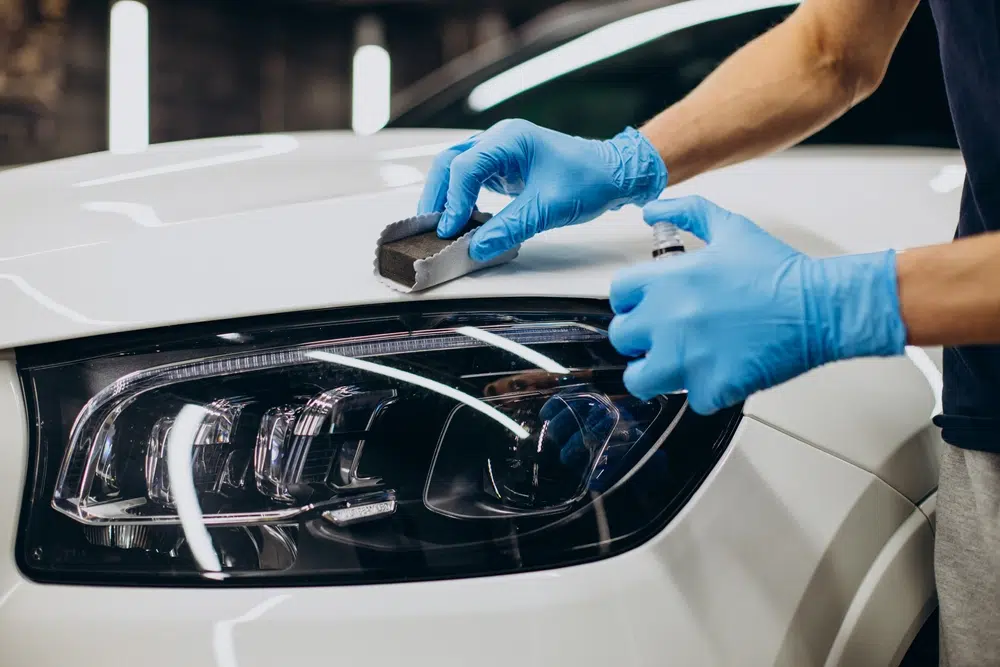
Ceramic coating is a liquid-applied protective coating that cures on compatible exterior surfaces.
Unlike PPF, ceramic coating is not designed to absorb meaningful physical impacts or prevent rock chips.
Depending on the product, preparation, installation, and maintenance, ceramic coating can help:
- Improve resistance to environmental contamination
- Enhance gloss and surface appearance
- Create hydrophobic water behavior
- Make routine washing and drying easier
- Reduce how strongly some contamination adheres
- Support long-term surface maintenance
Ceramic coating creates a comparatively thin protective layer. It can improve cleanability and chemical resistance, but it should not be represented as an alternative to the physical impact protection provided by PPF.
The Most Important Difference
The simplest distinction is the type of protection each product provides:
- PPF primarily addresses physical impacts and abrasion.
- Ceramic coating primarily addresses contamination, cleanability, gloss, and maintenance.
Both products support surface preservation, but they do so through different material properties and at very different thicknesses.
PPF as a Physical Barrier
PPF is sometimes described as armor. That analogy is useful as long as its limitations are understood.
The film provides a physical barrier over the paint. When a small stone strikes a protected bumper or hood, the film may deform, distribute, absorb, or sacrifice itself before the impact reaches the finish beneath it.
Modern PPF may also include a self-healing topcoat that can reduce the appearance of suitable minor surface marks when exposed to warmth.
Self-healing does not repair punctures, deep cuts, damaged adhesive, crushed panels, or paint damage beneath the film.

Ceramic Coating as a Surface-Management Layer
Ceramic coating is sometimes described as a shield, although it is more accurately understood as a surface-management layer.
Its water behavior, gloss, chemical resistance, and surface characteristics can make a vehicle easier to maintain while reducing how strongly certain environmental contaminants adhere.
Ceramic coating does not make a vehicle scratch-proof, chip-proof, or maintenance-free. Improper washing can still create swirl marks, and physical impacts can still damage the paint.
PPF vs. Ceramic Coating at a Glance
| Consideration | Paint Protection Film | Ceramic Coating |
|---|---|---|
| Primary purpose | Physical impact and abrasion protection | Contamination resistance and easier maintenance |
| Rock-chip protection | Designed to help reduce rock-chip damage | Not designed to stop rock chips |
| Thickness | Comparatively thick film system | Comparatively thin cured coating |
| Self-healing | Available in the topcoat of many modern films | Not a universal ceramic-coating property |
| Water behavior | Varies by film and topcoat | Usually a principal performance feature |
| End-of-life service | Individual film sections may be removed and replaced | Coating may be maintained, polished, or reapplied as appropriate |
| Best suited for | High-impact and wear-prone surfaces | Surfaces where gloss and cleanability are priorities |
Why Many Vehicle Owners Choose Both
Many drivers initially believe they must choose one product or the other.
In practice, PPF and ceramic coating can complement each other when the products are compatible and installed in the correct sequence.
Paint protection film can be installed on surfaces most vulnerable to physical damage. Ceramic coating can then be applied to compatible film and exposed painted surfaces to support cleanability, gloss, and more consistent maintenance characteristics.
Compatibility should be confirmed for the exact film and coating systems being used. Product selection, preparation, curing requirements, warranty terms, and installation sequence all matter.

Which Areas Are Commonly Protected With PPF?
Common PPF coverage areas include:
- Front bumper
- Partial or full hood
- Partial or full front fenders
- Mirror caps
- Rocker panels
- Door edges and handle cups
- Rear-wheel impact areas
- Loading ledges
- Other vehicle-specific high-impact areas
Some owners choose partial-front protection, while others select full-front, high-impact, or full-vehicle coverage.
Package names differ among installers, so estimates should identify the actual panels, boundaries, and expected edge treatment.
Where Is Ceramic Coating Commonly Applied?
Depending on the selected product and compatibility requirements, ceramic coating may be used on:
- Exterior painted surfaces
- Compatible paint protection film
- Wheels
- Exterior glass
- Trim
- Other approved exterior materials
Different surfaces may require different coating products. One coating should not automatically be assumed suitable for every material on the vehicle.
Which Product Should Be Installed First?
When PPF and ceramic coating are being combined, the general sequence is:
- Inspect and document the vehicle’s condition.
- Wash and decontaminate the surfaces.
- Perform appropriate paint correction before protection.
- Install paint protection film.
- Allow the film to settle according to product and installer guidance.
- Apply a compatible ceramic coating to the intended surfaces.
Installing a coating before PPF may interfere with film adhesion. The exact sequence and waiting periods should follow the current instructions for the products being used.
How Cost and Ownership Goals Affect the Decision
PPF and ceramic coating should be evaluated according to the owner’s priorities rather than treated as automatic purchases.
PPF may provide greater value when:
- The vehicle receives frequent highway exposure
- Rock chips are a primary concern
- The owner wants to preserve original paint
- High-impact surfaces are still in excellent condition
- The vehicle will be kept for several years
Ceramic coating may provide greater value when:
- Easier washing is a major priority
- The vehicle is exposed to environmental contamination
- Gloss and appearance are important
- The owner follows an appropriate maintenance routine
- Physical impact protection is not the primary concern
The APS Protection Framework Perspective
At Automotive Protection Services, both services play roles within the APS Protection Framework.
Paint protection film supports surface preservation by placing a serviceable physical barrier over vulnerable painted surfaces.
Ceramic coating also supports surface preservation by improving cleanability, environmental resistance, gloss, and maintenance characteristics.
Within the broader APS Protection Ecosystem, these products function as complementary layers rather than competing purchases.

So, Which Is Better?
If your primary concern is rock chips, road debris, and physical abrasion, paint protection film is generally the more appropriate solution.
If your primary concern is gloss, contamination resistance, water behavior, and easier maintenance, ceramic coating may be the better fit.
If you want both physical impact protection and improved maintenance characteristics, a properly planned combination may provide the most complete result.
The correct choice depends on the vehicle, surface condition, driving exposure, ownership period, maintenance expectations, and available budget.
Compare PPF and Ceramic Coating With APS
APS can evaluate your vehicle and help determine whether PPF, ceramic coating, or a coordinated combination best fits your driving exposure and ownership goals.
Automotive Protection Services
3170 Draper Drive, Unit #8
Fairfax, VA 22031
(703) 591-0900
Schedule a Consultation Explore PPF Services Explore Ceramic Coating
Understand PPF Before Building Your Protection Plan
The complete APS Paint Protection Film Guide examines film construction, impact protection, coverage choices, installation, compatibility, maintenance, aging, removal, warranties, and long-term cost.
Read the Complete PPF Guide Read the Ceramic Coating GuideRelated Posts
Ceramic Coating in Fairfax VA | Protection You Can Count On
[siteorigin_widget class="WP_Widget_Custom_HTML"][/siteorigin_widget]
Protect Your Vehicle From the Damage of Winter Dirt, Debris, Salt, and Chemicals
Winter in Fairfax, Virginia, can be hard on your vehicle’s…
Is Ceramic Coating Worth It? 7 Reasons Drivers Say Yes
[siteorigin_widget class="WP_Widget_Custom_HTML"][/siteorigin_widget]