
Paint Protection Film Installers • Fairfax, VA
Paint Protection Film Installed Right — Before the Damage Starts.
Looking for paint protection film installers near you? APS specializes in PPF (clear bra) installation for Northern Virginia drivers — protecting against rock chips, road debris, and daily wear from I-66, Fairfax County Parkway, and beyond.
- PPF • Clear Bra • Full & Partial Coverage
- Cleanroom Install Bay
- Precision-Cut Patterns
What Is Paint Protection Film (PPF / Clear Bra)?
Paint protection film (PPF), often called a clear bra, is a clear, self-healing urethane film applied to painted panels to stop rock chips, road rash, stains, and micro-scratches before they reach your paint. If you’ve been searching for PPF installers near you in Fairfax or Northern Virginia, this is the protection system designed for real-world driving — from I-66 commutes to daily exposure on Fairfax County Parkway. It’s invisible protection that preserves gloss and resale value without changing the look of your vehicle.
How Paint Protection Film Works
- Multi-layer TPU: An impact-absorbing urethane core with a clearcoat top layer that resists chips and abrasion.
- Self-healing topcoat: Light swirls and marring relax with engine heat or warm water.
- Optically clear: High-quality PPF is non-yellowing and keeps factory color and metallic flake visible.
What PPF Protects Against
- High-speed impacts: gravel, sand, road salt, and debris common on Northern Virginia roads.
- Mechanical abrasion: brush washes, jacket zippers, luggage contact.
- Staining & etching: bug acids, bird droppings, tar, and environmental fallout.
Best Areas for Paint Protection Film
Front Bumper Hood & Fenders Mirror Caps Rocker Panels Door Edges/Cups Trunk LedgeWhere PPF Came From
What to Expect From a Professional Install
- Installed in a clean, controlled environment by experienced PPF installers.
- Precision-cut patterns with wrapped edges where possible for a seamless look.
- Panels cure within 24–48 hours; avoid pressure washing for the first week.


How We Apply Paint Protection Film
Every install is planned in software, prepped in a clean bay, and laid with slip/tack solutions so the film sits flat, clear, and tight—just like OEM.
Step-by-Step
- Patterning in Software: We load your Year/Make/Model into professional pattern software and select panels (bumper, hood, fenders, mirrors, rockers). Edges and relief cuts are adjusted for your trim level to minimize seams and stretch.
- Plotter Cut: A dedicated PPF plotter cuts the film from the selected template set. This avoids knife work on paint and keeps edges consistent.
- Decon & Prep: Foam wash → iron remover (as needed) → clay bar → panel wipe (isopropyl-based). We remove badges or hardware only when specified and safe to do so.
- Final Surface Check: Bright light inspection for bonded contaminants, sap, or micro-marring. Minor polish only where appropriate; paint must be clean and cool to the touch.
- Wet Install (Slip): The panel and adhesive side of the film are misted with a slip solution (distilled water + a small amount of pH-neutral surfactant). This lets the film float so we can align patterns perfectly.
- Lock Points (Tack): Alignment is set at reference points using a tack solution (distilled water + isopropyl alcohol mix). We “lock” anchors and squeegee out solutions in controlled passes.
- Edge Work & Wraps: Where feasible, edges are wrapped and relieved so they lie flat without tension. Corners are warmed and set—never overheated—to preserve optical clarity.
- Set & Cure: Heat is used sparingly to relax remaining tension and dry edges. Vehicle remains indoors while the film settles; we provide post-care and first-wash guidance.
Tools & Solutions
Professional pattern software Dedicated PPF plotter Install lights & stands
Slip solution (water + surfactant) Tack solution (water + IPA) Soft & firm squeegees Edge tools & sprays
Heat control (low, even) Edge inspection 24–48 hr settle 7-day no pressure wash
Optional: Ceramic coating over PPF for slickness and easier washing.
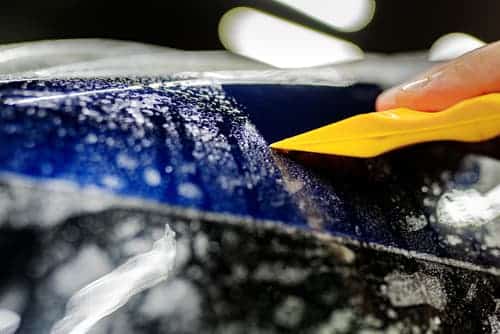
PPF in Action
From plotting to final squeegee—here’s how protection comes together in our Fairfax cleanroom.


PPF FAQs
Everything you wanted to know about Paint Protection Film—how it works, where it goes, care, removal, and more.
1) What is Paint Protection Film (PPF)?
2) Why should I apply PPF to my vehicle?
3) Where is PPF most often applied?
4) How long does the installation take?
5) How long does PPF last and what’s the warranty?
6) Does PPF change how my paint looks?
7) Can I apply ceramic coating on top of PPF?
8) How do I care for PPF (washing, waxing, automatic washes)?
9) What is “self-healing” PPF—does it really work?
10) Can PPF be removed without damaging paint?
11) What coverage options are there (Partial Front, Full Front, Full Vehicle)?
- Partial Front: Bumper, partial hood/fenders, mirrors.
- Full Front: Bumper, full hood/fenders, mirrors.
- Full Vehicle: All painted panels; add rockers/quarters as needed.