APS Knowledge Base

The APS Guide to Automotive Window Film

A comprehensive reference for understanding automotive window film, comparing modern technologies, evaluating performance specifications, and choosing the right solution for your vehicle.

Why We Created This Guide

Most information about automotive window tint is written to sell a particular product or brand. Our objective is different. We created this guide to explain the science, technologies, terminology, performance measurements, and installation practices behind modern automotive window film so that you can make an informed decision based on facts rather than marketing claims.

Whether you're protecting a brand-new truck, reducing summer heat in your daily driver, preserving the interior of a luxury vehicle, or simply trying to understand the differences between ceramic and traditional films, this guide is designed to answer the questions that matter before you make an investment.

Introduction

Automotive window film is often presented as a simple choice between darkness, price, and brand names. In reality, selecting the right film involves understanding heat rejection, ultraviolet protection, visible light transmission, optical clarity, warranty coverage, installation quality, and the unique needs of both the vehicle and its owner.

Throughout this guide, we'll explain how automotive window film works, why performance specifications are frequently misunderstood, what separates today's leading film technologies, and how professional installation influences the finished result just as much as the film itself.

By the time you finish reading, you'll understand not only which questions to ask before purchasing window film, but also how to evaluate competing products, recognize quality workmanship, and choose the solution that best fits your driving habits, comfort expectations, and long-term ownership goals.

The APS Philosophy: We believe informed customers make better long-term decisions. Our role is to educate first, recommend second, and install solutions that deliver lasting performance—not simply sell a product.

How Automotive Window Film Works

Understanding what modern automotive window film actually does—and why it's much more than simply making your windows darker.

Many people believe automotive window film exists primarily to darken vehicle windows for privacy or appearance. While darker glass can certainly change the look of a vehicle, modern automotive window film is actually a highly engineered solar management technology designed to improve comfort, reduce ultraviolet exposure, manage solar heat, protect vehicle interiors, and enhance the overall driving experience.

Every time your vehicle sits in the sun, sunlight passes through the glass carrying several different forms of energy. Some of that energy is visible light, allowing you to see through the windows. Some is ultraviolet (UV) radiation, which contributes to fading interior materials and prolonged exposure to harmful rays. A significant portion of the heat you feel inside the vehicle is carried by infrared (IR) energy, while the total heating effect comes from the combination of the entire solar spectrum.

Illustration showing ultraviolet, visible light, and infrared energy interacting with automotive window film.
Modern automotive window film selectively manages different portions of the solar spectrum, reducing heat, blocking harmful ultraviolet radiation, and improving comfort while maintaining excellent visibility.

Automotive window film works by selectively filtering portions of this solar energy before it enters the passenger compartment. Depending on the film technology used, the film may absorb, reflect, or reject different wavelengths of energy while maintaining excellent outward visibility and preserving the appearance of the vehicle.

The result is a vehicle that stays more comfortable during hot weather, experiences less interior fading, reduces glare during both daytime and nighttime driving, and provides a more enjoyable environment for everyone inside.

Automotive Window Film Provides Much More Than Privacy

  • Helps reduce solar heat entering the passenger compartment.
  • Blocks more than 99% of harmful ultraviolet (UV) radiation with professional-grade films.
  • Reduces glare from sunlight and headlights.
  • Helps preserve leather, plastics, vinyl, and interior trim from premature fading.
  • Improves driving comfort during every season.
  • Adds privacy while maintaining excellent outward visibility.

Window Film Is a Performance System—Not Simply a Shade

One of the biggest misconceptions surrounding automotive window tint is that darker automatically means cooler. In reality, darkness alone tells us very little about how well a film performs.

Two films with nearly identical Visible Light Transmission (VLT) can deliver dramatically different heat rejection because they are built using completely different materials and technologies. Modern nano-ceramic films, for example, can reject substantially more solar energy than traditional dyed films while maintaining similar appearance and excellent optical clarity.

This is why two vehicles parked next to one another with windows that appear equally dark can feel completely different inside after sitting in the summer sun.

Throughout the remainder of this guide, you'll learn why understanding the science behind automotive window film is far more valuable than simply comparing darkness percentages or marketing claims.

Key Takeaway

Automotive window film should be evaluated as a solar management technology—not simply a cosmetic upgrade. Appearance is only one benefit. The real value comes from managing solar energy, improving comfort, protecting your interior, reducing glare, and enhancing the everyday ownership experience.

```

How Heat Enters Your Vehicle

Understanding why parked vehicles become so hot—and why managing total solar energy matters more than simply making the windows darker.

Anyone who has opened the door of a vehicle after it has been sitting in the summer sun has experienced the intense heat trapped inside. Even when the outside air feels manageable, the passenger compartment, dashboard, steering wheel, seats, center console, and other interior surfaces can become dramatically hotter.

This happens because sunlight carries energy through the vehicle's glass. Once that energy reaches the dashboard, seats, carpeting, trim, steering wheel, and other interior materials, those surfaces absorb it and begin to heat up.

The heated surfaces then release energy back into the passenger compartment. Because the vehicle is enclosed and has limited airflow while parked, heat accumulates faster than it can escape. This process is commonly described as the greenhouse effect, although the actual heating process involves several forms of solar energy, absorption, radiation, and restricted ventilation working together.

Thermal infographic showing how solar energy heats a vehicle interior and comparing cabin temperatures with no window tint and with ceramic automotive window film.
Solar energy passes through automotive glass, is absorbed by interior surfaces, and is released back into the cabin as heat. Quality automotive window film helps reduce the amount of solar energy entering the vehicle before that heating process begins.

Why Interior Surfaces Become So Hot

The air inside a parked vehicle is only part of the problem. Interior surfaces can become significantly hotter than the surrounding cabin air because they directly absorb incoming solar energy.

  • Dark dashboards and trim absorb substantial amounts of solar energy.
  • Leather, vinyl, plastic, and metal components retain and radiate heat.
  • Large windshields and windows allow considerable solar exposure.
  • Limited ventilation allows heat to accumulate inside the cabin.
  • Continued exposure can accelerate fading, drying, discoloration, and material deterioration.

The Three Primary Regions of Solar Energy

Sunlight is not a single form of energy. It contains several regions of the electromagnetic spectrum, each of which affects the vehicle and its occupants differently. Understanding these regions makes it easier to understand how automotive window film is evaluated.

Ultraviolet Radiation

Ultraviolet radiation, commonly abbreviated as UV, represents a relatively small portion of total solar energy, but it can have a major effect over time. Prolonged UV exposure contributes to fading, discoloration, drying, and deterioration of leather, fabric, vinyl, plastics, dashboards, and interior trim.

UV exposure is also associated with skin damage. Professional-grade automotive window films commonly block more than 99% of ultraviolet radiation, helping protect both occupants and interior materials.

Visible Light

Visible light is the portion of the solar spectrum human eyes can see. The amount of visible light passing through automotive glass and window film is measured as Visible Light Transmission, or VLT.

Reducing visible light can improve privacy, reduce glare, and change the appearance of the vehicle. However, visible darkness alone does not determine how effectively a film manages heat.

Infrared Energy

Infrared energy is commonly associated with the radiant heat people feel from direct sunlight. Advanced ceramic window films are engineered to reduce substantial portions of infrared energy while maintaining strong optical clarity.

Infrared rejection is important, but it should not be viewed in isolation. Manufacturers may measure and report infrared performance across different wavelength ranges or at specific points in the spectrum. For that reason, a high advertised infrared-rejection percentage does not always provide a complete picture of total heat performance.

Why Automotive Glass Alone Does Not Solve the Problem

Modern automotive glass provides some protection from ultraviolet radiation and solar energy. Laminated windshields, factory privacy glass, and specialized glass constructions can all affect the amount of energy entering a vehicle.

However, untreated automotive glass still allows substantial solar energy to reach the passenger compartment. Factory privacy glass may appear dark, especially on the rear windows of trucks and SUVs, but darkness does not necessarily mean that the glass provides strong infrared or total solar-energy rejection.

This distinction is important. Privacy glass is generally designed to reduce visible light and create a darker appearance. Performance window film is engineered to manage multiple parts of the solar spectrum while also providing UV protection, glare reduction, and measurable heat-rejection benefits.

Factory Privacy Glass Is Not the Same as Performance Window Film

Many trucks and SUVs arrive with dark rear glass from the factory. That glass may improve privacy and appearance, but it should not automatically be assumed to provide the same heat-rejection performance as professionally installed ceramic window film.

A nearly clear or lightly shaded ceramic film can sometimes provide better solar-energy management than much darker untreated privacy glass.

How Window Film Interrupts the Heating Process

Automotive window film works with the existing glass to reduce the amount of solar energy entering the vehicle. Depending on the film's construction, some energy may be reflected, some may be absorbed within the glass-and-film system, and less may be transmitted into the passenger compartment.

Reducing transmitted solar energy means less energy reaches the dashboard, seats, steering wheel, center console, and other interior surfaces. Because those materials absorb less energy, they generate and radiate less heat back into the cabin.

Window film does not turn a parked vehicle into a refrigerated space, and no responsible installer should suggest that it does. A vehicle sitting in direct summer sunlight will still become warm. The goal is to reduce solar heat gain, improve recovery time once the air conditioning begins operating, make interior surfaces more comfortable, and create a better driving environment.

Understanding Temperature Comparisons

Cabin-temperature and surface-temperature examples are useful for illustrating how vehicles heat up, but actual results vary. Vehicle type, glass area, exterior color, interior color, film selection, installation location, cloud cover, ventilation, humidity, geographic location, and the amount of time spent in direct sunlight can all affect measured temperatures.

The most meaningful way to compare window films is through standardized performance data, especially Total Solar Energy Rejected, rather than relying solely on a demonstration lamp, a single temperature reading, or an isolated infrared-rejection percentage.

Key Takeaway

Vehicles become hot because solar energy passes through the glass, is absorbed by interior surfaces, and is released back into the cabin as heat. Automotive window film helps interrupt that process by reducing the amount of solar energy entering the vehicle before it can be absorbed. The result is improved comfort, reduced glare, greater UV protection, and less thermal stress on the vehicle's interior.

```
```

Understanding Automotive Window Film Technologies

How dyed, carbon, metalized, ceramic, and advanced ceramic films differ—and why the name of a technology does not tell the whole story.

Automotive window films are frequently divided into categories such as dyed, carbon, metalized, ceramic, and nano-ceramic. These labels are useful starting points, but they should not be treated as universal performance grades.

A film does not become exceptional simply because the word ceramic appears in its name, just as every dyed film should not automatically be dismissed as low quality. Construction quality, material stability, optical clarity, scratch resistance, adhesive performance, warranty coverage, installation quality, and verified solar-performance data all influence the finished result.

It is also important to understand that terminology is not perfectly standardized across the window-film industry. Two manufacturers may describe products using similar language even though the films differ considerably in construction and performance. That is why APS recommends comparing measurable specifications and real-world priorities rather than relying on a category name alone.

A Technology Label Is Not a Performance Guarantee

Terms such as carbon, ceramic, nano-ceramic, infrared, and high-performance ceramic are widely used in product marketing. They may describe legitimate differences in film construction, but the terminology alone does not establish how much total solar energy a film rejects, how clear it will appear, how long it will remain color stable, or how well it will perform after years of use.

Dyed Window Film

Dyed automotive window film uses colorant within one or more layers of the film to reduce visible light transmission and create a darker appearance. It is one of the longest-established forms of automotive window tint and remains a practical option for drivers primarily concerned with appearance, privacy, glare reduction, and ultraviolet protection.

Better-quality dyed films use stable color systems designed to resist fading, discoloration, and the purple appearance historically associated with inexpensive tint. A well-made color-stable dyed film can provide a sophisticated, low-reflectivity appearance and dependable long-term performance when professionally installed.

Common Advantages of Dyed Film

  • Attractive, non-reflective appearance.
  • Improved privacy and glare reduction.
  • Strong ultraviolet protection in professional-grade products.
  • No metallic content that could interfere with electronic signals.
  • Generally more affordable than ceramic technologies.

Common Limitations of Dyed Film

  • Usually provides less heat rejection than premium ceramic films at a comparable shade.
  • Product quality can vary substantially between manufacturers and product lines.
  • Low-quality dyes may fade, shift color, or deteriorate prematurely.

Dyed film can be a sensible choice for a customer who wants a clean appearance, privacy, UV protection, and reasonable value without requiring the highest available heat-rejection performance.

Carbon Window Film

Carbon window film is generally marketed as an improvement over conventional dyed film. Carbon-based particles or pigments are used to create a dark, color-stable appearance while providing additional solar-energy management.

In practice, the term carbon is used differently throughout the industry. It does not identify one universal manufacturing process or guarantee a specific level of performance. Some carbon films provide meaningful improvements over entry-level dyed products, while others may perform more like traditional color-stable film.

Common Advantages of Carbon Film

  • Deep, low-reflectivity appearance.
  • Good color stability when made with quality materials.
  • No metallic signal interference.
  • Potentially improved heat performance compared with basic dyed films.
  • Often positioned between dyed and ceramic films in price.

Common Limitations of Carbon Film

  • The term is not applied consistently across manufacturers.
  • Heat-rejection performance can vary widely.
  • It may not approach the performance of a premium ceramic film at the same visible-light transmission.

Consumers should not assume that every film advertised as carbon will outperform every dyed film. The published performance data and the quality of the product matter more than the label.

Metalized Window Film

Metalized films incorporate extremely small metallic particles or layers to reflect and manage solar energy. Historically, these films were known for strong heat rejection and durability, and some remain highly effective in appropriate applications.

However, metallic content may create a more reflective appearance and can potentially interfere with radio-frequency signals, depending on the film, vehicle, glass construction, and electronic systems involved. Modern vehicles rely on cellular connectivity, GPS, Bluetooth, satellite radio, toll transponders, antennas, sensors, and other integrated technologies, so compatibility should be considered carefully.

Common Advantages of Metalized Film

  • Effective solar-energy rejection.
  • Strong durability and color stability in quality products.
  • Can reduce glare and visible-light transmission efficiently.

Common Limitations of Metalized Film

  • May create a noticeably reflective appearance.
  • Can potentially interfere with some electronic or radio-frequency signals.
  • May not complement the factory appearance of every vehicle.

Metalized technology is less prominent in many premium automotive product lines today because ceramic films can provide strong performance without relying on metallic components.

Hybrid Window Film

Hybrid films combine multiple technologies, such as dyed layers with metallic, carbon-based, or ceramic components. The purpose is often to balance appearance, performance, cost, color stability, and durability.

Because the term hybrid can describe many different constructions, it does not indicate one predictable level of quality. One hybrid film may be designed as an economical upgrade over dyed tint, while another may be a sophisticated performance product.

As with every category, the most useful questions concern the film's actual specifications, optical quality, warranty, electronic compatibility, and suitability for the customer's goals.

Ceramic Window Film

Ceramic window film uses non-metallic ceramic materials engineered to manage solar energy while maintaining optical clarity and avoiding the signal-interference concerns associated with some metalized films.

Ceramic technology allows manufacturers to produce films that reject meaningful amounts of solar energy without requiring an extremely dark shade. This is particularly valuable for drivers who want improved cabin comfort while preserving visibility and a refined factory-like appearance.

Common Advantages of Ceramic Film

  • Strong heat rejection relative to many traditional films.
  • Excellent ultraviolet protection in professional-grade products.
  • No metallic signal interference.
  • Good optical clarity.
  • Available in a wide range of visible-light transmissions.
  • Can improve performance without requiring the darkest available shade.

Common Limitations of Ceramic Film

  • Generally costs more than traditional dyed film.
  • Performance differs significantly between product lines.
  • The word ceramic alone does not establish quality.
  • Some manufacturers emphasize infrared-rejection figures that may not be directly comparable with competing products.

Ceramic film is often an excellent choice for commuters, families, luxury-vehicle owners, truck and SUV drivers, electric-vehicle owners, and anyone who places a high priority on comfort and solar performance.

Advanced and High-Performance Ceramic Film

Advanced ceramic films build upon the objectives of standard ceramic products by using more sophisticated material combinations, coating methods, particle technologies, or multilayer constructions. These films are typically designed to provide greater total solar-energy rejection, improved infrared management, strong optical clarity, and high performance across lighter and darker shades.

This category is sometimes described using terms such as nano-ceramic, multi-layer ceramic, infrared ceramic, or high-performance ceramic. These descriptions may be technically meaningful within a manufacturer's product family, but they are not universal industry grades.

Common Advantages of Advanced Ceramic Film

  • Higher solar-energy rejection than many conventional films.
  • Strong performance in lighter visible-light transmissions.
  • Excellent optical clarity in quality products.
  • No metallic signal interference.
  • Strong UV protection.
  • Premium warranty coverage may be available.

Common Limitations of Advanced Ceramic Film

  • Higher initial cost.
  • Published infrared figures may still use different measurement ranges.
  • Marketing terminology can make objective comparison difficult.
  • Real-world results still depend heavily on glass type, vehicle design, film shade, and installation quality.

Drivers seeking the greatest available heat-management performance often gravitate toward advanced ceramic films. The decision should still be based on overall solar performance, visibility, appearance, warranty protection, and the specific needs of the vehicle owner.

Darker Does Not Automatically Mean Better

A darker dyed film may transmit less visible light than a lighter ceramic film while still rejecting less total solar energy. Shade and heat performance are related only indirectly.

This is why a customer can often select a relatively light ceramic film and receive meaningful heat and UV protection without dramatically changing the appearance of the vehicle.

How APS Approaches Film Selection

APS does not begin by assuming that every customer needs the darkest film or the most expensive product. We begin by identifying the customer's priorities and the characteristics of the vehicle.

Relevant considerations include:

  • Desired appearance and level of privacy.
  • Heat-rejection expectations.
  • Daytime and nighttime visibility.
  • Vehicle glass configuration and existing factory privacy glass.
  • Daily driving conditions and commute length.
  • Whether children, pets, or heat-sensitive passengers regularly ride in the vehicle.
  • Interior materials and long-term ownership plans.
  • Virginia tint-law requirements.
  • Budget and warranty priorities.

Once those priorities are clear, film technology and shade can be selected as part of a complete solution rather than as an isolated product choice.

Film, Glass, and Installation Work Together

Published film specifications are commonly measured on a particular type of test glass under controlled conditions. Actual installed performance can vary based on the vehicle's original glass, factory tint, windshield construction, angle of the glass, interior color, total glass area, and environmental conditions.

The film should therefore be viewed as one part of a complete glass-and-film system. Product selection, shade selection, glass characteristics, and installation quality all affect the final result.

Key Takeaway

Dyed, carbon, metalized, hybrid, ceramic, and advanced ceramic films each represent different approaches to controlling light and solar energy. However, the technology name alone does not determine quality. The best choice is the film that delivers the appropriate balance of heat rejection, visible-light transmission, optical clarity, appearance, warranty protection, electronic compatibility, and long-term value for the specific vehicle and driver.

```

Understanding Window Film Performance Specifications

How to read VLT, VLR, UVR, IRR, TSER, and SHGC—and why no single percentage tells the complete story.

Automotive window-film specification sheets can appear deceptively simple. They usually contain a series of abbreviations followed by percentages, and it is easy to assume that the film with the highest number must automatically be the best choice.

In reality, each specification measures something different. Some relate to appearance, others measure visible light, some describe ultraviolet protection, while others attempt to quantify how much solar heat enters your vehicle. Looking at only one number rarely tells the complete story.

Understanding these measurements will allow you to compare products intelligently, recognize misleading marketing claims, and select window film based on real-world performance rather than advertising.

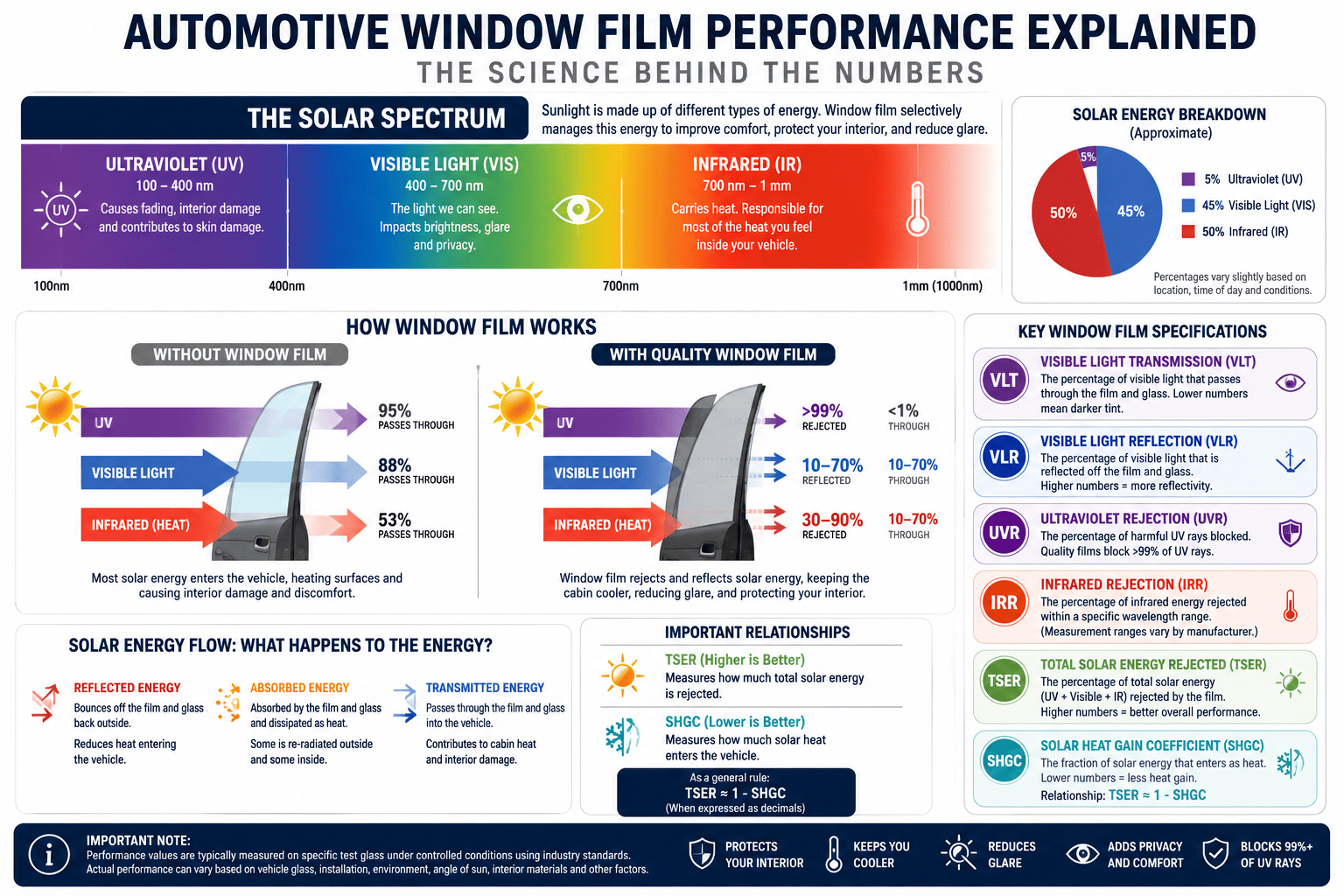
Automotive Window Film Performance Guide explaining the solar spectrum, VLT, VLR, UVR, IRR, TSER and SHGC.
Understanding automotive window film begins with understanding the measurements used to describe its performance. No single specification tells the entire story.

No Single Number Determines the Best Film

A film may advertise extremely high infrared rejection while another delivers better overall heat performance. A darker film may reject more visible light while allowing more solar heat into the cabin than a lighter ceramic film. Every specification describes only one part of the overall performance profile.

Visible Light Transmission (VLT)

VLT measures the percentage of visible light that passes through both the glass and the installed window film.

  • Higher VLT = More visible light passes through.
  • Lower VLT = Darker appearance and greater privacy.

Although VLT determines how dark a vehicle appears, it does not determine how much heat the film rejects. Two films with nearly identical VLT values may have dramatically different solar-performance characteristics.

Visible Light Reflection (VLR)

VLR measures the amount of visible light reflected from the surface of the glass and film.

Higher VLR creates a more reflective or mirror-like appearance, while lower VLR typically produces the factory-style appearance preferred by many vehicle owners.

Ultraviolet Rejection (UVR)

UVR measures the percentage of harmful ultraviolet radiation blocked by the film.

Most professional-grade automotive window films block more than 99% of UV radiation, helping reduce interior fading while providing additional protection for occupants.

Infrared Rejection (IRR)

Infrared Rejection measures how effectively a film reduces infrared energy, which contributes significantly to the radiant heat you feel inside a vehicle.

IRR is an important measurement—but it should always be viewed in context. Different manufacturers may measure infrared rejection across different wavelength ranges or even at individual wavelengths. As a result, two products advertising similar IRR percentages may not provide the same real-world performance.

Don't Compare IR Numbers Without Context

A headline claiming "95% Infrared Rejection" sounds impressive, but unless you understand how that value was measured, it may not provide a fair comparison with competing products.

Total Solar Energy Rejected (TSER)

TSER measures the percentage of total solar energy rejected by the complete glass-and-film system.

Unlike IRR, TSER considers the combined effects of ultraviolet, visible light, and infrared energy. Because it evaluates the complete solar spectrum, TSER is generally considered one of the best indicators of overall heat-management performance.

When comparing films with similar VLT values, TSER usually provides a more meaningful comparison than IRR alone.

Solar Heat Gain Coefficient (SHGC)

SHGC measures how much solar heat actually enters the vehicle through the glass-and-film system.

Lower SHGC values indicate less solar heat entering the vehicle.

In simple terms:

TSER ≈ 1 − SHGC

The two measurements describe the same relationship from opposite perspectives.

The APS Recommendation

When comparing premium automotive window films, start by comparing films with similar VLT values. Then evaluate TSER, optical clarity, warranty, UV protection, installation quality, and only then consider infrared rejection. Looking at the complete performance profile produces a much better purchasing decision than chasing a single marketing number.

Key Takeaway

Window-film performance cannot be summarized by one percentage. VLT determines darkness, VLR affects reflectivity, UVR measures ultraviolet protection, IRR describes infrared performance, TSER evaluates total solar energy rejection, and SHGC measures solar heat entering the vehicle. Understanding how these measurements work together allows consumers to compare products objectively and choose the solution that best fits their vehicle and driving needs.

Why TSER Matters More Than Infrared Rejection Alone

Infrared rejection is important, but understanding how it is measured is essential before using it to compare automotive window films.

If you have researched automotive window film, you have probably encountered advertisements claiming extremely high infrared-rejection numbers. Statements such as “95% infrared rejection,” “97% IR blocking,” or “up to 99% infrared heat rejection” are common throughout the industry.

These numbers can sound like definitive measures of performance. It is natural to assume that a film advertising 97% infrared rejection must outperform one advertising 93%.

The reality is more complicated.

Infrared rejection is an important characteristic of automotive window film, particularly when evaluating ceramic and high-performance ceramic products. However, infrared energy covers a broad range of wavelengths, and manufacturers do not always measure or report infrared rejection across the same portion of that range.

Without knowing how the measurement was produced, two impressive-looking infrared percentages may not be directly comparable.

Infographic explaining why infrared rejection percentages measured across different wavelength ranges are not directly comparable and why Total Solar Energy Rejected provides a more complete measure of automotive window film performance.
Infrared-rejection percentages may be measured across a narrow range, a broad range, or at a single wavelength. TSER evaluates the combined effect of the full solar spectrum and provides a more complete picture of overall solar performance.

The Most Important Question Is Not “How High Is the Number?”

The more useful question is:

How was the infrared-rejection number measured?

A published infrared-rejection percentage becomes much more meaningful when the manufacturer also identifies the wavelength, wavelength range, test glass, and measurement method used.

Infrared Energy Is Not a Single Measurement Point

Infrared energy occupies a broad portion of the electromagnetic spectrum. It is not one isolated wavelength that can always be measured in exactly the same way.

Depending on the manufacturer and testing method, infrared rejection may be reported:

  • Across a relatively narrow infrared wavelength range.
  • Across a much broader portion of the infrared spectrum.
  • At one selected wavelength, such as 940 or 1,000 nanometers.
  • Using different test glass, laboratory instruments, or reporting standards.

Each measurement may be technically accurate within its stated test conditions. The problem occurs when consumers compare the resulting percentages as though every manufacturer measured the same portion of the spectrum in the same way.

Three Infrared Claims Can All Be Accurate

Consider three hypothetical films:

  • Film A: Advertises 95% infrared rejection measured across a narrow wavelength range.
  • Film B: Advertises 93% infrared rejection measured across a substantially wider range.
  • Film C: Advertises 97% infrared rejection measured at one specific wavelength.

Film C displays the highest number, but that does not automatically mean it rejects more total solar heat than Films A or B. The three percentages describe different tests and therefore should not be treated as direct head-to-head scores.

Different Measurement Methods Do Not Automatically Mean Dishonesty

Different manufacturers may use legitimate testing methods that emphasize different portions of the infrared spectrum. The existence of different methods does not, by itself, mean that a manufacturer is being deceptive.

It does mean that an infrared-rejection claim should be presented with enough context for consumers and installers to understand what was actually measured.

Why a Narrow Measurement Can Produce an Impressive Number

A window film may perform exceptionally well at a particular infrared wavelength. If the manufacturer reports only that wavelength, the resulting rejection percentage may appear extremely high.

That number can accurately describe performance at the selected measurement point while still providing limited information about the film's performance across the rest of the infrared region.

This is similar to evaluating a vehicle's fuel economy based only on its performance during one portion of one trip. The result may be accurate, but it does not necessarily describe the entire driving experience.

IR Rejection Measures Part of the Story

Infrared rejection describes performance within a defined portion of the infrared spectrum.

It does not, by itself, describe all ultraviolet, visible-light, infrared, absorbed, reflected, and transmitted solar energy affecting the vehicle.

Your Vehicle Is Heated by More Than Infrared Energy

Infrared energy contributes significantly to the radiant heat occupants feel inside a vehicle, but it is not the only form of solar energy involved in cabin heating.

The complete heating process includes:

  • Ultraviolet energy reaching the glass and interior.
  • Visible light entering the passenger compartment.
  • Infrared energy transmitted through the glass.
  • Solar energy absorbed by the glass and film.
  • Energy reflected away from the vehicle.
  • Energy reradiated from heated glass and interior surfaces.
  • The thermal characteristics of the vehicle's original glass.

This is why the highest advertised infrared-rejection percentage does not automatically identify the film that will provide the strongest overall solar-heat performance.

What Total Solar Energy Rejected Measures

Total Solar Energy Rejected, abbreviated as TSER, measures the percentage of total solar energy rejected by the complete glass-and-film system.

Instead of evaluating only one region or measurement point, TSER considers the combined effect of ultraviolet, visible, and infrared solar energy.

It accounts for energy that is:

Transmitted

Solar energy that passes through the glass-and-film system and enters the passenger compartment.

Reflected

Solar energy redirected away from the vehicle before it can pass through the glass.

Absorbed

Solar energy retained within the glass-and-film system and later released toward the exterior or interior as heat.

Because TSER evaluates the broader solar-energy relationship, it is generally one of the most useful specifications for comparing the overall heat-management performance of automotive window films.

TSER Provides the More Complete Picture

IRR asks:

How effectively does this film reduce infrared energy within the measured wavelength or range?

TSER asks:

How much of the total solar energy is rejected by the complete glass-and-film system?

Both measurements are useful, but TSER more directly addresses the overall solar-energy performance most consumers are trying to understand.

The Relationship Between TSER and SHGC

Solar Heat Gain Coefficient, abbreviated as SHGC, measures the fraction of solar heat that ultimately enters through the glass-and-film system.

TSER and SHGC describe the same general relationship from opposite perspectives:

TSER ≈ 1 − SHGC

When expressed as decimals, an SHGC of 0.40 corresponds to approximately 60% Total Solar Energy Rejected.

  • Higher TSER generally indicates greater total solar-energy rejection.
  • Lower SHGC generally indicates less solar heat entering the vehicle.

Why VLT Must Be Considered During Comparisons

TSER should not be compared without also considering Visible Light Transmission.

Darker films generally reject more total solar energy partly because they transmit less visible light. Comparing a 5% film with a 50% film does not provide a fair evaluation of the underlying film technology.

The most useful comparisons place films with similar VLT values next to one another. This makes it easier to evaluate whether one technology delivers stronger total solar performance without simply relying on greater darkness.

A Better Comparison

Compare a 35% ceramic film with another product in approximately the same VLT range. Then review:

  • TSER.
  • IRR and its stated measurement range.
  • VLR and exterior appearance.
  • Optical clarity and haze.
  • UV protection.
  • Warranty coverage.
  • Film construction and long-term stability.

Why Heat-Lamp Demonstrations Have Limitations

Heat-lamp demonstrations can be useful for helping customers feel a difference between products. However, they should not be treated as complete scientific comparisons.

The result can be influenced by:

  • The type of lamp being used.
  • The wavelengths produced by the lamp.
  • The distance between the lamp, film, and sensor.
  • The type and thickness of the test glass.
  • The length of the demonstration.
  • The location and calibration of the measuring instrument.

A demonstration may accurately show how a film responds to that particular heat source while still providing an incomplete picture of how the film manages the full solar spectrum outdoors.

Demonstrations are most useful when combined with standardized published data rather than used as a replacement for it.

Laboratory Data Is a Comparison Tool, Not a Cabin-Temperature Promise

Film specifications are generally measured under controlled laboratory conditions using defined test glass and testing procedures.

Actual vehicle performance will also be influenced by glass area, windshield size, factory privacy glass, interior color, dashboard materials, cabin volume, ventilation, climate, sun angle, installation quality, and the amount of time the vehicle remains exposed.

Published data allows products to be compared more intelligently, but no responsible manufacturer or installer should promise one exact cabin-temperature reduction for every vehicle and every condition.

How APS Recommends Comparing Heat Performance

When comparing premium automotive window films, APS recommends using the following process:

  1. Compare products with similar VLT. This creates a fairer comparison between film technologies.
  2. Review TSER. Use Total Solar Energy Rejected as a primary measure of overall solar-heat performance.
  3. Review IRR with context. Determine whether the stated wavelength or wavelength range is available.
  4. Evaluate optical quality. Strong performance should not come at the expense of clarity, visibility, or excessive haze.
  5. Consider appearance and reflectivity. Make sure the film complements the vehicle and matches the owner's expectations.
  6. Review warranty protection. Understand what is covered, who administers the warranty, and how claims are handled.
  7. Evaluate the installer. Even excellent film can produce poor results when the glass is improperly prepared or the film is installed carelessly.

APS Expert Insight

Customers frequently begin their research by looking for the film with the highest advertised infrared-rejection number. Once the measurement methods and complete specification tables are explained, the conversation usually changes.

Instead of chasing one percentage, the customer can choose the right balance of total solar-energy rejection, visible-light transmission, optical clarity, appearance, warranty protection, and cost.

That is a much more reliable way to select automotive window film.

Key Takeaway

Infrared rejection is an important measurement, but the advertised percentage alone does not tell the full story. Manufacturers may legitimately measure infrared performance across different wavelength ranges or at individual points, which means their published numbers are not always directly comparable.

Total Solar Energy Rejected provides a broader view of how the complete glass-and-film system manages ultraviolet, visible, and infrared solar energy. When comparing films with similar VLT, TSER is generally a more meaningful starting point for evaluating overall heat performance.

```

Comparing Premium Automotive Window Films

How to compare film technologies, specification sheets, warranties, appearance, and real-world value without relying on brand recognition alone.

Once consumers begin researching premium automotive window film, they quickly encounter a long list of brands, product lines, technologies, warranties, performance claims, and installer recommendations.

Each company naturally presents its own products in the most favorable light. One may emphasize infrared rejection. Another may focus on a nationwide warranty, optical clarity, ceramic construction, proprietary technology, celebrity endorsements, or authorized-dealer status.

These distinctions can all be meaningful, but no single marketing claim determines which film is best for every vehicle owner.

The most reliable comparison begins by identifying the driver’s priorities, comparing films at similar visible-light transmission levels, reviewing complete performance data, and evaluating the quality of the installer who will ultimately apply the product.

Premium Does Not Mean the Same Thing to Every Driver

One customer may define premium as the greatest available heat rejection. Another may prioritize nighttime visibility, a factory-matched appearance, a transferable warranty, low reflectivity, or a moderate price.

The best film is not necessarily the product with the highest number or the highest price. It is the product that delivers the right combination of performance, appearance, visibility, warranty protection, and long-term value for the specific owner and vehicle.

Begin With the Driver’s Objective

Before comparing brands or specification sheets, determine what the window film is expected to accomplish.

Common priorities include:

  • Reducing cabin heat during summer driving.
  • Improving comfort for children, pets, or rear-seat passengers.
  • Reducing glare during daytime driving.
  • Maintaining strong nighttime visibility.
  • Protecting leather, plastics, fabrics, and interior trim from UV exposure.
  • Matching factory privacy glass on a truck or SUV.
  • Creating a darker, more private appearance.
  • Preserving a subtle, nearly factory-original appearance.
  • Improving comfort without using a very dark shade.
  • Obtaining strong warranty protection for long-term ownership.

A customer who wants maximum privacy may choose differently from a customer who regularly drives at night. A truck owner trying to match rear privacy glass may require a different solution than a luxury-car owner seeking nearly invisible heat protection.

Product comparisons become far more useful once the intended outcome is clearly defined.

Compare Similar Visible-Light Transmission Levels

The first rule of responsible window-film comparison is to place products with similar Visible Light Transmission values next to one another.

A 5% film will generally reject more solar energy than a 50% film partly because it blocks substantially more visible light. Comparing those two products does not reveal which underlying technology is more effective.

A more meaningful comparison would place:

  • A 30% ceramic film beside another film in approximately the 30% to 35% range.
  • A 50% light ceramic film beside competing films near 50% VLT.
  • A dark privacy film beside products offering a similar installed appearance.

Once the shades are reasonably similar, differences in TSER, reflectivity, optical clarity, warranty, construction, and price become much more informative.

A Darker Film Can Create a Misleading Advantage

A manufacturer or installer may place a darker film beside a lighter competing product and emphasize the darker film’s stronger heat-rejection number.

The comparison may be factually accurate, but it does not isolate the quality of the technology because the two products transmit different amounts of visible light.

Always compare films at similar VLT levels whenever possible.

Evaluate Total Solar Energy Rejected

As explained in the previous chapter, Total Solar Energy Rejected provides one of the most useful starting points for comparing overall solar-heat performance.

TSER accounts for the combined effects of ultraviolet, visible, and infrared solar energy within the complete glass-and-film system. When two products have similar VLT values, the film with the stronger TSER generally offers greater overall solar-energy rejection under the stated test conditions.

TSER should still be considered alongside:

  • The test glass used to produce the published data.
  • The visible-light transmission of the product.
  • The film’s reflectivity.
  • The vehicle’s factory glass.
  • Optical quality and appearance.
  • The owner’s driving conditions and expectations.

It is a powerful comparison tool, but it is not the only consideration.

Review Infrared Rejection With Context

Infrared rejection remains valuable when the manufacturer clearly identifies how it was measured.

When reviewing IRR, ask:

  • Was the value measured at one specific wavelength?
  • Was it measured across a stated range?
  • How broad was that range?
  • Was the measurement produced on clear test glass or another glass type?
  • Is the test method explained in the specification sheet?

A high IRR percentage can support an excellent product, but it should not be treated as an independent ranking system without this context.

Consider Optical Clarity

Window film becomes part of the driver’s field of vision. For that reason, optical quality is not a secondary luxury—it is a core performance characteristic.

A premium film should provide a clean and natural view through the glass with minimal:

  • Haze.
  • Milky appearance.
  • Color distortion.
  • Nighttime light scatter.
  • Internal reflection.
  • Optical distortion.
  • Unwanted texture or visual grain.

Optical clarity becomes especially important on:

  • Front side windows.
  • Windshields.
  • Vehicles driven frequently at night.
  • Luxury and performance vehicles.
  • Vehicles with large or steeply angled glass.
  • Drivers who are particularly sensitive to glare or visual distortion.

Strong heat-rejection numbers provide little comfort if the owner dislikes looking through the installed film every day.

Specification Sheets Cannot Fully Describe the View Through the Film

Many of the qualities drivers notice most—clarity, color tone, reflectivity, nighttime appearance, and visual comfort—are difficult to communicate through a single percentage.

Reviewing physical film samples and completed vehicles can be just as important as reviewing laboratory data.

Compare Color and Exterior Appearance

Window films can differ in color even when their VLT values are similar. Depending on the product, the installed appearance may lean toward:

  • Neutral black.
  • Charcoal.
  • Blue-gray.
  • Bronze.
  • Green.
  • Slightly reflective or metallic.

Color becomes especially important when matching film to existing factory privacy glass. A technically strong film that appears noticeably different from the rear glass may not satisfy the owner’s aesthetic expectations.

Premium film selection should therefore consider both the exterior view of the vehicle and the color seen from inside the cabin.

Evaluate Visible-Light Reflection

Visible Light Reflection affects how mirrored or reflective the vehicle appears from outside.

Higher reflectivity may contribute to solar-energy management, but it can also:

  • Create a more metallic appearance.
  • Make it difficult to match factory privacy glass.
  • Conflict with the owner’s aesthetic preference.
  • Become subject to legal restrictions.

Many modern premium ceramic films are designed to provide strong performance with relatively low reflectivity, preserving a deeper and more factory-like appearance.

Review the Full Product Line—not Just the Flagship Film

Manufacturers often draw the greatest attention to their highest-performing and most expensive ceramic product. That product may be excellent, but not every customer needs the flagship option.

A complete product family may include:

  • A color-stable dyed film.
  • A standard ceramic film.
  • A premium or advanced ceramic film.
  • A light-transmission ceramic product for windshields or subtle applications.
  • Specialized products for sunroofs, panoramic roofs, or architectural-style glass.

A strong manufacturer and installer relationship should allow customers to select an appropriate performance level rather than forcing every buyer into the most expensive product.

Understand the Warranty

Most premium automotive window films include some form of lifetime warranty, but the words lifetime warranty do not always describe identical coverage.

Consumers should ask:

  • Who is issuing the warranty—the installer, distributor, or manufacturer?
  • Is the warranty valid nationwide?
  • Is it transferable to a future owner?
  • Does it cover bubbling, peeling, cracking, adhesive failure, fading, and color change?
  • Does it cover removal and replacement labor?
  • Does it include accidental damage or a no-fault provision?
  • What documentation must the customer retain?
  • Can another authorized dealer perform warranty service?
  • What exclusions apply?

The practical value of a warranty depends not only on the language in the brochure, but also on the strength of the company and dealer network standing behind it.

A Warranty Is Only as Useful as the Support Behind It

A broad written warranty may look reassuring, but customers should also consider whether the manufacturer, distributor, and installer have a stable history and a clear process for resolving claims.

A trusted local installer who remains available after the sale is often one of the most important parts of warranty protection.

Ask Who Manufactures and Controls the Product

Automotive window-film brands operate under several business models. Some manufacture film within facilities they own. Others develop product specifications and use specialized contract manufacturers. Some distribute films manufactured by third parties, while others combine several approaches.

Outsourced manufacturing does not automatically mean a product is inferior. Many respected companies rely on contract manufacturing while maintaining detailed specifications, quality-assurance procedures, supply agreements, and warranty standards.

The more meaningful questions are:

  • Does the brand control the product specification?
  • Is the film produced consistently over time?
  • Is performance data documented?
  • Does the company conduct quality assurance?
  • Is the warranty supported reliably?
  • Will replacement material remain available if a warranty claim occurs years later?

Factory ownership is one business characteristic. It should not replace an evaluation of actual product performance, quality control, consistency, and support.

Consider the Dealer and Distribution Model

Premium film brands may be sold through:

  • Exclusive geographic territories.
  • Open dealer networks.
  • Manufacturer-owned retail locations.
  • Franchise systems.
  • Independent authorized installers.
  • Direct-to-consumer or loosely controlled distribution.

The distribution model can influence:

  • Product availability.
  • Installer training.
  • Territory protection.
  • Pricing consistency.
  • Warranty administration.
  • The customer’s ability to obtain service while traveling or after moving.

A recognizable brand name may provide a broad dealer network, while a protected independent-dealer model may provide greater local accountability and reduce competition from manufacturer-owned stores.

Neither approach automatically produces a better installation. The business model should be evaluated alongside product quality and installer capability.

Examine Scratch Resistance and Surface Durability

Automotive window film is installed on the interior surface of the glass, where it is exposed to cleaning, contact with seat belts, cargo, pets, children, and everyday use.

Quality films include a scratch-resistant surface coating intended to protect the film during normal maintenance. However, scratch-resistant does not mean scratch-proof.

Consumers should ask:

  • Does the product include a documented scratch-resistant coating?
  • What cleaning products are approved?
  • Does the warranty cover coating or surface failure?
  • What care instructions does the installer provide?

Film durability depends on both the product and the way it is maintained after installation.

Do Not Overlook Adhesive Quality

The adhesive layer is one of the least visible yet most important parts of automotive window film.

A quality adhesive must:

  • Bond consistently to automotive glass.
  • Remain optically clear.
  • Resist bubbling and delamination.
  • Tolerate temperature changes.
  • Conform to curved glass.
  • Remain stable over years of exposure.

Consumers rarely see adhesive specifications in marketing brochures, but premature adhesive failure can ruin an otherwise attractive installation.

Product history, manufacturer reputation, warranty coverage, and installer experience all provide useful evidence of long-term adhesive performance.

Consider Electronic Compatibility

Modern vehicles rely on a wide range of electronic and radio-frequency systems, including:

  • Cellular connectivity.
  • GPS navigation.
  • Bluetooth.
  • Satellite radio.
  • Toll transponders.
  • Integrated antennas.
  • Keyless-entry and security systems.

Non-metallic dyed and ceramic films are generally selected when avoiding signal interference is a priority. Metal-containing films may require more careful consideration depending on the product and vehicle.

Compatibility concerns should be discussed with an installer familiar with the specific vehicle.

Account for Factory Privacy Glass

Trucks and SUVs frequently include dark factory privacy glass on the rear doors and cargo area. This creates two separate decisions:

  1. Appearance: Which front-door film will create the closest visual match to the factory rear glass?
  2. Performance: Should a ceramic film also be applied over the rear privacy glass to improve UV and solar-energy rejection?

Factory privacy glass primarily reduces visible-light transmission. Its dark appearance does not automatically provide the same heat-management performance as a quality ceramic film.

A complete truck or SUV solution may therefore use one shade on the front doors and a lighter performance film over the already-dark rear glass.

Matching the Shade Is Not the Same as Matching the Performance

Front windows may be tinted to visually match factory rear glass, but the front film and untreated rear glass may still provide different levels of heat and UV protection.

Customers seeking consistent performance throughout the cabin should consider the entire glass area, not only the front-window appearance.

Evaluate the Installed Price—not Just the Film Price

Window film is not a product the consumer installs independently. The finished result combines the film, installation environment, preparation, pattern accuracy, technician skill, vehicle complexity, warranty, and post-installation support.

A lower price may reflect:

  • A more basic product.
  • Reduced preparation time.
  • Less experienced labor.
  • A less controlled installation environment.
  • Limited warranty support.
  • A promotional price that changes after arrival.

A higher price may reflect:

  • Premium material.
  • Greater installation time and preparation.
  • Experienced technicians.
  • A clean, controlled tinting environment.
  • Complex vehicle disassembly or glass configuration.
  • Stronger warranty protection.
  • Long-term customer support.

Price should always be evaluated in the context of what is included.

A Practical Premium-Film Comparison Framework

APS recommends comparing competing products using the following categories:

Category Questions to Ask Why It Matters
VLT Are the products being compared at similar shades? Creates a fairer comparison of the underlying technologies.
TSER How much total solar energy is rejected? Provides a broad measure of overall solar-heat performance.
IRR What wavelength or range was used? Prevents misleading comparisons between different test methods.
Optical Quality Is the view clear during daylight and nighttime driving? The driver looks through the film every day.
Appearance Does the color and reflectivity complement the vehicle? The installed film becomes part of the vehicle’s appearance.
UV Protection Does the film block greater than 99% of UV radiation? Helps protect occupants and interior materials.
Construction Is it dyed, metalized, ceramic, hybrid, or advanced ceramic? Influences heat performance, signal compatibility, clarity, and price.
Warranty Who supports it, what is covered, and is it transferable? Determines the practical value of long-term protection.
Installer What experience, environment, preparation, and support are provided? The installation determines whether the film performs and appears as intended.
Price What product and services are included? The lowest quote may not provide the strongest long-term value.

There Is No Universal “Best Window Film”

A film that is ideal for one driver may be inappropriate for another.

The driver who wants maximum heat rejection, the driver who prioritizes nighttime visibility, the truck owner matching factory privacy glass, and the customer seeking an affordable appearance upgrade may all reasonably choose different products.

The purpose of a knowledgeable installer is not to force every customer into one product. It is to explain the differences clearly and recommend the appropriate solution.

APS Expert Insight

Customers often arrive asking for a particular brand because it was recommended by a friend, an online forum, a video, or an AI platform. Brand recognition can be a useful starting point, but it should not end the conversation.

We encourage customers to compare complete specification tables, view physical samples, consider their driving habits, understand the warranty, and evaluate the installer who will stand behind the work.

A well-known logo cannot compensate for the wrong shade, poor visibility, careless installation, weak support, or a product that does not match the owner’s priorities.

Key Takeaway

Premium automotive window films should be compared as complete systems rather than ranked by one percentage, one technology label, or one brand name.

Begin by identifying the driver’s goals. Compare films at similar VLT levels. Review TSER, infrared testing methodology, optical clarity, color, reflectivity, warranty coverage, construction, electronic compatibility, and price. Then evaluate the installer responsible for turning the film into a finished result.

The best window film is the product that provides the right balance of comfort, appearance, visibility, performance, protection, and long-term value for the specific vehicle owner.

```
```

Comparing Premium Automotive Window Films

How to compare film technologies, performance data, warranties, appearance, and long-term value without relying on brand recognition or a single advertised percentage.

Once consumers begin researching premium automotive window film, they quickly encounter a long list of brands, product lines, technologies, warranties, performance claims, and installer recommendations.

Each company naturally presents its products in the most favorable light. One may emphasize infrared rejection. Another may focus on ceramic construction, optical clarity, a nationwide warranty, proprietary technology, authorized-dealer status, or a highly recognizable brand name.

These distinctions can all be meaningful, but no single marketing claim determines which film is best for every vehicle owner.

The most reliable comparison begins by identifying the driver’s priorities, comparing products at similar Visible Light Transmission levels, reviewing complete performance data, and evaluating the quality of the installer responsible for applying the film.

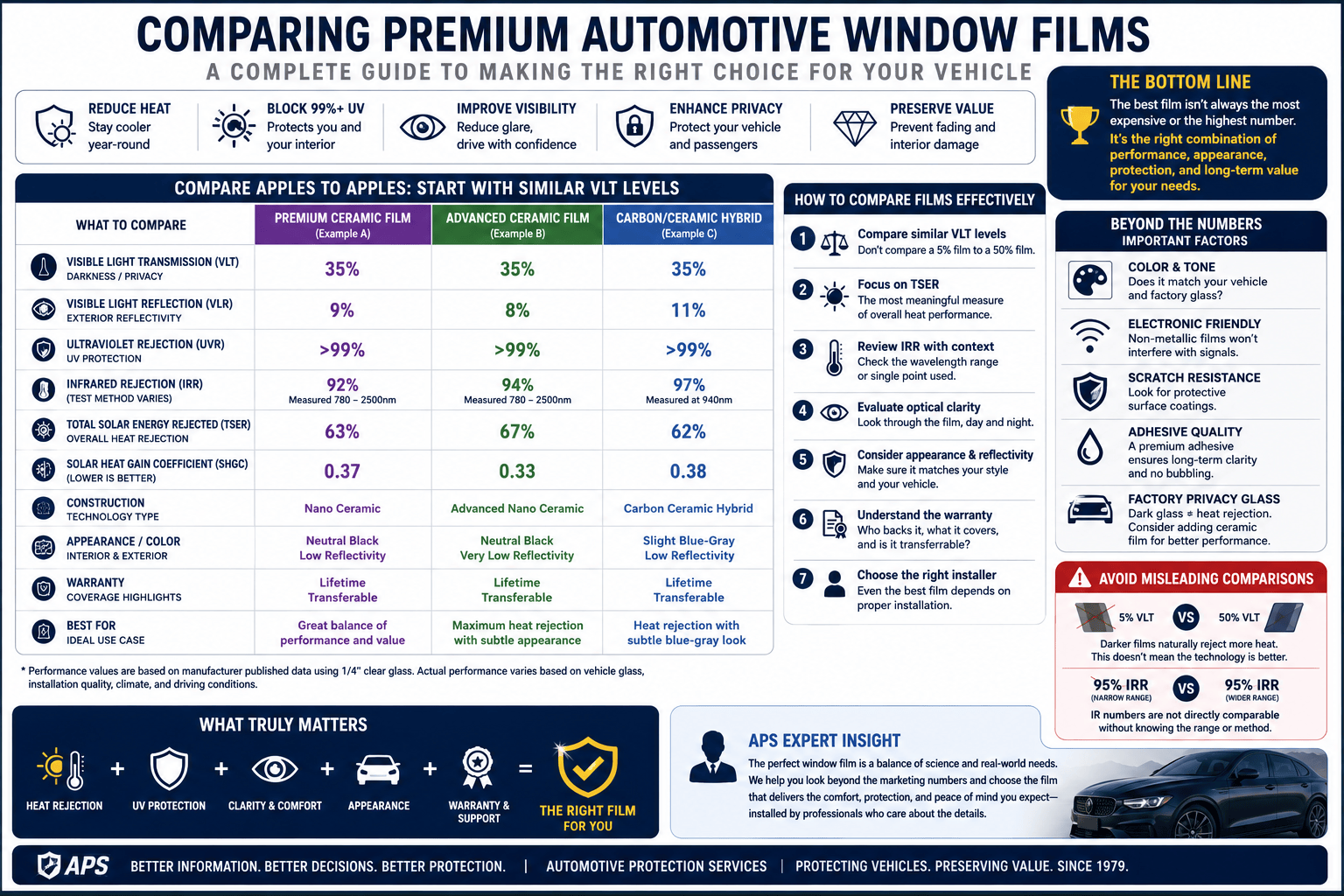
Infographic explaining how to compare premium automotive window films using similar VLT levels, TSER, infrared testing methods, optical clarity, appearance, warranty coverage, construction, and installer quality.
Premium window films should be compared at similar VLT levels and evaluated as complete systems. Heat rejection matters, but so do optical clarity, appearance, UV protection, construction, warranty support, and installation quality.

Premium Does Not Mean the Same Thing to Every Driver

One customer may define premium as the greatest available heat rejection. Another may prioritize nighttime visibility, a factory-matched appearance, low reflectivity, a transferable warranty, or a more moderate price.

The best film is not necessarily the product with the highest number or the highest price. It is the product that delivers the right combination of performance, appearance, visibility, protection, warranty coverage, and long-term value for the specific owner and vehicle.

Begin With the Driver’s Objective

Before comparing brands or specification sheets, determine what the window film is expected to accomplish.

Common priorities include:

  • Reducing cabin heat during summer driving.
  • Improving comfort for children, pets, and rear-seat passengers.
  • Reducing glare during daytime driving.
  • Maintaining strong nighttime visibility.
  • Protecting leather, plastics, fabrics, and interior trim from UV exposure.
  • Matching factory privacy glass on a truck or SUV.
  • Creating a darker and more private appearance.
  • Preserving a subtle, nearly factory-original appearance.
  • Improving comfort without selecting a very dark shade.
  • Obtaining strong warranty protection for long-term ownership.

A customer who wants maximum privacy may choose differently from someone who regularly drives at night. A truck owner trying to match rear privacy glass may require a different solution than a luxury-vehicle owner seeking nearly invisible heat protection.

Product comparisons become far more useful once the intended outcome is clearly defined.

Compare Similar Visible Light Transmission Levels

The first rule of responsible window-film comparison is to place products with similar Visible Light Transmission values next to one another.

A 5% film will generally reject more solar energy than a 50% film partly because it blocks substantially more visible light. Comparing those products does not reveal which underlying film technology is more effective.

A more meaningful comparison would place:

  • A 30% ceramic film beside another product in approximately the 30% to 35% range.
  • A 50% light ceramic film beside competing products near 50% VLT.
  • A dark privacy film beside other films offering a similar installed appearance.

Once the shades are reasonably similar, differences in TSER, reflectivity, optical clarity, warranty protection, construction, and price become much more informative.

A Darker Film Can Create a Misleading Advantage

A manufacturer or installer may place a darker film beside a lighter competing product and emphasize the darker film’s stronger heat-rejection number.

The comparison may be factually accurate, but it does not isolate the quality of the technology because the products transmit different amounts of visible light.

Always compare films at similar VLT levels whenever possible.

Evaluate Total Solar Energy Rejected

As explained in the previous chapter, Total Solar Energy Rejected provides one of the most useful starting points for comparing overall solar-heat performance.

TSER accounts for the combined effects of ultraviolet, visible, and infrared solar energy within the complete glass-and-film system. When two products have similar VLT values, the film with the stronger TSER generally offers greater overall solar-energy rejection under the stated test conditions.

TSER should still be considered alongside:

  • The test glass used to produce the published data.
  • The visible-light transmission of the product.
  • The film’s visible-light reflection.
  • The vehicle’s original glass.
  • Optical clarity and appearance.
  • The owner’s driving conditions and expectations.

TSER is a powerful comparison tool, but it is not the only consideration.

Review Infrared Rejection With Context

Infrared rejection remains useful when the manufacturer clearly identifies how the figure was measured.

When reviewing IRR, ask:

  • Was the value measured at one specific wavelength?
  • Was it measured across a stated wavelength range?
  • How broad was that range?
  • Was the measurement produced on clear test glass or another glass type?
  • Is the testing method identified in the specification sheet?

A high IRR percentage can support an excellent product, but it should not be treated as an independent ranking system without this context.

Consider Optical Clarity

Window film becomes part of the driver’s field of vision. Optical quality is therefore not a secondary luxury—it is a core performance characteristic.

A premium film should provide a clean and natural view through the glass with minimal:

  • Haze.
  • Milky or cloudy appearance.
  • Color distortion.
  • Nighttime light scatter.
  • Internal reflection.
  • Optical distortion.
  • Unwanted texture or visual grain.

Optical clarity becomes especially important on front side windows, windshields, vehicles driven frequently at night, and vehicles with large or steeply angled glass.

Strong heat-rejection numbers provide little comfort if the owner dislikes looking through the installed film every day.

Specification Sheets Cannot Fully Describe the View Through a Film

Many qualities drivers notice most—clarity, color tone, reflectivity, nighttime appearance, and visual comfort—are difficult to communicate through a single percentage.

Reviewing physical film samples and completed vehicles can be just as important as reviewing laboratory data.

Compare Color and Exterior Appearance

Window films can differ in color even when their VLT values are similar. Depending on the product, the installed appearance may lean toward:

  • Neutral black.
  • Charcoal.
  • Blue-gray.
  • Bronze.
  • Green.
  • A slightly reflective or metallic finish.

Color becomes especially important when matching film to existing factory privacy glass. A technically strong film that appears noticeably different from the rear glass may not satisfy the owner’s aesthetic expectations.

Premium film selection should therefore consider both the exterior appearance of the vehicle and the color seen from inside the cabin.

Evaluate Visible Light Reflection

Visible Light Reflection affects how mirrored or reflective the vehicle appears from outside.

Higher reflectivity may contribute to solar-energy management, but it can also:

  • Create a more metallic appearance.
  • Make it difficult to match factory privacy glass.
  • Conflict with the owner’s aesthetic preferences.
  • Become subject to legal restrictions.

Many modern premium ceramic films are designed to provide strong performance with relatively low reflectivity, preserving a deep and factory-like appearance.

Review the Full Product Line—not Only the Flagship Film

Manufacturers often draw the greatest attention to their highest-performing and most expensive ceramic product. That product may be excellent, but not every customer needs the flagship option.

A complete product family may include:

  • A color-stable dyed film.
  • A standard ceramic film.
  • A premium or advanced ceramic film.
  • A high-light-transmission ceramic product for subtle applications.
  • Specialized products for windshields, sunroofs, or panoramic glass.

A strong manufacturer and installer relationship should allow customers to select an appropriate performance level rather than forcing every buyer into the most expensive product.

Understand the Warranty

Most premium automotive window films include some form of lifetime warranty, but the words lifetime warranty do not always describe identical coverage.

Consumers should ask:

  • Who issues the warranty—the installer, distributor, or manufacturer?
  • Is the warranty valid nationwide?
  • Is it transferable to a future owner?
  • Does it cover bubbling, peeling, cracking, adhesive failure, fading, and color change?
  • Does it cover removal and replacement labor?
  • Does it include accidental damage or no-fault coverage?
  • What documentation must the customer retain?
  • Can another authorized dealer perform warranty service?
  • What limitations and exclusions apply?

The practical value of a warranty depends not only on the language in the brochure, but also on the strength of the company and dealer network standing behind it.

A Warranty Is Only as Useful as the Support Behind It

Broad written coverage may look reassuring, but customers should also consider whether the manufacturer, distributor, and installer have a stable history and a clear process for resolving claims.

A trusted local installer who remains available after the sale is often one of the most valuable parts of warranty protection.

Ask Who Manufactures and Controls the Product

Automotive window-film brands operate under several business models. Some manufacture film within facilities they own. Others develop product specifications and rely on specialized contract manufacturers. Some distribute films manufactured by third parties, while others combine several approaches.

Outsourced manufacturing does not automatically mean a product is inferior. Many respected companies rely on contract manufacturing while maintaining detailed specifications, quality-assurance procedures, supply agreements, and warranty standards.

The more useful questions are:

  • Does the brand control the product specification?
  • Is the product manufactured consistently over time?
  • Is performance data clearly documented?
  • Does the company conduct meaningful quality assurance?
  • Is the warranty supported reliably?
  • Will compatible replacement material remain available if a claim occurs years later?

Factory ownership is one business characteristic. It should not replace an evaluation of actual product performance, quality control, consistency, and support.

Consider the Dealer and Distribution Model

Premium film brands may be sold through:

  • Exclusive geographic territories.
  • Open dealer networks.
  • Manufacturer-owned retail locations.
  • Franchise systems.
  • Independent authorized installers.
  • Direct-to-consumer or loosely controlled distribution.

The distribution model can influence:

  • Product availability.
  • Installer training.
  • Territory protection.
  • Pricing consistency.
  • Warranty administration.
  • The customer’s ability to obtain service after moving or while traveling.

A recognizable brand may provide a broad dealer network, while a protected independent-dealer model may provide stronger local accountability and reduce competition from manufacturer-owned stores.

Neither approach automatically produces a better installation. The business model should be evaluated alongside product quality and installer capability.

Examine Scratch Resistance and Surface Durability

Automotive window film is installed on the interior surface of the glass, where it may be exposed to cleaning, contact with seat belts, cargo, pets, children, and everyday use.

Quality products include a scratch-resistant surface coating intended to protect the film during normal maintenance. However, scratch-resistant does not mean scratch-proof.

Consumers should ask:

  • Does the product include a documented scratch-resistant coating?
  • Which cleaning products and tools are approved?
  • Does the warranty cover coating or surface failure?
  • What care instructions does the installer provide?

Film durability depends on both the product and the way it is maintained after installation.

Do Not Overlook Adhesive Quality

The adhesive layer is one of the least visible yet most important parts of automotive window film.

A quality adhesive must:

  • Bond consistently to automotive glass.
  • Remain optically clear.
  • Resist bubbling and delamination.
  • Tolerate repeated temperature changes.
  • Conform to curved glass.
  • Remain stable over years of exposure.

Consumers rarely see adhesive specifications in marketing brochures, but premature adhesive failure can ruin an otherwise attractive installation.

Product history, manufacturer reputation, warranty coverage, and installer experience all provide useful evidence of long-term adhesive performance.

Consider Electronic Compatibility

Modern vehicles rely on a wide range of electronic and radio-frequency systems, including:

  • Cellular connectivity.
  • GPS navigation.
  • Bluetooth.
  • Satellite radio.
  • Toll transponders.
  • Integrated antennas.
  • Keyless-entry and security systems.

Non-metallic dyed and ceramic films are generally selected when avoiding signal interference is a priority. Films containing metallic components may require more careful consideration depending on the product and vehicle.

Compatibility concerns should be discussed with an installer familiar with the specific vehicle.

Account for Factory Privacy Glass

Trucks and SUVs frequently include dark factory privacy glass on the rear doors and cargo area. This creates two separate decisions:

  1. Appearance: Which front-door film will create the closest visual match to the factory rear glass?
  2. Performance: Should ceramic film also be applied over the rear privacy glass to improve UV and solar-energy rejection?

Factory privacy glass primarily reduces visible-light transmission. Its dark appearance does not automatically provide the same heat-management performance as quality ceramic film.

A complete truck or SUV solution may therefore use one shade on the front doors and a lighter performance film over the already-dark rear glass.

Matching the Shade Is Not the Same as Matching the Performance

Front windows may be tinted to visually match factory rear glass, but the front film and untreated rear glass may still provide very different levels of heat and UV protection.

Customers seeking consistent performance throughout the cabin should consider the entire glass area, not only the appearance of the front windows.

Evaluate the Installed Price—not Only the Film Price

Automotive window film is not simply a product handed to the customer. The finished result combines the material, installation environment, preparation, pattern accuracy, technician skill, vehicle complexity, warranty, and post-installation support.

A lower price may reflect:

  • A more basic product.
  • Reduced preparation time.
  • Less experienced labor.
  • A less controlled installation environment.
  • Limited warranty support.
  • A promotional price that changes after arrival.

A higher price may reflect:

  • Premium material.
  • Greater installation time and preparation.
  • Experienced technicians.
  • A clean and controlled tinting environment.
  • Complex vehicle disassembly or glass configuration.
  • Stronger warranty protection.
  • Long-term customer support.

Price should always be evaluated in the context of what is included.

A Practical Premium-Film Comparison Framework

APS recommends comparing competing products using the following categories:

Category Questions to Ask Why It Matters
VLT Are the products being compared at similar shades? Creates a fairer comparison of the underlying technologies.
TSER How much total solar energy is rejected? Provides a broad measure of overall solar-heat performance.
IRR What wavelength or range was used? Prevents misleading comparisons between different testing methods.
Optical Quality Is the view clear during daylight and nighttime driving? The driver looks through the film every day.
Appearance Does the color and reflectivity complement the vehicle? The installed film becomes part of the vehicle’s appearance.
UV Protection Does the film block greater than 99% of ultraviolet radiation? Helps protect occupants and interior materials.
Construction Is it dyed, metalized, ceramic, hybrid, or advanced ceramic? Influences heat performance, signal compatibility, clarity, appearance, and price.
Warranty Who supports it, what is covered, and is it transferable? Determines the practical value of long-term protection.
Installer What experience, environment, preparation, and support are provided? The installation determines whether the film performs and appears as intended.
Price Which product, preparation, warranty, and services are included? The lowest quote may not provide the strongest long-term value.

There Is No Universal “Best Window Film”

A film that is ideal for one driver may be inappropriate for another.

The driver who wants maximum heat rejection, the driver who prioritizes nighttime visibility, the truck owner matching factory privacy glass, and the customer seeking an affordable appearance upgrade may all reasonably choose different products.

The purpose of a knowledgeable installer is not to force every customer into one product. It is to explain the differences clearly and recommend the appropriate solution.

APS Expert Insight

Customers often arrive asking for a particular brand because it was recommended by a friend, an online forum, a video, a search engine, or an AI platform. Brand recognition can be a useful starting point, but it should not end the conversation.

We encourage customers to compare complete specification tables, view physical samples, consider their driving habits, understand the warranty, and evaluate the installer who will stand behind the work.

A well-known logo cannot compensate for the wrong shade, poor visibility, careless installation, weak support, or a product that does not match the owner’s priorities.

Key Takeaway

Premium automotive window films should be compared as complete systems rather than ranked by one percentage, one technology label, or one brand name.

Begin by identifying the driver’s goals. Compare films at similar VLT levels. Review TSER, infrared testing methodology, optical clarity, color, reflectivity, warranty coverage, construction, electronic compatibility, and price. Then evaluate the installer responsible for turning the film into a finished result.

The best automotive window film is the product that provides the right balance of comfort, appearance, visibility, performance, protection, and long-term value for the specific vehicle owner.

```
```

How to Choose the Right Window Tint Installer

Why installation quality matters as much as the film itself—and what to look for before trusting a shop with your vehicle.

Premium automotive window film is only one part of a successful installation. The final result also depends on the installer’s experience, preparation process, working environment, equipment, pattern accuracy, attention to detail, and willingness to support the customer after the work is complete.

Even an exceptional film can produce disappointing results when it is installed carelessly. Dust contamination, light gaps, lifting edges, creases, trapped debris, damaged trim, scratched glass, poor pattern fit, or incomplete preparation can undermine the appearance and longevity of the finished installation.

By contrast, a skilled installer can help a well-selected film perform and appear as intended for many years.

Choosing a window tint installer should therefore involve more than comparing prices or asking which film brand the shop carries. Consumers should evaluate the complete installation process and the business standing behind the work.

The Film and the Installation Become One Finished Product

Customers do not experience window film as a roll of material or a specification sheet. They experience the finished installation every time they enter the vehicle, look through the glass, roll down a window, drive at night, or return for warranty support.

The film may come from the manufacturer, but the installer creates the result.

Look for Automotive Window Tint Experience

Automotive glass presents challenges that differ from residential or commercial window-film installation. Vehicle glass may be curved, steeply angled, frameless, tightly fitted into door panels, surrounded by delicate trim, or integrated with antennas, cameras, sensors, defroster elements, and electronic components.

An experienced automotive installer should understand:

  • How to heat-shrink film to curved rear windows.
  • How to work around defroster lines and embedded antennas.
  • How to tint frameless windows that move when the door opens.
  • How to protect door panels, electronics, speakers, and switches from moisture.
  • How to handle vehicles with tight seals and complex trim.
  • How to work around cameras, sensors, inspection stickers, and windshield-mounted equipment.
  • How different vehicle glass types affect installation and final VLT.

General experience matters, but experience with the specific vehicle type can be especially valuable when working on luxury vehicles, sports cars, EVs, trucks, SUVs, and vehicles with unusually complex glass.

Ask How Many Vehicles the Shop Tints

The number of vehicles completed does not automatically prove quality, but it provides useful context about the installer’s experience and repetition.

A shop that regularly performs automotive tinting is more likely to have established procedures for:

  • Vehicle intake and inspection.
  • Interior protection.
  • Glass cleaning and preparation.
  • Pattern selection and cutting.
  • Film shrinking and installation.
  • Quality control.
  • Aftercare and warranty documentation.

Consumers should feel comfortable asking how long the shop has installed automotive window film, how many technicians perform the work, and whether those technicians specialize in tinting or divide their time among unrelated services.

Evaluate the Installation Environment

Window film is installed using water and requires an exceptionally clean working environment. Dust, pollen, hair, fibers, dirt, and airborne debris can become trapped between the film and the glass.

No automotive tint installation is completed in a laboratory clean room, and a small amount of minor contamination may occasionally be visible under close inspection. However, the shop should actively control the environment and take reasonable steps to minimize debris.

A professional tinting area should ideally be:

  • Indoors and protected from wind.
  • Separate from grinding, sanding, bodywork, or other dust-producing activity.
  • Clean and regularly maintained.
  • Well lit so technicians can identify contamination and installation defects.
  • Large enough to work safely around the vehicle.
  • Protected from unnecessary foot traffic during installation.

A dusty, cluttered, or uncontrolled work area increases the likelihood of contamination and makes consistent quality more difficult to achieve.

Be Cautious With Outdoor or Open-Bay Installation

Automotive window film can technically be installed in many environments, but wind, pollen, insects, dust, changing temperatures, and uncontrolled airflow increase the risk of contamination.

A controlled indoor environment does not guarantee perfection, but it gives the installer a much better opportunity to produce a clean and consistent result.

Understand the Preparation Process

Much of the work involved in a high-quality tint installation occurs before the film touches the glass.

Proper preparation may include:

  • Inspecting the glass for scratches, chips, damage, adhesive residue, or previous film.
  • Inspecting trim, seals, door panels, switches, and interior surfaces.
  • Protecting sensitive areas from water.
  • Removing dirt and debris from the glass edges and seals.
  • Thoroughly cleaning the glass with appropriate tools and solutions.
  • Removing old film and adhesive when necessary.
  • Confirming the selected film and shade before installation begins.
  • Reviewing factory privacy glass and expected installed VLT.

Preparation takes time. A quote that is dramatically lower than competing shops may reflect less time devoted to cleaning, inspection, protection, and final quality control.

Clean Glass Is Not the Same as Prepared Glass

Glass can look clean while still holding fine contamination near the edges, inside seals, around defroster lines, or in areas exposed during installation.

Professional preparation is intended to clean not only the visible center of the glass, but also the areas most likely to release debris beneath the film.

Ask Whether Patterns Are Computer Cut

Many professional installers use plotters and vehicle-specific software to cut window-film patterns before the film is applied to the glass.

Computer-cut patterns can provide several advantages:

  • Consistent pattern dimensions.
  • Reduced need to cut directly against the vehicle’s glass.
  • Lower risk of scoring glass, seals, or trim with a blade.
  • Repeatability across similar vehicles.
  • Efficient material use.

Computer cutting does not automatically guarantee a perfect fit. Technicians may still need to adjust, extend, shave, or hand-finish patterns depending on the vehicle and desired edge coverage.

Experienced hand cutting can also produce excellent results when performed by a skilled technician. The important issue is whether the installer uses safe, controlled methods and understands how to avoid damaging the vehicle.

Computer Cut Does Not Mean Technician Free

Software produces a pattern, but the technician still determines how the glass is prepared, how the film is handled, how it is positioned, how edges are finished, and whether the installation passes final inspection.

Technology supports craftsmanship; it does not replace it.

Examine Edge Quality and Pattern Fit

A professionally installed film should fit the window closely and consistently without leaving distracting gaps or extending into areas that cause lifting and damage.

Edge quality may vary depending on:

  • Whether the window is framed or frameless.
  • The shape and movement of the glass.
  • The depth and condition of the window seals.
  • The manufacturer’s pattern.
  • The film’s thickness and construction.
  • The installer’s preferred finishing method.

Small clear borders may be necessary on some windows to prevent the film from contacting seals and lifting. On other vehicles, an experienced installer may be able to provide a closely shaved or micro-edged finish.

The goal is not to force every vehicle into one visual standard. It is to produce an edge that is clean, even, durable, and appropriate for the glass design.

Ask How the Vehicle Interior Is Protected

Automotive tint installation uses a slip solution that allows the film to be positioned on the glass. Professional installers should take precautions to control that moisture and protect the vehicle.

Protection may include:

  • Covering door panels and dashboards.
  • Using absorbent ropes, towels, or protective barriers near electronics.
  • Controlling solution near switches, speakers, control modules, and trim.
  • Protecting leather, fabric, wood, piano-black trim, and sensitive surfaces.
  • Using appropriate tools around delicate seals and panels.

Modern vehicles contain far more electronics inside doors, dashboards, mirrors, pillars, and headliners than older vehicles. Careful moisture management is an essential part of professional installation.

Review Examples of Completed Work

A reputable installer should be able to show photographs or examples of completed vehicles.

When reviewing previous work, look for:

  • Clean and consistent edge alignment.
  • Minimal visible contamination.
  • No obvious fingers, creases, or trapped air.
  • Film that complements the vehicle’s appearance.
  • Consistent shade from one window to another.
  • Experience with vehicles similar to yours.

Social-media images can be helpful, but they often show vehicles from a distance. Close-up photographs, customer reviews, and in-person examples provide a better understanding of workmanship.

Read Reviews for Installation-Specific Feedback

Overall star ratings provide useful context, but the most valuable reviews often describe what happened before, during, and after the installation.

Look for comments about:

  • Cleanliness of the finished work.
  • How clearly film options were explained.
  • Whether pricing matched the original quote.
  • How the shop handled questions or concerns.
  • Whether the vehicle was returned clean and undamaged.
  • How warranty issues were resolved.
  • Long-term film performance.

An installer’s response to a problem may be more revealing than a flawless review history. Even good shops occasionally encounter a defect, contamination issue, material problem, or customer concern. The important question is whether the business responds professionally and makes reasonable efforts to correct the issue.

Perfect Reviews Are Less Important Than Responsible Support

Window film is a hand-installed product. A strong shop should be judged not only by how often problems occur, but also by how it responds when a legitimate concern is raised.

Confirm the Film Brand and Product Line in Writing

A reputable installer should clearly identify the brand, product line, and shade being installed.

Before approving the work, confirm:

  • The film manufacturer or brand.
  • The exact product line.
  • The selected VLT or shade.
  • Which windows are included.
  • Whether old film removal is included.
  • Whether the windshield strip or full windshield is included.
  • The warranty terms.
  • The total installed price.

Vague descriptions such as “ceramic tint” do not identify the exact product. Different ceramic films from the same company may have substantially different specifications, prices, and warranty provisions.

“Ceramic” Is Not a Complete Product Description

A shop should be able to tell you exactly which ceramic film it installs and provide supporting specifications or manufacturer documentation.

If the installer cannot identify the product line, explain the performance data, or provide warranty information, the customer has little basis for comparing the offer.

Understand the Quote Before Scheduling

Window-tint quotes may differ because they include different products, windows, preparation, removal work, warranties, and installation standards.

Ask whether the quoted price includes:

  • All side and rear windows.
  • Small quarter windows.
  • The windshield strip.
  • A full windshield installation.
  • Removal of existing film.
  • Adhesive removal.
  • Sales tax.
  • Vehicle-specific surcharges.
  • Warranty registration.

A low advertised price may apply only to a small vehicle, an entry-level product, or a limited number of windows. The customer should understand the complete installed price before arriving.

Ask About the Warranty Process

A warranty should be more than a sentence printed on an invoice.

Ask the installer:

  • Who administers the warranty?
  • What failures are covered?
  • Is labor included?
  • Is the warranty nationwide?
  • Is it transferable?
  • Is accidental or no-fault coverage included?
  • What records must the customer retain?
  • Can another authorized dealer perform the repair?
  • How are installation concerns handled during the curing period?

The installer should provide clear documentation and explain what the customer should do if a concern develops.

Understand the Curing Process

Automotive window film does not look fully cured immediately after installation. Moisture remains between the film and glass while the adhesive begins bonding.

During curing, customers may notice:

  • A slightly hazy or cloudy appearance.
  • Small water pockets.
  • Temporary distortion.
  • Moisture patterns that change as the film dries.

Drying time varies based on film type, temperature, humidity, sunlight, glass construction, and season. Some installations may begin clearing within days, while complete curing can take longer.

A professional installer should explain what is normal, how long the windows should remain closed, and when the customer should return if a concern does not improve.

Do Not Judge Freshly Installed Film Too Quickly

Temporary moisture and haze are not the same as permanent contamination, bubbles, or adhesive failure.

Customers should follow the installer’s curing instructions and allow sufficient drying time before deciding whether the installation has a defect.

Consider the Shop’s Long-Term Stability

A lifetime warranty is more valuable when the installer has a stable history and intends to remain available for future support.

Consider:

  • How long the business has operated.
  • Whether it has a permanent commercial location.
  • Whether the shop provides written invoices and warranty records.
  • Whether the business has established contact information.
  • Whether it maintains a consistent reputation over time.
  • Whether customers can return for inspection or service.

Mobile and newer businesses can produce excellent work, but customers should understand who will provide support if a problem occurs several years later.

Questions to Ask Before Choosing an Installer

Question What a Strong Answer Should Include
Which film will you install? A specific manufacturer, product line, shade, specification sheet, and warranty.
Where is the installation performed? A clean, controlled indoor environment protected from dust, wind, and unrelated work.
How are patterns cut? A clear explanation of plotter-cut or safe hand-cutting procedures.
How is the interior protected? Specific moisture-control and surface-protection procedures.
What does the warranty cover? Written details regarding film failure, labor, transferability, and claim handling.
How long should the film cure? Realistic expectations based on season, climate, and film type.
What happens if I see a problem? A defined inspection and correction process rather than dismissal or vague promises.
Have you tinted this vehicle before? Relevant experience or a thoughtful explanation of how the vehicle will be handled.
Is the quote complete? A written description of windows, removal work, product, taxes, warranty, and final price.

Warning Signs of a Poor Window Tint Shop

  • The shop will not identify the film brand or product line.
  • The price changes significantly after the vehicle arrives without a clear reason.
  • No written warranty or invoice is provided.
  • The installer cannot explain differences between film options.
  • The installation area is exposed to heavy dust, wind, or unrelated fabrication work.
  • The shop promises that fresh film will look perfect immediately.
  • The installer guarantees exact cabin-temperature reductions.
  • The shop relies entirely on one headline IR percentage.
  • Reviews repeatedly mention contamination, peeling, scratched glass, damaged trim, or unresolved concerns.
  • The customer is pressured into an upgrade without a clear explanation of its value.

APS Expert Insight

Customers often spend most of their research time comparing film brands and very little time evaluating the installer. In practice, the installer is responsible for inspecting the vehicle, protecting the interior, preparing the glass, selecting and fitting the patterns, managing contamination, finishing the edges, inspecting the completed work, and supporting the customer afterward.

Film quality matters. Installation quality determines whether the customer receives the benefit of that film.

Key Takeaway

Choosing the right window tint installer is just as important as choosing the right film. Look for automotive experience, a clean installation environment, thorough preparation, safe pattern-cutting practices, interior protection, clear product identification, written warranty coverage, complete pricing, strong reviews, and a defined process for resolving concerns.

A premium brand cannot compensate for careless workmanship. The strongest result comes from combining a well-selected film with an experienced installer who takes responsibility for the finished product.

```
```html

Understanding Virginia Window Tint Laws

Understanding Virginia's tint laws helps you choose a window film that provides the appearance and performance you want while remaining compliant with current state regulations.

One of the most common questions customers ask is, "How dark can I legally tint my windows?"

The answer depends on several factors, including which window is being tinted, the type of vehicle you drive, the factory glass already installed by the manufacturer, and Virginia's Visible Light Transmission (VLT) requirements.

Understanding these rules before selecting a film helps prevent unexpected inspection issues, unnecessary expense, or having to remove and replace otherwise excellent window film.

While this guide summarizes the current Virginia regulations, automotive window-tint laws can change. If you have questions about a unique vehicle, medical exemption, or special application, discuss your options with a qualified installer before making your final decision.

Virginia automotive window tint regulations showing legal tint limits for windshield, front side windows, rear side windows and rear window.
Virginia regulates different areas of the vehicle separately. Always consider the complete glass-and-film combination rather than the film specification alone.

Know the Difference Between Film VLT and Installed VLT

This is one of the biggest sources of confusion.

Window film has its own Visible Light Transmission rating, but Virginia law applies to the completed glass-and-film system, not simply the film by itself.

Virginia Passenger Vehicle Requirements

Window Virginia Requirement
Windshield No aftermarket film below the manufacturer's AS-1 line unless specifically permitted by law.
Front Side Windows Minimum 50% Visible Light Transmission.
Rear Side Windows Minimum 35% Visible Light Transmission.
Rear Window Minimum 35% Visible Light Transmission.
Reflectivity Maximum 20% reflectance.

Virginia also prohibits films that create a holographic or prism effect.

Trucks and SUVs Are Different

Multipurpose passenger vehicles—including many SUVs, crossovers, vans, and pickup trucks—are treated differently under Virginia law.

While the front side windows remain subject to the same 50% VLT requirement, the rear side windows and rear glass generally have greater flexibility than passenger cars, provided the vehicle complies with the applicable requirements and is equipped with proper exterior mirrors.

This is one reason truck owners often choose to match the appearance of their factory privacy glass while still adding ceramic performance to improve heat rejection.

Factory Glass Already Reduces Light

Many customers assume that installing 50% window film automatically results in a legal 50% window.

In reality, factory automotive glass already blocks a portion of visible light before any film is applied.

Because the film and the factory glass work together, the finished window almost always measures darker than the film's advertised specification.

That is why professional installers evaluate the complete glass-and-film combination instead of relying solely on the film manufacturer's VLT number.

Film Percentage Does Not Equal Final Window Percentage

A film labeled "50%" does not necessarily produce a completed window measuring 50% Visible Light Transmission.

The finished measurement depends on the original factory glass and the film installed on it.

Medical Exemptions

Virginia provides a process through which qualifying drivers with certain medical conditions may obtain authorization for window tint that would otherwise exceed the standard limits.

These exemptions are administered through the Commonwealth and require appropriate documentation. Customers who believe they may qualify should review the current requirements before scheduling installation.

What APS Recommends

Our goal is not simply to install darker window film.

Our goal is to help customers choose a film that balances appearance, comfort, visibility, heat rejection, UV protection, and legal compliance.

Every vehicle is different. Factory glass varies, customer priorities vary, and different film technologies perform differently even when they appear similar from outside.

Taking a few extra minutes to discuss those variables before installation is far easier than replacing film later because expectations were never properly established.

Important Disclaimer

This guide is intended for educational purposes and reflects our understanding of Virginia window-tint regulations at the time of publication. Laws and administrative requirements may change. Customers remain responsible for ensuring their vehicles comply with all applicable federal, state, and local laws. When questions arise, APS recommends consulting the current Virginia Code or discussing your specific vehicle with a qualified installer before installation.

APS Expert Insight

One of the most common misconceptions we encounter is that selecting a film with a particular VLT automatically guarantees a legal result. In reality, factory glass already filters light, and the final measurement depends on the combination of the original glass and the installed film. That's why we discuss the entire vehicle—not just the film specification—before recommending a solution.

Key Takeaway

Virginia regulates the completed window—not simply the film you purchase. Understanding VLT, factory glass, reflectivity limits, vehicle classifications, and the applicable legal requirements helps ensure you select a window film that delivers the performance you want while remaining appropriate for your vehicle.

```
```

Caring for Automotive Window Film

What to expect after installation, how the curing process works, and how to protect the appearance and performance of your window film for years to come.

Professionally installed automotive window film requires relatively little maintenance, but the first several days after installation are important.

The film is applied using a liquid installation solution that allows the technician to position it accurately and remove excess air. Although most of that solution is removed during installation, a small amount of moisture may remain between the film and the glass while the adhesive begins to cure.

During this period, the film may not appear completely clear or fully bonded. Temporary haze, moisture pockets, or slight visual distortion can be normal and usually improve as the film dries.

Following the installer’s aftercare instructions helps protect the film, reduces the likelihood of accidental damage, and allows the adhesive to establish a strong long-term bond.

Freshly Installed Film Is Not Fully Cured Film

A window tint installation may be complete before the film has completely dried.

The film should be allowed to cure naturally before it is cleaned aggressively, exposed to unnecessary contact, or subjected to repeated window movement.

Keep the Windows Closed After Installation

Customers are commonly instructed to keep roll-down windows closed for a period after installation. The exact recommendation may vary based on the film, adhesive, vehicle, temperature, humidity, and season.

Rolling the glass down too soon can cause the upper edge of the film to contact the window seal before the adhesive has fully bonded. This may result in:

  • Lifting along the top edge.
  • Peeling.
  • Wrinkling.
  • Creases.
  • Damage that requires reinstallation.

Follow the time period provided by your installer rather than assuming one universal rule applies to every installation.

Avoid Operating the Windows Too Soon

Even when the film appears dry, the adhesive near the edges may still be curing.

Waiting the recommended period is far easier than replacing film that has been damaged by premature window operation.

Understand the Curing Process

Window film cures as moisture gradually escapes and the adhesive bonds more completely to the glass.

Curing time varies according to:

  • Film construction and adhesive type.
  • Outdoor temperature.
  • Humidity.
  • Sunlight exposure.
  • Glass thickness and construction.
  • Window size and curvature.
  • The amount of installation solution remaining.
  • The time of year.

Warm, dry weather often allows film to cure more quickly. Cool temperatures, high humidity, limited sunlight, and winter conditions may extend the drying period.

Rear windows and large glass panels can sometimes require more time because of their size, curvature, and the amount of moisture involved during installation.

Curing Time Is Not the Same as Warranty Time

Temporary moisture, haze, and visual variation during the curing period do not automatically indicate a defect.

A legitimate concern should be evaluated after the film has had sufficient time to dry, unless the issue involves obvious lifting, tearing, severe creasing, or another condition that should be inspected immediately.

What Can Be Normal After Installation

During the curing process, customers may temporarily notice:

  • A slightly cloudy or hazy appearance.
  • Small water pockets.
  • Temporary optical distortion.
  • Moisture patterns that change over time.
  • Small areas that appear lighter or darker while drying.
  • Minor edge moisture.

These conditions should gradually diminish as moisture evaporates and the adhesive clears.

Avoid pressing on water pockets, attempting to push moisture out manually, or using tools against the film. Doing so can damage the surface or disturb the adhesive.

What Is Not Normal

Some conditions are less likely to resolve through normal curing and should be brought to the installer’s attention.

These may include:

  • Film peeling away from the glass.
  • Edges that continue lifting after the recommended curing period.
  • Large air bubbles that do not change or diminish.
  • Permanent creases or fingers.
  • Visible tears or punctures.
  • Severe contamination that interferes with visibility or appearance.
  • Film separating from the adhesive.
  • Unexpected discoloration.
  • Damage to defroster lines, trim, seals, or glass.

If a concern develops, contact the installer before attempting a repair. Self-repair efforts may worsen the problem or affect warranty coverage.

When in Doubt, Let the Installer Inspect It

Photographs can be useful, but some conditions are difficult to diagnose without seeing the vehicle in person.

A professional installer should be willing to inspect a legitimate concern and explain whether the film is still curing, requires additional time, or needs correction.

When to Clean Newly Installed Window Film

Do not clean the inside surface of newly tinted glass until the installer’s recommended waiting period has passed.

Cleaning too soon can disturb the curing adhesive, introduce pressure near the edges, or scratch a film surface that has not yet fully settled.

Once the film is ready to be cleaned, use gentle products and techniques intended for automotive window film.

Use an Ammonia-Free Glass Cleaner

Ammonia-based cleaners have historically been associated with damage to some automotive window films, especially older dyed products. They may contribute to discoloration, adhesive deterioration, or premature aging.

Choose a cleaner clearly labeled as:

  • Ammonia free.
  • Safe for tinted windows.
  • Safe for automotive window film.

A mild soap-and-water solution may also be appropriate when recommended by the film manufacturer or installer.

Avoid assuming that every household glass cleaner is safe simply because it is designed for ordinary windows.

Use Soft Microfiber Towels

Clean the film with a clean, soft microfiber towel.

The towel should be free from:

  • Dirt and grit.
  • Metal particles.
  • Fabric-softener residue.
  • Hard seams or tags.
  • Contamination from wheels, paint, or exterior detailing work.

Use light pressure and avoid aggressively scrubbing the film.

A second dry microfiber towel can be used to remove remaining moisture and reduce streaking.

Avoid Abrasive Cleaning Tools

Do not use razor blades, abrasive pads, stiff brushes, scouring products, hard squeegees, or aggressive scraping tools on installed window film.

Scratch-resistant coatings improve durability during normal use, but they do not make the film scratch-proof.

Be Careful Around the Film Edges

The edges of automotive window film are vulnerable to repeated contact, especially on roll-down windows.

Avoid:

  • Picking at the film with fingernails.
  • Pulling stickers or adhesive items across the edge.
  • Using sharp tools near the top of the glass.
  • Allowing seat belts or cargo to strike exposed edges repeatedly.
  • Scraping residue from the film surface.

If an edge begins lifting, do not pull it. Contact the installer before the affected area becomes larger.

Use Caution With Stickers, Suction Cups, and Mounting Devices

Stickers, permits, suction cups, phone mounts, cameras, toll devices, and other accessories can place stress on window film.

Before attaching anything to tinted glass:

  • Make sure the film is fully cured.
  • Confirm that the adhesive or suction cup is appropriate for window film.
  • Avoid repeatedly removing and reinstalling the device.
  • Do not use blades or hard scrapers during removal.
  • Ask the installer before attaching an item to a newly tinted windshield.

Even when the film itself is durable, concentrated pressure or adhesive removal can damage the surface.

Protect Film From Seat Belts, Cargo, Pets, and Jewelry

Many window-film scratches are caused mechanically rather than by material failure.

Common sources of damage include:

  • Seat-belt buckles striking side glass.
  • Boxes, tools, and cargo rubbing against rear windows.
  • Dogs placing claws against the glass.
  • Rings, watches, bracelets, or metal objects touching the film.
  • Children using toys or hard objects near the windows.
  • Cleaning towels containing grit or debris.

Window film is designed for normal automotive use, but avoiding repeated contact with sharp or hard objects will help preserve its appearance.

Use Care During Winter

Automotive window film is installed on the inside surface of the glass, so ordinary exterior snow removal should not directly contact it. However, winter still creates several situations that deserve attention.

  • Do not use an interior scraper or blade against tinted glass.
  • Avoid striking the inside of the glass with a snow brush or tool.
  • Do not pick at film edges if a window seal freezes.
  • Allow frozen roll-down windows to thaw before operating them.
  • Follow the installer’s instructions regarding rear defroster use after installation.

Factory rear-window defrosters are generally compatible with professionally installed automotive film when the film and installation are appropriate for the application. The defroster lines themselves should never be scraped or cleaned aggressively.

Rear Defrosters and Embedded Antennas

Many rear windows include defroster lines, antennas, or other conductive elements bonded to the inside surface of the glass.

When cleaning these areas:

  • Use gentle pressure.
  • Wipe in the direction of the lines when practical.
  • Avoid scraping across the surface.
  • Do not use abrasive tools or aggressive chemicals.

Improper removal of old film can damage defroster lines. For that reason, existing tint should generally be removed by an experienced professional rather than peeled away without the appropriate process.

Do Not Attempt to Repair Damaged Film Yourself

Once automotive window film is cut, punctured, creased, deeply scratched, or separated from the adhesive, it usually cannot be restored through polishing or spot repair.

Home remedies involving heat guns, needles, blades, solvents, or aggressive pressure can:

  • Damage the film further.
  • Scratch the glass.
  • Damage defroster lines.
  • Harm interior trim.
  • Affect warranty coverage.

Contact the installer and allow the affected window to be evaluated properly.

How Long Should Automotive Window Film Last?

Quality automotive window film can provide many years of service when it is professionally installed, properly maintained, and supported by a reputable manufacturer and installer.

Longevity depends on:

  • Film quality and construction.
  • Adhesive quality.
  • Installation workmanship.
  • Climate and sun exposure.
  • Vehicle storage conditions.
  • Glass orientation and size.
  • Cleaning practices.
  • Mechanical contact and accidental damage.

Premium films commonly include lifetime warranty coverage against specified material failures, but warranty terms vary. A lifetime warranty does not mean the film is immune to scratches, misuse, accidental damage, or improper cleaning.

Warranty Coverage and Maintenance Are Different

A manufacturer warranty may cover defects such as bubbling, peeling, adhesive failure, fading, or color change under stated conditions.

It may not cover scratches, damage caused by sharp objects, improper cleaning, broken glass, accidental tearing, or unauthorized removal.

Review the written warranty and retain the required invoice, registration, and product information.

Automotive Window Film Care Checklist

Care Step Recommended Practice
After installation Keep roll-down windows closed for the period recommended by the installer.
During curing Allow temporary moisture, haze, and water pockets time to clear naturally.
First cleaning Wait until the installer confirms that the film is ready to be cleaned.
Cleaner Use an ammonia-free product labeled safe for tinted windows.
Towels Use clean and soft microfiber towels with light pressure.
Edges Avoid picking, scraping, or pulling at film edges.
Sharp objects Keep razor blades, abrasive pads, tools, jewelry, and hard cargo away from the film.
Winter use Allow frozen windows to thaw before rolling them down.
Defroster lines Clean gently and never scrape across embedded components.
Concerns Contact the installer before attempting any repair or removal.

APS Expert Insight

Most long-term care is simple: allow the film to cure, use the right cleaner, use a clean microfiber towel, and protect the surface from sharp objects.

Many concerns that appear immediately after installation are temporary signs of the curing process rather than product failure. At the same time, customers should never hesitate to contact the installer if an issue continues beyond the expected curing period or appears to be getting worse.

Good aftercare protects the film. Good communication protects the customer.

Key Takeaway

Automotive window film requires minimal maintenance, but the first days after installation are important. Keep the windows closed as directed, allow temporary moisture and haze to clear naturally, wait before cleaning, and use only soft microfiber towels with ammonia-free products.

Avoid sharp objects, abrasive tools, excessive pressure, and do-it-yourself repair attempts. When concerns arise, contact the installer and allow the finished work to be inspected properly.

With professional installation and sensible care, quality automotive window film can preserve its appearance, clarity, and performance for many years.

```
```

Frequently Asked Questions About Automotive Window Film

Clear answers to the questions vehicle owners most often ask about window tint performance, appearance, installation, legality, warranties, and long-term care.

Automotive window film combines appearance, comfort, solar-energy management, ultraviolet protection, privacy, and installation craftsmanship. Because several technologies and performance measurements are involved, customers often encounter conflicting or incomplete information while researching their options.

The following answers summarize the most important principles covered throughout this guide. Individual vehicles, glass types, film products, laws, and owner priorities may still require a more specific recommendation.

What is the difference between window tint and automotive window film?

The terms are commonly used interchangeably. Window tint usually describes the service or the darker appearance created by the product. Automotive window film is the broader technical term for the engineered material applied to vehicle glass.

Modern automotive window film may provide heat rejection, ultraviolet protection, glare reduction, privacy, improved appearance, and interior protection in addition to changing the darkness of the glass.

Does darker window tint block more heat?

Not necessarily.

Darker film reduces more visible light, which can contribute to solar-energy rejection, but darkness alone does not determine heat performance. Two films with similar Visible Light Transmission can reject very different amounts of total solar energy because they use different materials and technologies.

A lighter premium ceramic film may reject more solar energy than a considerably darker basic dyed film.

Is ceramic window tint better than dyed film?

Ceramic film generally provides stronger solar-energy rejection than conventional dyed film at a similar shade. It can also deliver strong optical clarity and avoid the signal-interference concerns associated with some metalized products.

However, ceramic is not automatically the best choice for every customer. A quality color-stable dyed film may be appropriate for someone primarily seeking appearance, privacy, glare reduction, UV protection, and a lower installed price.

The better choice depends on the driver’s goals, budget, visibility preferences, vehicle, and ownership plans.

Is every ceramic window film basically the same?

No.

Ceramic products vary significantly in construction, Total Solar Energy Rejected, optical clarity, color, reflectivity, adhesive quality, scratch resistance, warranty coverage, and price.

The word ceramic identifies a broad technology category. It does not function as a universal quality grade.

What is the best automotive window tint?

There is no single product that is best for every driver.

The most appropriate film is the one that provides the right balance of:

  • Heat rejection.
  • Visible-light transmission.
  • Daytime and nighttime visibility.
  • Optical clarity.
  • Appearance and privacy.
  • UV protection.
  • Warranty coverage.
  • Price and long-term value.

The installer should identify the customer’s objectives before recommending a product or shade.

Which matters more: the film brand or the installer?

Both matter, but an excellent film cannot compensate for careless installation.

The manufacturer determines the product’s materials, specifications, adhesive, warranty, and consistency. The installer determines how the vehicle is protected, how the glass is prepared, how contamination is controlled, how accurately the pattern fits, how the edges are finished, and how concerns are handled afterward.

The strongest result combines a reputable film with an experienced and accountable installer.

Does a well-known film brand guarantee a better installation?

No.

Authorized-dealer status may provide product authenticity, training resources, warranty access, or manufacturer support. It does not automatically guarantee clean preparation, careful handling, accurate pattern fit, strong edge work, or good customer service.

Consumers should evaluate the film and the installer separately.

Does it matter whether the film brand owns its manufacturing facility?

Factory ownership is one business characteristic, but it does not independently determine product quality.

Some brands manufacture products in facilities they own. Others design or specify films and rely on specialized contract manufacturers. Outsourced manufacturing can still produce a high-quality product when the brand maintains clear specifications, quality assurance, supply consistency, documented performance, and reliable warranty support.

Consumers should focus on product consistency, test data, quality control, warranty support, and installer accountability rather than factory ownership alone.

What is VLT?

Visible Light Transmission, or VLT, measures the percentage of visible light that passes through the glass-and-film system.

  • A higher VLT creates a lighter appearance.
  • A lower VLT creates a darker appearance.

VLT affects appearance, privacy, glare, nighttime visibility, and legal compliance. It does not independently measure heat rejection.

Why does installed VLT differ from the number printed on the film?

The vehicle’s factory glass already reduces some visible light before film is installed.

The final measurement reflects the combination of the original glass and the added film. A film labeled at 50% VLT will therefore usually produce an installed result below 50% when applied to automotive glass.

Legal limits generally apply to the completed glass-and-film system rather than the film specification by itself.

What is TSER?

Total Solar Energy Rejected, or TSER, measures the percentage of total solar energy rejected by the complete glass-and-film system.

It accounts for ultraviolet, visible, and infrared solar energy, making it one of the most useful specifications for comparing overall solar-heat performance.

TSER is most useful when comparing products with similar Visible Light Transmission levels.

What is infrared rejection?

Infrared rejection describes how effectively a film reduces infrared energy within a stated wavelength or range.

Infrared performance is important, but manufacturers may measure it using different wavelength ranges or at individual points in the spectrum. Two advertised IRR percentages are therefore not always directly comparable.

Review infrared rejection alongside TSER, VLT, optical clarity, and the stated testing method.

Is 95% infrared rejection automatically better than 90%?

Not necessarily.

One figure may have been measured across a narrow wavelength range while the other was measured across a broader range. One may also represent performance at a single wavelength.

Without understanding the test method, the two percentages should not be treated as direct head-to-head scores.

Does window tint block ultraviolet radiation?

Most professional-grade automotive window films block greater than 99% of ultraviolet radiation.

This can help reduce accumulated UV exposure for occupants and slow fading, drying, discoloration, and deterioration of leather, fabric, plastic, vinyl, and interior trim.

UV rejection is an important benefit, although many premium products provide similar UV performance.

Can window film prevent my vehicle from getting hot?

Window film can reduce solar heat gain, but it cannot prevent a parked vehicle from becoming hot in direct sunlight.

Quality film helps reduce the amount of solar energy entering through the glass. This may improve cabin comfort, reduce the temperature of interior surfaces, and help the air-conditioning system recover more quickly after the vehicle has been parked.

No responsible installer should promise that window film will keep a parked vehicle cool under every condition.

Will ceramic tint interfere with GPS, cellular service, Bluetooth, or satellite radio?

Quality non-metallic ceramic films are generally designed to avoid the radio-frequency interference associated with some metalized products.

Vehicle glass, antennas, electronic systems, and film construction can vary, so compatibility should still be discussed with the installer when working on a vehicle with unusual glass or integrated electronics.

Does factory privacy glass provide the same performance as ceramic film?

Usually not.

Factory privacy glass primarily creates a darker appearance by reducing visible-light transmission. It may provide some solar and UV performance, but darkness alone does not establish strong heat rejection.

A ceramic film can be installed over factory privacy glass to improve total solar-energy rejection and UV protection while preserving the existing dark appearance.

Can the front windows be matched to factory rear privacy glass?

In many trucks and SUVs, a front-door film can create a close visual match to the darker rear privacy glass.

The exact result depends on the original glass color, darkness, film color, reflectivity, and legal requirements. A visual shade match does not necessarily produce equal heat or UV performance between the front and rear glass.

Can clear or light window film still reject heat?

Yes.

Advanced ceramic films can provide meaningful solar-energy rejection at relatively high VLT levels. This allows drivers to improve comfort and UV protection without creating an extremely dark appearance.

Lighter films can be useful for windshields, luxury vehicles, drivers concerned about nighttime visibility, or customers who want subtle performance.

Is windshield film worth considering?

The windshield represents a large glass area and can allow substantial solar energy into the vehicle. A legal, high-light-transmission ceramic film may improve heat and UV performance while producing only a subtle visual change.

Windshield applications require careful attention to legal requirements, optical clarity, haze, vehicle sensors, inspection stickers, and driver visibility.

Customers should discuss the specific product and legal application with a qualified installer.

How long does automotive window film last?

Quality automotive window film can provide many years of service when it is professionally installed and maintained appropriately.

Longevity depends on the film construction, adhesive, climate, exposure, vehicle storage, cleaning practices, installation quality, and accidental damage.

Many premium products include lifetime warranty coverage against specified material failures, but warranty terms differ.

Does lifetime warranty mean the film can never be damaged?

No.

Lifetime warranties generally cover specific product failures such as bubbling, peeling, adhesive failure, fading, or color change under stated conditions.

They may not cover scratches, tears, broken glass, pet damage, improper cleaning, sharp objects, unauthorized removal, or other accidental damage unless the warranty specifically includes no-fault protection.

What is a no-fault window-film warranty?

A no-fault warranty may provide limited replacement coverage for accidental film damage that would not ordinarily qualify as a manufacturing defect.

Terms vary by manufacturer and product line. Customers should ask how many windows are covered, whether labor is included, whether a deductible applies, and how claims are processed.

How long does window film take to cure?

Curing time varies with temperature, humidity, sunlight, film construction, glass size, and season.

Warm and dry weather generally speeds the process. Cold or humid conditions may extend it. Temporary haze, moisture pockets, and visual variation can be normal while the film dries.

Follow the installer’s specific instructions rather than relying on one universal curing period.

Are small bubbles or cloudy areas normal after installation?

Small moisture pockets, temporary haze, or cloudy areas can be normal during curing.

They should gradually change and diminish as moisture leaves the glass-and-film system. Do not press on them or attempt to remove them manually.

Large air bubbles, permanent creases, peeling edges, or conditions that remain unchanged beyond the expected curing period should be inspected by the installer.

How soon can I roll down my windows?

Keep roll-down windows closed for the period recommended by the installer.

Operating them too soon can cause the film edge to catch on the seal, leading to lifting, peeling, wrinkling, or creasing.

The appropriate waiting period depends on the film, adhesive, vehicle, temperature, and humidity.

What should I use to clean tinted windows?

Use an ammonia-free cleaner labeled safe for automotive window film and a clean, soft microfiber towel.

Avoid abrasive pads, razor blades, stiff brushes, aggressive chemicals, dirty towels, and hard scraping tools.

Wait until the installer’s recommended period has passed before cleaning newly installed film.

Can window film be repaired if it is scratched or torn?

Deep scratches, tears, punctures, creases, and adhesive separation generally cannot be polished or spot-repaired invisibly.

The affected window usually requires removal and replacement. Contact the installer before attempting any repair, heating, scraping, or peeling.

Can old window film be safely removed?

Yes, but removal should be approached carefully.

Old adhesive can be difficult to remove, and rear glass may contain delicate defroster lines or embedded antennas. Aggressive scraping or peeling can damage these components.

Professional removal is especially important on rear windows and vehicles with complex glass.

Can window tint damage rear defroster lines?

Properly installed film is generally compatible with factory rear defrosters.

The greater risk often occurs during improper removal of old film or aggressive cleaning. Defroster lines should never be scraped, cut, or pulled carelessly.

Why do quotes from different tint shops vary so much?

Quotes may include different products, product lines, windows, warranties, removal work, preparation standards, technician experience, installation environments, and post-installation support.

One quote may cover a basic dyed film, while another includes advanced ceramic material and no-fault warranty protection. One may include every small quarter window, while another does not.

Compare the complete installed package rather than price alone.

Why is premium ceramic tint more expensive?

Premium ceramic products generally use more advanced materials and coating technologies to provide stronger solar-energy rejection, especially at lighter VLT levels.

The installed price may also reflect product cost, warranty coverage, technician experience, vehicle complexity, preparation, environmental controls, and post-installation support.

The highest-priced product is not automatically necessary for every customer, but the added performance may provide meaningful value for drivers who prioritize heat management and long-term comfort.

Should I choose tint based on a heat-lamp demonstration?

Heat-lamp demonstrations can help customers feel a difference between products, but they should not replace standardized performance data.

The result depends on the lamp’s wavelength output, distance, test glass, sensor, timing, and demonstration setup.

Use the demonstration as one piece of information alongside TSER, VLT, IR testing methodology, optical clarity, warranty, and installer quality.

Can window tint improve air-conditioning efficiency?

By reducing solar heat gain, quality window film may reduce the amount of heat the climate-control system must overcome after the vehicle has been exposed to sunlight.

The exact effect varies with the vehicle, glass area, film, climate, driving conditions, and HVAC system. Window film should not be viewed as a replacement for functioning air conditioning, but it can contribute to a more manageable thermal load.

Is window tint useful during winter?

Yes.

Window film continues to provide UV protection, glare reduction, privacy, and interior protection throughout the year. Low winter sun angles can create significant glare, and UV exposure remains present even when temperatures are cold.

The primary heat-rejection benefit is most noticeable during sunny and warm conditions, but the film remains part of the vehicle year-round.

Can I tint a leased vehicle?

Window film can generally be removed before lease return, but the lease agreement and return standards should be reviewed.

Professional removal reduces the risk of adhesive residue, scratched glass, or damaged defroster lines. Customers should also consider whether the cost and remaining lease term justify the investment.

Does window tint increase vehicle resale value?

Window film does not guarantee a specific increase in resale value.

A clean, legal, professionally installed film may make a vehicle more appealing to some buyers while helping protect interior materials from UV exposure. Poor-quality, excessively dark, damaged, or illegal film can have the opposite effect.

The greater value often comes from the comfort and protection received throughout ownership.

How should I choose a legal window-tint shade?

Consider the legal limit for each glass area, the vehicle classification, the factory glass, and the final installed VLT.

The film rating alone does not determine the final measurement. A professional installer should explain how the original glass affects the completed result.

Tint laws can change, so current state requirements should be reviewed before installation.

Can a shop guarantee that my tint will always pass inspection or never receive a citation?

No installer can control every meter, inspection procedure, enforcement decision, legal change, or future modification to the vehicle.

A responsible shop can explain the current requirements, measure the existing glass, discuss likely installed VLT, and help the customer make an informed decision.

The vehicle owner remains responsible for legal compliance.

What questions should I ask before scheduling window tint?

  • Which exact film brand and product line will be installed?
  • What VLT or shade is recommended and why?
  • What are the TSER and IRR figures?
  • How was the IR value measured?
  • What warranty is included?
  • Is accidental or no-fault coverage available?
  • Where will the installation be performed?
  • How is the vehicle interior protected?
  • Are patterns computer cut?
  • What is included in the quoted price?
  • How long should curing take?
  • What happens if a concern develops?

The Best Question Is Often “What Are You Trying to Accomplish?”

Customers frequently begin by asking for a particular shade, film technology, or brand.

A thoughtful recommendation begins one step earlier by identifying the desired outcome: heat rejection, privacy, glare control, factory matching, nighttime visibility, UV protection, appearance, or a combination of several goals.

APS Expert Insight

The right answer is rarely found by selecting the highest percentage, darkest shade, most recognizable brand, or lowest price.

Window film is a system involving the product, factory glass, vehicle design, driver, installation, warranty, and legal environment. The strongest decisions account for all of those factors together.

Key Takeaway

Automotive window film should be chosen according to the vehicle owner’s goals, the measurable performance of the product, the characteristics of the original glass, legal requirements, and the quality of the installer.

Ceramic technology, high IR rejection, a recognized brand, or a lifetime warranty can all be valuable—but none independently guarantees the right result.

An informed customer should understand what is being installed, why it is being recommended, how it will perform, how it should be maintained, and who will support it after the installation.

```
```

APS Window Film Recommendations

How Automotive Protection Services matches film technology, shade, performance, appearance, and warranty protection to the needs of each vehicle owner.

Throughout this guide, we have intentionally avoided beginning with a brand recommendation.

Before recommending any automotive window film, we believe customers should understand how solar energy enters a vehicle, how different film technologies work, what the major performance specifications mean, why infrared-rejection figures require context, how products should be compared, and why installation quality matters as much as the material itself.

Once those fundamentals are understood, the final decision becomes much easier.

APS installs the Autobahn automotive window-film family because it provides a clear range of solutions for customers with different priorities—from appearance and privacy to advanced heat rejection and premium everyday comfort.

We do not believe every customer requires the darkest film, the most expensive film, or the same product. Our role is to understand the vehicle, understand the driver, explain the available options, and recommend the solution that provides the strongest overall fit.

Guide explaining how to choose automotive window tint based on appearance, privacy, heat rejection, visibility, legal requirements, warranty protection, and driving priorities.
The right automotive window film is not determined by one percentage or brand name. The best choice balances appearance, visibility, heat rejection, legal requirements, warranty protection, and the way the vehicle is used.

There Is No Single Best Window Film

There is a best film for the priorities of a specific driver.

A customer primarily seeking appearance and privacy may reasonably choose a different film than a commuter focused on summer heat, a parent transporting children, a truck owner matching factory privacy glass, or a luxury-vehicle owner seeking the greatest available performance with refined optical clarity.

How APS Begins the Recommendation Process

We begin with a conversation rather than a product.

Before recommending film, APS considers:

  • The type of vehicle.
  • The vehicle’s original glass and factory privacy glass.
  • The customer’s desired appearance.
  • The desired level of privacy.
  • Heat-rejection expectations.
  • Daytime and nighttime visibility.
  • Daily driving habits and commute length.
  • Whether children, pets, or heat-sensitive passengers regularly ride in the vehicle.
  • The owner’s long-term plans for the vehicle.
  • Virginia window-tint regulations.
  • Budget and warranty priorities.

These considerations help us recommend both the appropriate film technology and the appropriate shade.

Autobahn Black

Autobahn Black is a color-stable, deep-dyed automotive window film designed for customers who primarily want a sophisticated appearance, greater privacy, glare reduction, ultraviolet protection, and dependable long-term value.

It uses a thick, deep-dyed construction intended to create a rich, low-reflectivity appearance without metallic signal interference.

Autobahn Black May Be Appropriate For:

  • Customers primarily focused on appearance and privacy.
  • Drivers seeking a clean, low-reflectivity finish.
  • Customers who want strong UV protection at a more accessible price.
  • Vehicles where maximum heat rejection is not the primary objective.
  • Owners who want a quality color-stable film without moving into ceramic technology.

Autobahn Black Features

  • Greater than 99% ultraviolet rejection.
  • Low visible-light reflection.
  • Scratch-resistant coating.
  • Color-stable deep-dyed construction.
  • No metallic signal interference.
  • Lifetime manufacturer warranty.
Product VLT VLR UVR TSER
Black 05 5% 6% >99% 43%
Black 15 15% 6% >99% 42%
Black 20 19% 6% >99% 39%
Black 30 31% 6% >99% 36%
Black 36 36% 6% >99% 35%
Black 40 42% 6% >99% 34%
Black 50 49% 6% >99% 30%
Black 56 56% 6% >99% 29%

APS Recommendation: Autobahn Black

We recommend Autobahn Black for customers who want a refined appearance, privacy, glare reduction, UV protection, and dependable film quality without paying for ceramic heat-rejection technology they may not need.

It is not positioned as the highest-performing heat-control film in the product family. It is positioned as a strong appearance-and-value solution.

Autobahn Black Ceramic

Autobahn Black Ceramic adds nano-ceramic technology to a thick, deep-dyed, color-stable construction. It is designed for drivers who want the appearance and privacy benefits of premium tint along with meaningful improvements in heat rejection and everyday cabin comfort.

Black Ceramic provides broad-spectrum heat rejection, a factory-matching appearance, strong optical clarity, and non-metallic construction that does not interfere with common vehicle electronics or communication signals.

Autobahn Black Ceramic May Be Appropriate For:

  • Daily commuters seeking improved summer comfort.
  • Truck and SUV owners matching factory privacy glass.
  • Families transporting children or pets.
  • Drivers who want ceramic performance without moving to the highest product tier.
  • Customers seeking a strong balance of price, appearance, and heat rejection.

Autobahn Black Ceramic Features

  • Greater than 99% ultraviolet rejection.
  • 60% published infrared rejection across the product line.
  • Strong Total Solar Energy Rejected values.
  • Non-metallic nano-ceramic construction.
  • No signal interference.
  • Factory-matching appearance.
  • Scratch-resistant coating.
  • Lifetime manufacturer warranty.
  • No-fault warranty coverage, subject to applicable terms.
Product VLT VLR UVR TSER IRR
Black Ceramic 05 5% 8% >99% 63% 60%
Black Ceramic 15 16% 8% >99% 59% 60%
Black Ceramic 20 21% 8% >99% 56% 60%
Black Ceramic 30 31% 8% >99% 55% 60%
Black Ceramic 40 40% 8% >99% 53% 60%
Black Ceramic 50 47% 8% >99% 50% 60%

APS Recommendation: Autobahn Black Ceramic

Black Ceramic is often the strongest all-around choice for drivers who want meaningful heat rejection, excellent UV protection, a deep factory-like appearance, strong optical clarity, and premium warranty protection without moving to the highest-performing film available.

For many daily drivers, trucks, SUVs, and family vehicles, it provides an excellent balance of performance and value.

Autobahn Ceramic i3

Autobahn Ceramic i3 is the highest-performing automotive window film in the APS core product offering. It is designed for customers who place the greatest priority on solar-energy rejection, infrared management, long-term comfort, optical clarity, and premium warranty protection.

Ceramic i3 uses advanced ceramic technology to provide high heat rejection across a range of shades, including lighter visible-light transmissions that preserve visibility while still delivering meaningful performance.

Autobahn Ceramic i3 May Be Appropriate For:

  • Drivers seeking the greatest available heat-rejection performance.
  • Vehicles exposed to direct sunlight for extended periods.
  • Long-distance commuters.
  • Luxury and performance vehicles.
  • Electric vehicles where thermal comfort is a high priority.
  • Families transporting children, pets, or heat-sensitive passengers.
  • Customers seeking strong performance at lighter VLT levels.
  • Owners planning to keep their vehicles for many years.

Autobahn Ceramic i3 Features

  • Greater than 99% ultraviolet rejection.
  • 93% published infrared rejection across the product line.
  • High Total Solar Energy Rejected values.
  • Advanced non-metallic ceramic technology.
  • No signal interference.
  • Strong optical clarity.
  • Scratch-resistant coating.
  • Lifetime manufacturer warranty.
  • No-fault warranty coverage, subject to applicable terms.
Product VLT VLR UVR TSER IRR
i3 Ceramic 05 5% 6% >99% 71% 93%
i3 Ceramic 15 15% 7% >99% 68% 93%
i3 Ceramic 22 22% 7% >99% 66% 93%
i3 Ceramic 33 33% 7% >99% 62% 93%
i3 Ceramic 40 40% 8% >99% 60% 93%
i3 Ceramic 56 56% 8% >99% 56% 93%

APS Recommendation: Autobahn Ceramic i3

We recommend Ceramic i3 when solar-energy rejection and long-term comfort are the customer’s highest priorities.

Its strongest advantage is not simply a high published infrared figure. It also provides high TSER values across comparable shades, which gives a more complete indication of overall solar performance.

Ceramic i3 is particularly compelling for customers who want premium heat management without sacrificing optical clarity or selecting an unnecessarily dark film.

Compare the Films at Similar VLT Levels

The clearest way to understand the differences between the APS product tiers is to compare products with similar Visible Light Transmission.

At approximately 30% to 33% VLT:

Film VLT TSER Primary Benefit
Autobahn Black 30 31% 36% Appearance, privacy, UV protection, and value.
Autobahn Black Ceramic 30 31% 55% Balanced ceramic performance and everyday comfort.
Autobahn Ceramic i3 33 33% 62% Maximum solar-energy rejection and premium comfort.

This comparison demonstrates why shade alone does not determine performance. All three products create a broadly similar visible-light level, but their Total Solar Energy Rejected values differ substantially.

Choosing Between Autobahn Black, Black Ceramic, and Ceramic i3

Customer Priority APS Starting Recommendation
Appearance, privacy, and value Autobahn Black
Balanced heat rejection and price Autobahn Black Ceramic
Maximum available heat performance Autobahn Ceramic i3
Factory matching on a truck or SUV Black Ceramic or Ceramic i3, depending on desired performance.
Long daily commute Black Ceramic or Ceramic i3.
Children, pets, or heat-sensitive passengers Ceramic i3 when maximum heat management is the priority.
Subtle appearance with strong performance A lighter shade of Black Ceramic or Ceramic i3.
Budget-conscious appearance upgrade Autobahn Black.

These Recommendations Are Starting Points

The vehicle’s factory glass, the desired installed appearance, legal requirements, nighttime visibility, product availability, and the customer’s individual priorities can all affect the final recommendation.

APS evaluates the complete glass-and-film system before recommending a specific product and shade.

Why APS Chose Autobahn

APS selected Autobahn because the product family supports the way we believe window film should be sold: through education, product choice, documented performance, professional installation, and long-term customer support.

The program provides:

  • A complete progression from color-stable dyed film to advanced ceramic technology.
  • Published VLT, VLR, UVR, TSER, and IRR specifications.
  • Low-reflectivity and factory-matching appearances.
  • Non-metallic ceramic options that do not interfere with common vehicle signals.
  • Lifetime manufacturer warranty protection.
  • Transferable warranty coverage, subject to applicable terms.
  • Nationwide warranty support through participating dealers.
  • No-fault coverage on qualifying products, subject to the written warranty.
  • Protected dealer territories that support independent local installation businesses.

Those features matter, but the brand name alone is not why we recommend the product.

We recommend Autobahn because its range allows APS to match different levels of appearance, heat rejection, visibility, and value to different customers without pretending that one film is necessary for everyone.

Our Recommendation Is Based on the Customer—not the Highest Price

If Autobahn Black satisfies the customer’s goals, there is no reason to force that customer into Ceramic i3.

If maximum heat rejection is the customer’s priority, it would be equally inappropriate to recommend a basic appearance film simply because it carries a lower price.

The correct recommendation is the one that honestly matches the customer’s intended outcome.

Why Installation Still Matters

Selecting the right product does not eliminate the importance of professional installation.

APS combines the selected film with:

  • Vehicle inspection before work begins.
  • Interior and surface protection.
  • Thorough glass preparation.
  • Controlled indoor installation.
  • Vehicle-specific pattern cutting.
  • Careful film handling and shrinking.
  • Edge inspection and quality control.
  • Clear curing and maintenance instructions.
  • Written warranty documentation.
  • Post-installation support when questions arise.

The product and installation become one finished result. Both must be appropriate for the customer to receive the intended value.

APS Expert Insight

Customers sometimes arrive asking for the film with the highest advertised infrared-rejection percentage or the most recognizable brand name.

We believe the better conversation begins with how the vehicle is used, what the customer wants to accomplish, how much visible light the driver is comfortable with, and how long the vehicle will be owned.

From there, we compare similar shades, review TSER, discuss appearance and visibility, explain the warranty, and recommend the appropriate product tier.

That process may lead to Autobahn Black, Black Ceramic, or Ceramic i3. The goal is not to sell the most expensive roll of film. The goal is to create the right finished result.

Final Takeaway

The best automotive window film is not determined by darkness, price, infrared rejection, ceramic terminology, or brand recognition alone.

It is the film that provides the right balance of solar-energy rejection, visible-light transmission, optical clarity, appearance, privacy, UV protection, warranty coverage, legal compliance, and long-term value for the individual vehicle owner.

Autobahn Black provides a strong appearance-and-value solution. Black Ceramic adds meaningful ceramic heat performance for everyday comfort. Ceramic i3 delivers the highest solar-energy rejection in the APS core product family for drivers seeking premium performance.

APS exists to help customers understand those differences, choose confidently, and receive an installation that performs as intended for years to come.

Ready to Choose the Right Window Film for Your Vehicle?

Automotive Protection Services installs professional automotive window film for cars, trucks, SUVs, luxury vehicles, electric vehicles, and commercial vehicles throughout Fairfax and Northern Virginia.

We will help you compare the available films, understand the performance data, select an appropriate shade, and build a solution around your comfort, appearance, visibility, and ownership goals.

Explore APS Window Tint Services

Contact APS to discuss your vehicle

```